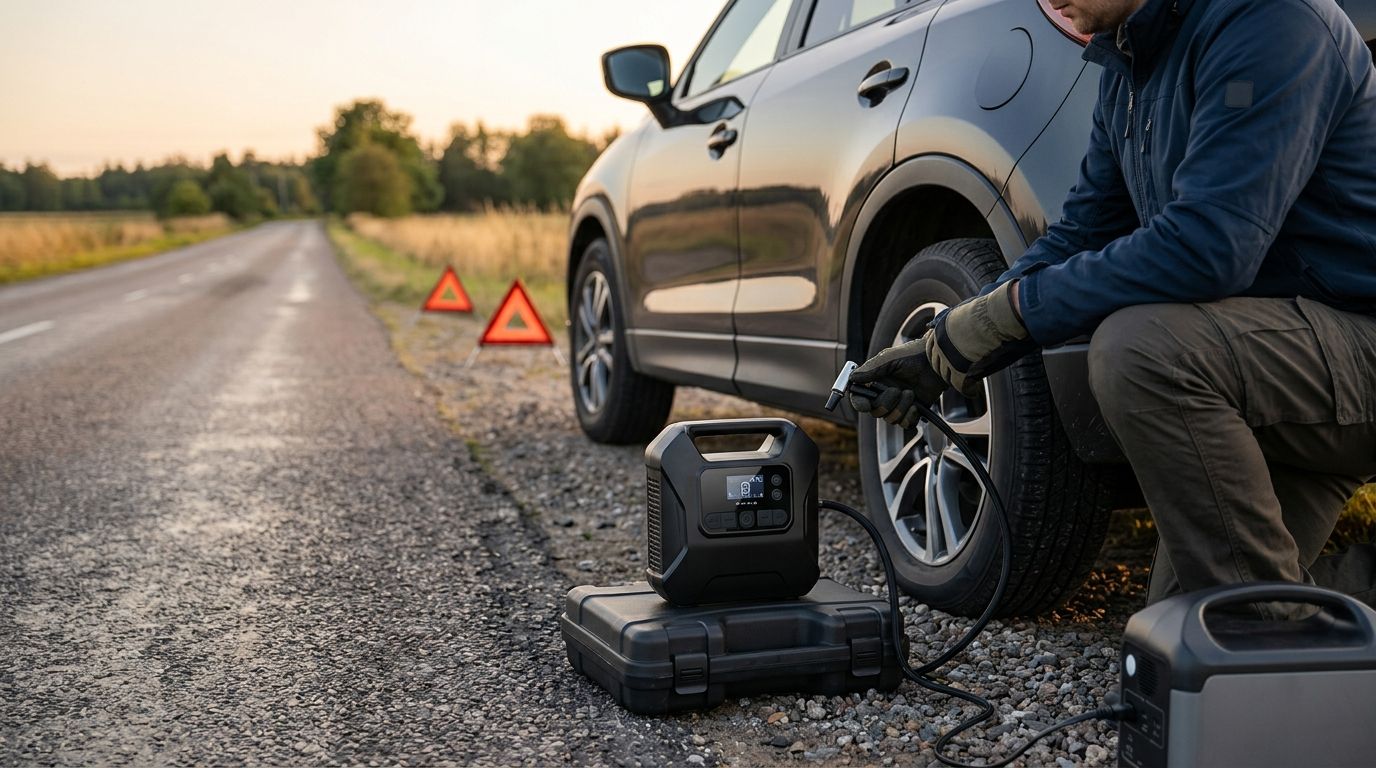
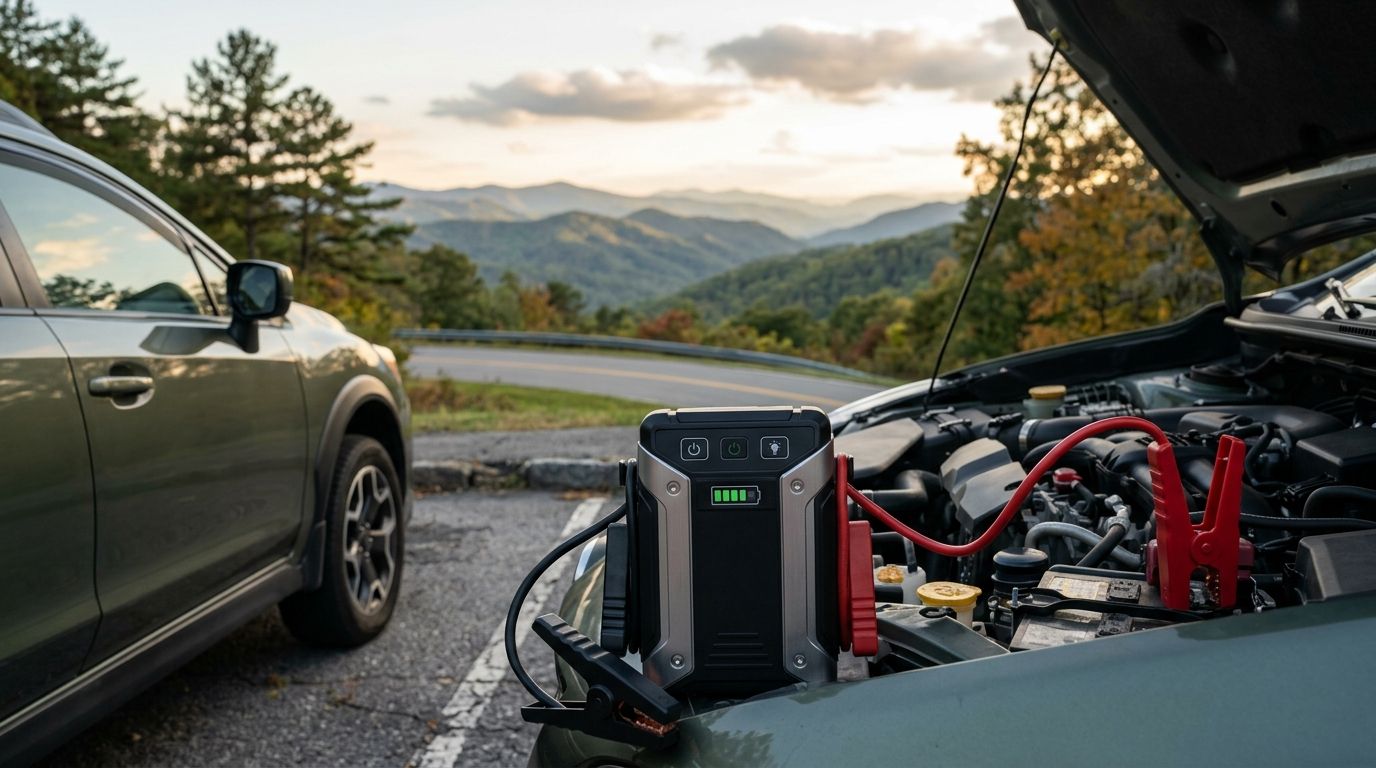
Best overall: a portable jump starter rated for your vehicle, with an air compressor if you also want tire help. Best budget option: a jump-only lithium pack rated for your car. Best for a dead battery right now in Atlanta: a 24/7 jump-start call. Stranded? Call Atlroadside at (678) 502-0513 instead of shopping for gear on the shoulder. This 2026 guide separates the pack to keep in your vehicle from the help you need today.
- The best portable jump starter for most Georgia drivers is a vehicle-rated lithium pack with an air compressor.
- Choose a jump-only lithium pack if you want a smaller kit for a passenger car.
- Check your vehicle's battery system and the starter's compatibility before buying; peak amps alone do not settle it.
- Atlroadside jump-start service is the 24/7 Atlanta option when your battery is dead and your pack is missing or uncharged.
Why your backup needs a backup
A jump starter does one job: it supplies power to help start a vehicle with a discharged battery. It does not repair a failed battery, alternator, cable, or other fault. If the engine starts and then dies, another jump is not the answer. You need help diagnosing the problem or moving the vehicle.
That distinction matters when you're stopped beside Atlanta traffic. A charged pack can get a compatible vehicle started without another driver's car. An uncharged pack is just cargo. Atlroadside provides 24/7 jump starts across the Atlanta metro for drivers who cannot use their own equipment or do not have any.
Do not stand beside moving traffic to set up a jump. Move to a safe place if the vehicle can be moved. If you cannot work away from traffic, call for help rather than opening the hood on an exposed shoulder.
What makes the best portable jump starter in 2026?
Check these points before comparing features. The right choice starts with your vehicle, not the largest number printed on a box.
- Vehicle match: Confirm the pack supports your vehicle's battery voltage, engine type, and engine size. Follow the vehicle and jump-starter manuals when their instructions differ.
- Charge status: Pick a unit whose charge indicator you can check easily. Put checking it on your regular vehicle checklist; a pack left unused still needs attention.
- Safe access: You need to reach the proper connection points without standing in traffic. No jump starter fixes an unsafe work area.
- Storage space: A small passenger car and a work truck do not need the same-sized kit. Decide where the pack will live before buying it.
- Backup plan: If the pack is uncharged, incompatible, or fails to start the vehicle, know whom you will call.
A 12-volt passenger-car pack is not automatically suitable for every truck or commercial vehicle. Check the vehicle's system before connecting anything. If you cannot confirm compatibility, leave the clamps off and call for assistance.
At a glance: the 2026 picks
| Option | Best for | Standout feature | Key limitation |
|---|---|---|---|
| Lithium jump starter with air compressor | Drivers preparing for a dead battery or low tire | Puts two roadside tools in one kit | Takes more storage space than a jump-only pack |
| Compact jump-only lithium pack | Passenger-car drivers with limited storage | Focuses on the jump without added tools | Not a match for every larger engine |
| Truck-rated portable jump starter | Pickup owners with a documented vehicle match | Capacity selected for the specific truck | A truck label does not prove commercial-vehicle compatibility |
| Portable lead-acid jump starter | Drivers keeping a backup at home | A dedicated unit for a planned garage setup | Bulk and storage make it less convenient to carry |
| Atlroadside jump-start service | Stranded Atlanta drivers and fleet dispatchers | 24/7 help without relying on your own pack | You must wait for assistance rather than self-start |
These are types and services, not tested product models. No named jump-starter models or verified specifications are supplied here, so a particular box still needs its own compatibility check. That is especially important for pickups, RVs, and commercial vehicles.
1. Lithium jump starter with air compressor: best overall
Best for: a Georgia driver who wants one kit for a dead battery and a low tire. This is the strongest general-purpose choice when the specific unit is rated for your vehicle. The compressor addresses a separate problem; it does not make an undersized jump starter capable of starting a larger engine.
Keep the two functions separate when you shop. Confirm the starting function against your battery system and engine. Then check whether the compressor and its fittings suit your tires. A feature list is not a substitute for either check.
Lithium jump starter with air compressor pros:
- Combines battery-starting and tire-inflation tools in one stored kit.
- Gives you another useful option when a tire is low but not damaged.
- Lets you check the pack's charge before leaving home.
Lithium jump starter with air compressor cons:
- Needs more space than a compact jump-only pack.
- Does not repair a puncture, damaged tire, or charging-system fault.
- Still needs to be charged and matched to your vehicle.
If a tire is visibly damaged or you cannot get clear of traffic, do not inflate it on the shoulder and assume you can drive. Call for roadside tire help instead. Verdict: Buy for a compatible passenger vehicle when you want both functions in one kit.
2. Compact jump-only lithium pack: best budget-focused choice
Best for: a passenger-car driver who wants a small emergency kit without extra functions. It supplies a jump-start connection and avoids making an air compressor or power bank part of the decision. Budget-focused does not mean every compact pack costs less or works with every car; check the actual unit before buying.
A glovebox-sized pack is easy to store, but size alone tells you nothing about whether it can start your vehicle. Match the manufacturer's vehicle guidance to your car, and keep the connection instructions with the unit. If the pack is not rated for your engine, a tidy storage fit will not help.
Compact jump-only lithium pack pros:
- Easier to store in a small vehicle than a larger combined kit.
- Keeps the buying decision focused on jump-start compatibility.
- Can help you start a compatible car without another vehicle present.
Compact jump-only lithium pack cons:
- Has no tire-inflation function.
- A compact model may not support your engine; verify its stated limits.
- Requires a charge check before you depend on it.
Verdict: Buy if the unit explicitly matches your passenger car and you have another plan for tire trouble. Skip a pack that leaves vehicle compatibility unclear.
3. Truck-rated portable jump starter: best for pickup owners
Best for: a pickup owner who can verify the truck's battery system and the pack's stated engine compatibility. Choose by the truck you drive, not by a generic truck label. The correct pack for one pickup is not automatically the correct pack for another.
This category is not a shortcut for a semi-truck or commercial fleet vehicle. Heavy-duty roadside needs call for vehicle-specific help; a consumer product's claim about starting trucks does not establish that it suits your rig. Tell dispatch what you drive and what happened before requesting a jump or tow.
Truck-rated portable jump starter pros:
- Lets you select a pack against a specific pickup's requirements.
- Gives you a self-start option when the pack is charged and access is safe.
- Can stay with the truck rather than at home.
Truck-rated portable jump starter cons:
- Needs more storage room than a compact car pack.
- The word truck on a package does not confirm a match for your vehicle.
- Does not solve an alternator fault or another cause of repeated stalling.
If you manage work vehicles, make the backup plan broader than a jump pack. The heavy-duty towing guide covers the separate decision to move a vehicle that cannot continue safely. Verdict: Buy only after checking the exact truck and unit instructions; otherwise, Hold.
4. Portable lead-acid jump starter: best for a garage backup
Best for: a driver who expects to keep a dedicated jump unit at home and has room to store it. This is a different use case from keeping a small pack in the car every day. It is portable in the sense that you can carry it to a vehicle, not that it is convenient on every trip.
Check the unit's battery condition and charging instructions before relying on it. Store and use it as its manufacturer directs. If your car dies away from home while the pack sits in the garage, that pack cannot help you there.
Portable lead-acid jump starter pros:
- Gives a home garage a dedicated starting tool.
- Keeps the jump function separate from phone charging or tire inflation.
- Lets you prepare before a vehicle fails at home.
Portable lead-acid jump starter cons:
- Bulk makes it less practical to keep in a small vehicle.
- Requires storage space and charge maintenance.
- Provides no help on the road when you leave it at home.
Verdict: Buy for a garage-based backup you will maintain. Skip if your real need is roadside coverage during a commute.
5. Atlroadside jump-start service: best when you are stranded now
Best for: an Atlanta-metro driver whose battery is dead and a fleet dispatcher who needs to arrange help. You do not need to own, charge, store, or connect a portable pack. Atlroadside jump-start service is the practical choice for Atlanta drivers who need 24/7 help instead of another device to manage.
Make the call from a safe position. Give your location, vehicle type, and what happens when you try to start it. If the vehicle has a damaged battery, a warning from the electrical system, or a problem beyond a discharged battery, say so; a jump may not be the right fix.
Atlroadside jump-start service pros:
- Available 24/7 across the Atlanta metro.
- Removes the need to keep your own pack charged.
- Lets you describe a commercial or heavy-duty vehicle's problem before help is arranged.
Atlroadside jump-start service cons:
- Is not an instant self-start; you wait for help to arrive.
- Does not turn a failed battery or charging system into a working one.
- Serves the Atlanta metro rather than every place you might drive.
For a vehicle that cannot continue, discuss towing rather than asking for repeated jumps. Verdict: Call if you are stranded now, your pack does not work, or you cannot make a safe connection.
Dead battery? Call now.
Call (678) 502-0513 for 24/7 roadside assistance across the Atlanta metro.
How these options were ranked
The ranking starts with the decision a stranded driver actually faces: can you use a charged, compatible pack safely, or do you need help? Vehicle match comes before extra features. Safe access comes before a do-it-yourself jump. Storage and charge checks determine whether a pack will be there when you need it.
That is why the combined lithium kit takes the overall slot for a driver buying a roadside tool in 2026. The jump-only pack owns the small-car, limited-storage slot. Truck-rated equipment belongs with verified pickups, and a garage unit belongs at home. A service call is ranked as an alternative, not presented as a product Atlroadside sells.
Which portable jump starter should you choose?
For most Georgia drivers buying a kit in 2026, choose a lithium jump starter rated for your vehicle; add an air compressor if you also want a low-tire tool. Choose a compact jump-only pack if storage matters more and the unit matches your passenger car. For a pickup, read the manufacturer's vehicle guidance before choosing any truck-rated pack.
Already stranded? Stop comparing boxes. Move away from traffic, check whether you can safely use a charged pack, and call (678) 502-0513 if you cannot. Atlroadside is the 24/7 Atlanta jump-start option for drivers who need help now, not a substitute for checking the cause if the vehicle fails again.
FAQ
What is the best portable jump starter for a Georgia driver in 2026?
A vehicle-rated lithium pack is the best portable jump starter for most passenger-car drivers; choose one with an air compressor if you also want tire-inflation help. Confirm the exact unit matches your vehicle before buying.
Can I use a 12-volt jump starter on any truck?
No. A 12-volt label alone does not establish that a pack suits every truck. Check the truck's battery system and the jump-starter manufacturer's vehicle guidance before connecting it.
Is a jump starter better than jumper cables?
A charged, compatible jump starter lets you attempt a start without another vehicle. Jumper cables require a suitable second vehicle and safe access to both battery connections.
What if my portable jump starter will not start my car?
Stop and check the unit's charge, connection instructions, and vehicle compatibility. If it still will not start, call for roadside help rather than repeatedly attempting a jump.
Should I jump-start a car on an Atlanta interstate shoulder?
Do not attempt a jump if you must stand beside moving traffic. Get to a safe position and call for roadside assistance when you cannot work clear of traffic.
Will a jump starter fix a bad alternator?
No. A jump starter supplies power for an attempted start; it does not repair the charging system. If the vehicle stalls again or cannot keep running, arrange further help.
Can a portable car jump starter start a semi-truck?
Do not assume a passenger-car jump starter is suitable for a semi-truck. Confirm the truck's electrical requirements and arrange vehicle-appropriate roadside assistance or recovery.
One last thing
The best portable jump starter in 2026 is the one that matches your vehicle and is charged when you reach for it. Check yours before a long drive. If the vehicle is already disabled in an unsafe spot, skip the clamps and make the call.