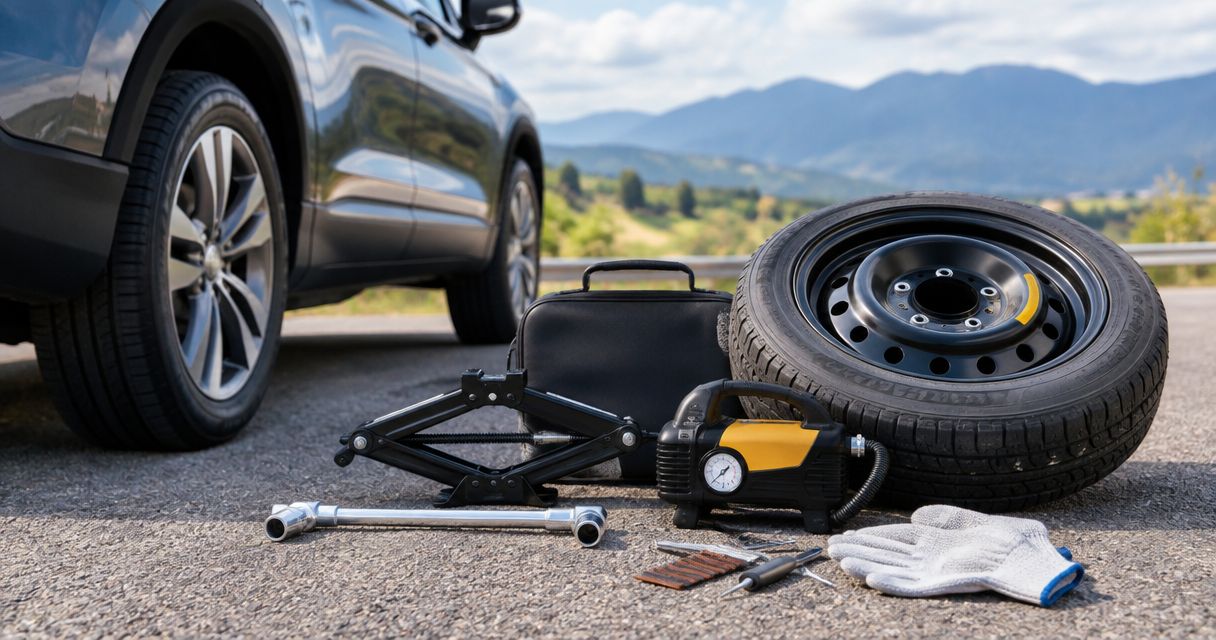
A flat tire on I-285 at rush hour doesn't wait for a slow Tuesday. The kit riding in your trunk right now decides whether you're back on the road in minutes or standing on the shoulder while traffic blows past at 70.
- A tire plug kit is the best flat tire repair kit for a tread puncture from a nail or screw.
- Sealant-and-inflator kits get you moving fast but usually ruin the tire for a real repair later.
- A full-size spare tire kit beats every patch option for sidewall damage or a total blowout.
- Sidewall blowouts, semi-truck tires, and shoulder breakdowns after dark call for professional roadside help, not a DIY kit.
Why this matters
Atlanta's interstates chew up tires. Potholes on I-20 and I-285, construction debris on the Downtown Connector, and Georgia summer heat that softens rubber all add up to more roadside flats than drivers expect in 2026. A kit that matches the damage gets you moving; the wrong one wastes ten minutes and still leaves you stuck.
Most flat tire repair kits fall into a handful of categories, and each one is built for a specific kind of damage. Pick the wrong category and you're patching a sidewall tear with a plug kit that was never meant for it — that's how a five-minute fix turns into a call for flat tire roadside help in Atlanta.
Best overall for a tread puncture: tire plug kit. Best for total blowouts or sidewall damage: full-size spare tire kit. Best for skipping the DIY altogether: professional flat tire roadside service. Each fits a different failure — nobody needs all three, but every Georgia driver should know which one their situation calls for.
What makes the best flat tire repair kit
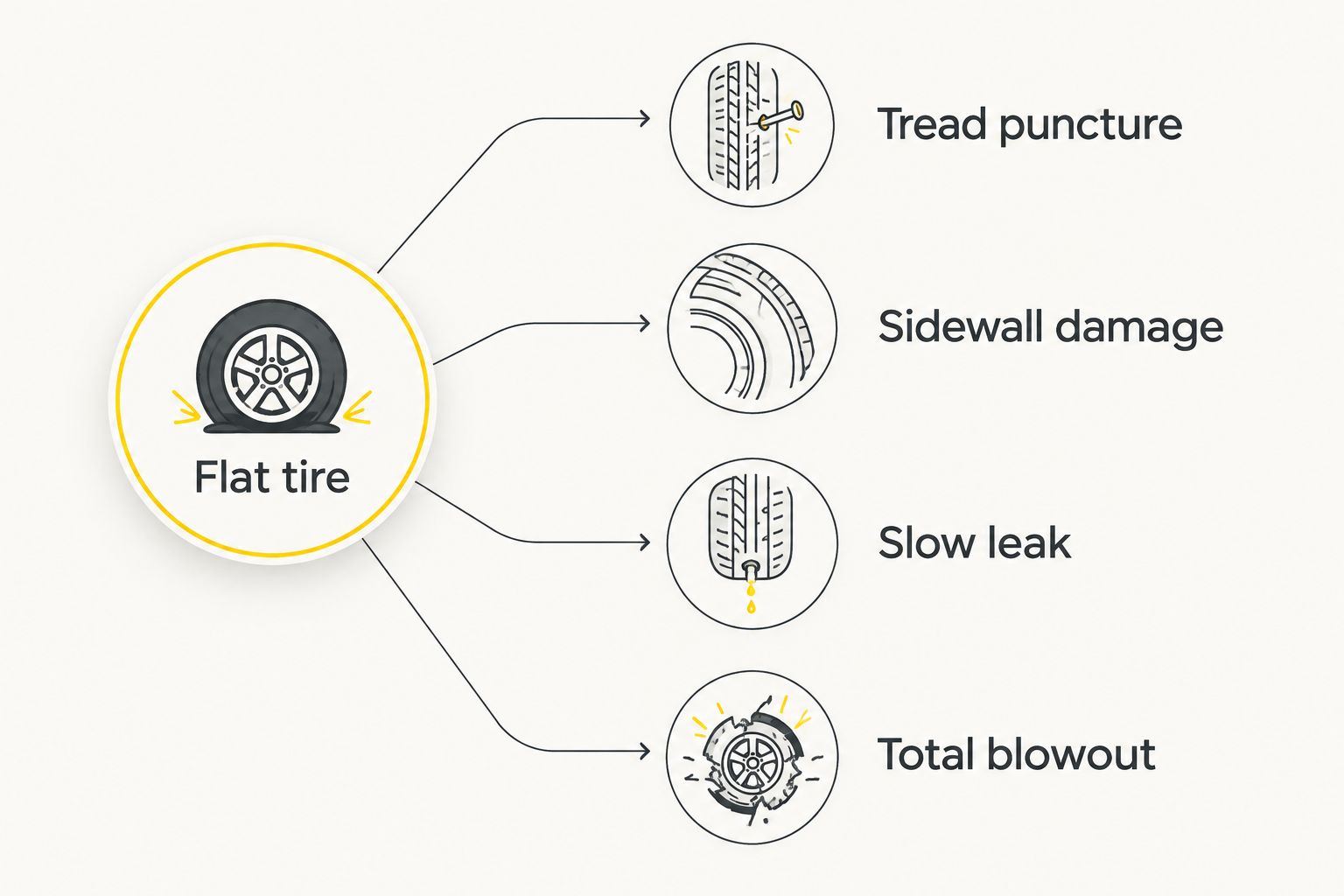
- Matches the damage type — tread puncture, sidewall tear, slow leak, or total blowout each need a different fix
- Fits in the trunk or glovebox without eating cargo space you actually use
- No specialty tools — if it needs a torque wrench and a lift, it's not a roadside kit
- Includes or pairs with an air source — a plug without a way to reinflate the tire is half a repair
- Clearly labeled temporary vs. permanent — a plug is a get-home fix, not a forever fix
- Fast enough to get you off an active shoulder safely — speed matters as much as the fix itself
Flat tire repair kits at a glance
| Kit type | Best for | Standout feature | Key limitation |
|---|---|---|---|
| Tire plug kit | Small tread punctures | Fixes most nail holes in under 10 minutes | Won't touch sidewall damage |
| Sealant-and-inflator kit | Quick emergency reinflation | No tools, just shake and connect | Often voids the tire for later repair |
| Portable 12V air compressor | Slow leaks and topping off | Plugs into the outlet, runs off the car battery | Not a repair on its own |
| Plug-and-patch combo kit | A more durable roadside repair | Two repair methods in one case | Takes longer than a straight plug |
| Full-size or compact spare kit | Sidewall damage or a blowout | Gets you fully back on four matched-height tires | Needs a jack, lug wrench, and open space to work |
| Professional flat tire roadside service | Highway shoulders, night calls, semi-truck tires | No jack, no kneeling on the shoulder, works on commercial tires too | Costs more than doing it yourself |
1. Tire plug kit: best flat tire repair kit for a tread puncture
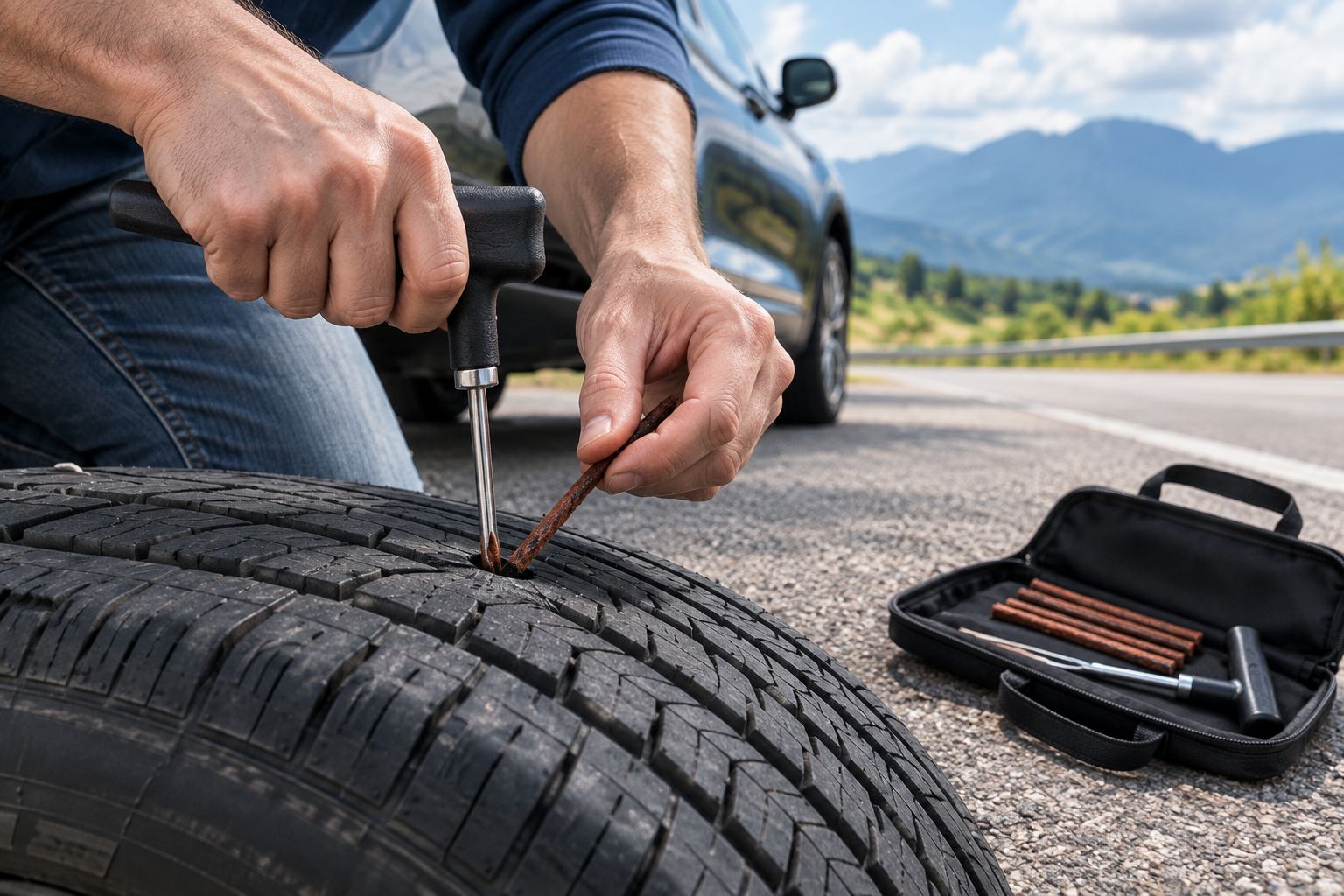
A plug kit forces a sticky rubber strip into a puncture using a reamer and insertion tool, then trims it flush. It works on nail holes and screws in the tread — not on sidewalls, and not on tears bigger than about a quarter inch.
Tire plug kit pros:
- Fixes most nail and screw punctures in the tread
- Small enough to keep in the glovebox
- No lifting the car required
Tire plug kit cons:
- Useless on sidewall damage or splits
- Needs a separate air source to reinflate
- Reamer tool takes some hand strength to use
Best for: drivers who pick up nails on Atlanta surface streets and need a fast, temporary fix. Verdict: Buy.
2. Sealant-and-inflator kit: best for a fast emergency reinflation
These cans force liquid sealant and compressed air into the tire through the valve stem. No tools, no jack — connect the hose and go. It's the fastest option in this list for getting rolling again.
Sealant-and-inflator kit pros:
- Fastest option — no tools, no jacking the car
- Works for someone who's never changed a tire
- Cheap to keep two cans in the trunk
Sealant-and-inflator kit cons:
- Many tire shops won't repair a tire that's had sealant in it
- Doesn't work well on larger punctures
- Messy if the tire needs to come off later
Best for: drivers who want the absolute fastest fix and plan to get the tire properly repaired or replaced right after. Verdict: Buy.
3. Portable 12V air compressor: best for slow leaks and topping off
A 12V compressor plugs into the car's outlet and reinflates a tire that's low but not flat. It's not a repair — it's a way to buy time on a slow leak while you get to a shop or call for help.
Portable compressor pros:
- Catches slow leaks before they become flats
- Doubles as general tire maintenance
- Works with plug and sealant kits, not against them
Portable compressor cons:
- Does nothing for a true puncture or blowout
- Slower than a sealant can for emergency reinflation
- Needs a working outlet and a few minutes of idle time
Best for: drivers pairing it with a plug kit as backup, not relying on it alone. Verdict: Buy (as a companion, not a standalone fix).
4. Plug-and-patch combo kit: best for a more durable roadside repair
This kit combines an external plug with an internal patch, giving a repair that holds up closer to shop standards. It takes longer than a straight plug — usually because you're doing two steps instead of one — but it's the most complete DIY option for a tread puncture.
Plug-and-patch kit pros:
- More durable than a plug or sealant alone
- Still fits in a trunk kit or glovebox
- Doesn't void the tire the way sealant often does
Plug-and-patch kit cons:
- Slower than a straight plug kit
- Still limited to tread damage, not sidewalls
- Needs a bit more hand skill than a basic plug
Best for: drivers who do a lot of highway miles and want a repair that lasts longer than a quick plug. Verdict: Buy.
5. Full-size or compact spare tire kit: best for sidewall damage or a total blowout
When the sidewall tears or the tire shreds on a highway pothole, no plug or sealant fixes that. A spare tire kit — jack, lug wrench, and a full-size or compact spare — is the only DIY option that actually gets you back on four functioning tires.
Spare tire kit pros:
- Handles sidewall damage and blowouts that plugs can't touch
- Gets you fully mobile, not just limping along
- Works on any tire failure, not just punctures
Spare tire kit cons:
- Requires a jack, open space, and physical effort
- Compact spares aren't rated for long-distance or high-speed driving
- Doing this on a live interstate shoulder is genuinely dangerous
A blowout on I-75 at highway speed isn't the time to be kneeling next to traffic with a jack. If the shoulder is narrow or traffic's moving fast, this is when a tow truck companies in Atlanta call makes more sense than a DIY spare swap.
Best for: sidewall tears, total blowouts, and drivers with room to work safely off the travel lanes. Verdict: Buy — but know when to skip it for a professional swap.
6. Professional flat tire roadside service: best for shoulders, night calls, and semi-truck tires
Some flats aren't a DIY job at all. A blown sidewall on a narrow shoulder, a flat at 2 a.m. on an unlit stretch of I-285, or a commercial tire that needs air-ride jacks and a different playbook than a passenger car — these call for someone who does this for a living, not a trunk kit.
All Around Atlanta Roadside runs flat tire and tire change service across the Atlanta metro, 24/7, for passenger vehicles and commercial fleets. Semi-truck and box truck tires need different tools and different training than a sedan's spare — see the full breakdown in the roadside assistance for semi-trucks guide.
Professional flat tire service pros:
- No kneeling on a live shoulder with a jack
- Handles sidewall damage, blowouts, and punctures alike
- Covers commercial and semi-truck tires, not just passenger cars
- Available around the clock, not just business hours
Professional flat tire service cons:
- Costs more than fixing it yourself
- Requires waiting for a truck to arrive, unlike a plug you carry
Best for: highway shoulders, nighttime breakdowns, sidewall damage, and any commercial or semi-truck tire failure. Verdict: this is the one to call, not buy — save the number.
Flat tire right now?
24/7 flat tire and tire change help across the Atlanta metro.
How we ranked these
Each kit is scored against the same six criteria: damage match, size, tool requirements, air source, temporary-vs-permanent labeling, and speed off an active shoulder. The professional service option is measured against those same criteria — it just wins on the ones a trunk kit can't touch, like sidewall damage and commercial tires.
Which flat tire repair kit should you choose in 2026?
Carry a plug kit and a can of sealant — that combination handles the vast majority of Atlanta tread punctures without any drama. Keep a spare tire kit in the trunk for the day a pothole shreds a sidewall. And save a number for the flats none of that covers: shoulder blowouts, night breakdowns, and semi-truck tires.
If you drive for work or run a fleet, don't wait for the first flat to figure out who to call — check a roadside assistance plans in Georgia option before you're stuck on I-20 at midnight.
FAQ
What's the best flat tire repair kit for a Georgia driver?
A tire plug kit paired with a can of sealant handles most tread punctures from nails and screws. Keep both in the trunk — the plug is more durable, the sealant is faster if you're in a hurry.
Can a plug kit fix a sidewall tear?
No. Plug kits only work on the tread, not the sidewall. A sidewall tear needs a spare tire swap or a tow — driving on a plugged sidewall risks a blowout.
Is a sealant-and-inflator kit better than a plug kit?
Sealant is faster with zero tools, but many tire shops won't repair a tire that's had sealant in it. A plug kit takes a few more minutes but doesn't limit your repair options later.
Do I need a compressor if I have a plug kit?
Yes. A plug kit fixes the hole, but you still need an air source to reinflate the tire. A 12V compressor also catches slow leaks before they become full flats.
What should I do for a semi-truck tire blowout in Atlanta?
Get the truck safely to the shoulder or the nearest exit and call a roadside service that handles commercial tires. Semi-truck tires need air-ride jacks and different equipment than a passenger car kit provides.
When should I call for professional flat tire help instead of using a kit?
Call when the damage is on the sidewall, the shoulder is narrow or unlit, or the vehicle is a commercial truck. Working a jack next to live traffic on I-285 or I-75 is a real risk, not a convenience trade-off.
How much space does a full flat tire kit take up?
A jack, lug wrench, and compact spare typically fit in a trunk's spare tire well without eating cargo space. A plug kit and sealant can add fit in a glovebox or door pocket.
Are compact spares safe for highway driving?
Compact spares are rated for lower speeds and shorter distances than a full-size tire. Treat one as a get-to-the-shop fix in 2026, not a long-haul replacement.
One last thing
A sealant can feels like the smart choice because it's the fastest — but it's also the one most likely to cost you a second repair bill, since plenty of shops treat a sealant-filled tire as a write-off rather than a patch job. Carry the plug kit as your primary fix in 2026 and save the sealant can for the day you genuinely can't spare ten minutes.