A soft tire on I-285 at rush hour doesn't wait for you to research anything. Grab a portable 12V plug-in tire inflator if you want the fastest, most reliable fix from your own trunk — it handles a slow leak in minutes without you touching a lug nut.
- The best tire inflator for car use in 2026 is a portable 12V plug-in model — it plugs into your outlet and refills a tire in minutes.
- Cordless battery inflators win for EVs and cars with no accessible power outlet.
- CO2 cartridge inflators are the smallest option but only push air once, not a repeat fix.
- A tire repair and inflate kit helps on cars with no spare, but it won't save a sidewall blowout.
- If the tire won't hold air after refilling it once, stop driving on it and call for flat tire roadside help.
Why this matters
A tire that's low but not shredded is the most common roadside call there is. Refill it right and you drive to a shop on your own schedule. Refill it wrong — or drive on a tire that's actually damaged — and a $20 inflator turns into a $400 tow and a wrecked rim.
Most cars sold in the last decade don't carry a full-size spare, which makes an inflator (or a repair kit) the only thing standing between a slow leak and a call for flat tire roadside help. Knowing which type actually works for your car in 2026 saves you from guessing on the shoulder.
What makes the best tire inflator for car emergencies
- Max PSI output — needs to comfortably clear the 30-35 PSI most passenger tires require
- Power source — 12V plug, rechargeable battery, or CO2 cartridge, each with a tradeoff
- Digital gauge accuracy — a display you can actually read in the dark on a shoulder
- Auto shut-off — stops at your set pressure so you're not eyeballing a needle
- Portability and storage size — has to fit in a trunk without eating your cargo space
- Run time before overheating — cheap units stall out on a near-flat tire before it's full
At a glance
| Type | Best for | Standout feature | Key limitation |
|---|---|---|---|
| Portable 12V plug-in inflator | Most drivers, everyday slow leaks | Refills a tire fully, repeatedly | Needs a running engine and outlet |
| Cordless battery inflator | EVs and no-outlet cars | Works with the engine off | Battery can die if it's never charged |
| CO2 cartridge inflator | Ultra-compact emergency backup | Instant burst of air, no power needed | One-shot — won't fully refill a big tire |
| Tire repair and inflate kit | Cars with no spare tire | Seals a small puncture and reinflates | Useless on sidewall damage or blowouts |
| Manual foot pump | Budget backup, works anywhere | No batteries, no engine, ever | Slow and tiring on a full-size tire |
1. Portable 12V plug-in inflator: best tire inflator for everyday slow leaks
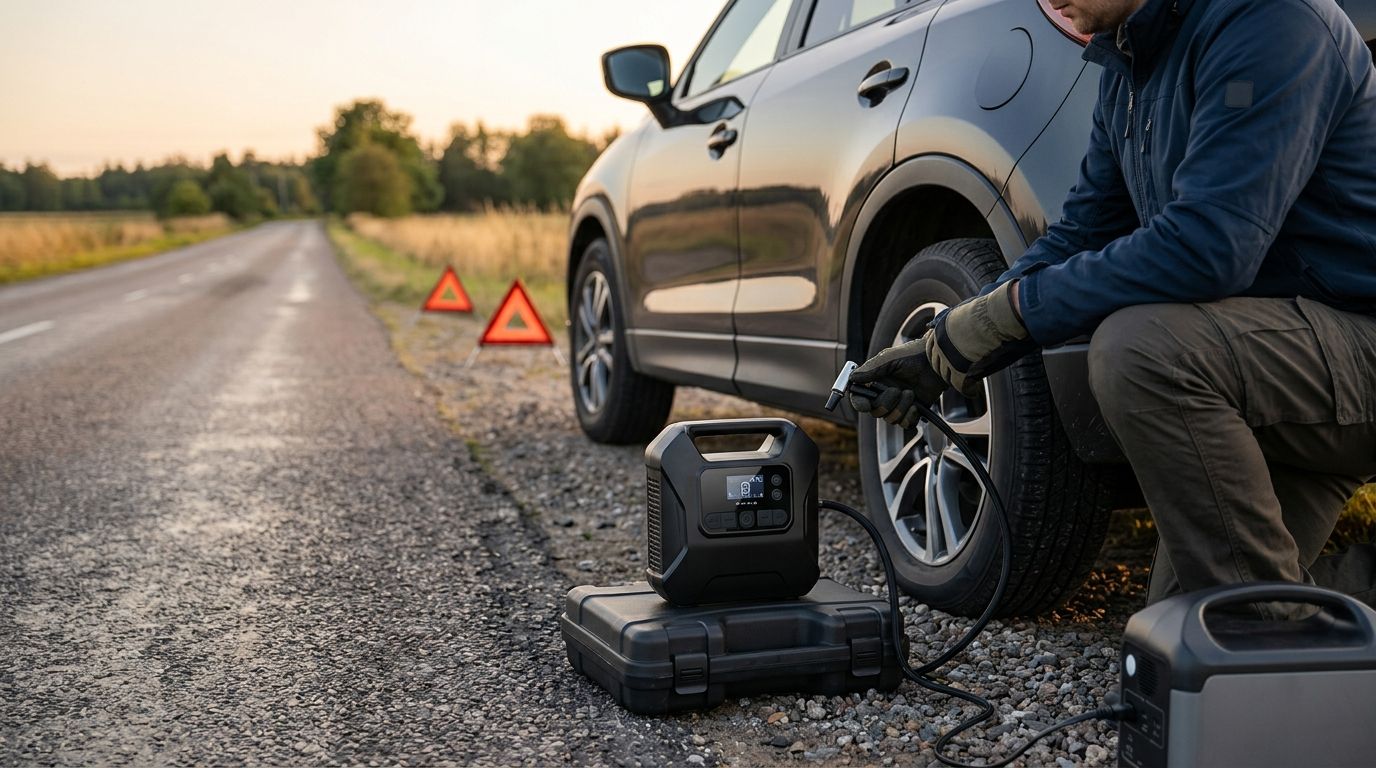
A 12V plug-in inflator runs off your car's outlet and pushes air until the built-in gauge hits your set number. It's the tool most drivers reach for because it works on nearly every passenger car, SUV, and light truck sold in 2026, and it keeps running as long as the engine does.
It's also the most forgiving type for someone who's never used one — plug it in, set the pressure, walk away.
Portable 12V inflator pros:
- Refills a fully flat tire, not just a top-off
- Digital models show live PSI so you're not guessing
- Works on cars, small trucks, and most SUVs
Portable 12V inflator cons:
- Needs the engine running or a healthy battery
- Bulkier than a CO2 canister or a battery unit
- Slower on a fully flat tire than a shop compressor
Best for: drivers who want one tool that handles nearly every slow leak. Verdict: Buy.
2. Cordless battery inflator: best for EVs and no-outlet situations
A cordless inflator runs on its own rechargeable battery instead of your car's 12V outlet. That matters more in 2026 than it used to — some EV trims don't route a usable 12V accessory outlet the same way older gas cars do, and a dead 12V battery kills a plug-in inflator's power source too.
The tradeoff is obvious: if you forget to charge it, it's dead weight in the trunk.
Cordless inflator pros:
- Works with the engine off or the 12V system down
- No cord to route through a window or door
- Doubles as a general air pump for bikes and sports gear
Cordless inflator cons:
- Battery needs regular charging to be ready when you need it
- Usually smaller air tank, so it can run hotter on a full refill
- Costs more upfront than a basic plug-in model
Best for: EV owners and anyone whose car's 12V outlet isn't reliable. Verdict: Buy.
3. CO2 cartridge inflator: best ultra-compact emergency backup
A CO2 inflator is a small threaded nozzle that screws onto a disposable cartridge and dumps a burst of compressed gas straight into the valve stem. No battery, no cord, no engine — it's the smallest thing on this list by far.
It's a backup, not a primary fix. One or two cartridges typically won't bring a fully flat passenger tire all the way to 32 PSI.
CO2 inflator pros:
- Fits in a glovebox pocket, no bulk at all
- Works instantly with zero power source
- Cheap to keep a couple of spare cartridges on hand
CO2 inflator cons:
- Doesn't fully refill a flat — gets you rolling, not fixed
- Cartridges are single-use, so you need spares
- No digital gauge, so you're estimating pressure
Best for: a glovebox backup behind a real inflator. Verdict: Hold — good as a second option, not your only one.
4. Tire repair and inflate kit: best for cars with no spare
Many 2026 model-year cars ship without a spare tire at all — just a repair kit in the trunk. It's usually a bottle of sealant plus a small compressor: you inject the sealant into the puncture, then inflate with the built-in pump.
It only works on small tread punctures. A sidewall puncture, a blowout, or a gash near the shoulder won't seal, and driving on a bad seal at highway speed is how a slow leak turns into a real emergency. Check the spare tire and repair kit guide for what's actually in your trunk before you need it.
Repair kit pros:
- Comes standard in many cars with no spare
- Handles small tread punctures without a jack
- Compact — takes up less trunk space than a spare
Repair kit cons:
- Won't seal sidewall damage or a blowout
- Sealant can mess with a shop's ability to patch the tire later
- One-time use per puncture
Best for: drivers whose car has no spare tire at all. Verdict: Buy — but know its limits.
5. Manual foot pump: best budget, no-power backup
A foot pump has no motor, no battery, and no cord — you step on it and the air goes in. It's the cheapest option and the one thing on this list that never runs out of charge or fuel.
It's also slow. Bringing a fully flat passenger tire up to 32 PSI by foot takes real effort and real time on a shoulder where you'd rather not linger.
Foot pump pros:
- Never needs a battery, cord, or running engine
- Works even if your car's entire electrical system is dead
- Cheapest option by a wide margin
Foot pump cons:
- Slow and physically tiring on a full-size tire
- No digital readout on most models
- Not practical if you're on a live traffic shoulder
Best for: a last-resort backup, not a daily tool. Verdict: Skip unless it's your only option.
How the ranking works
Each type is ranked against the six criteria above — max PSI, power source, gauge accuracy, auto shut-off, portability, and run time — and matched to the driver situation it actually solves. The portable 12V inflator tops the list because it clears every criterion for the widest range of cars on the road in 2026. Everything below it earns its slot by solving a specific gap the 12V unit doesn't cover.
“If the tire loses air again within a mile of refilling it, stop driving on it and call for a tow.”
Which tire inflator should you buy?
For most drivers, a portable 12V plug-in inflator is the right call — it fully refills a tire, shows you real PSI, and works on nearly any car built in the last twenty years. Add a CO2 cartridge as a glovebox backup and you're covered for the two most common failure modes: a slow leak and a dead 12V system.
None of these tools fix a shredded sidewall, a blown bead, or a tire that keeps losing air after two refills. That's when you stop pumping and call for help instead of pushing your luck on the shoulder in 2026 traffic.
FAQ
What's the best tire inflator for car use in 2026?
A portable 12V plug-in inflator is the best all-around choice in 2026 because it fully refills a tire and works on nearly any car with a functioning 12V outlet. Cordless battery models are the better pick for EVs or cars with an unreliable outlet.
Is a CO2 inflator better than a plug-in inflator?
No — a CO2 cartridge gives one quick burst of air but usually won't fully refill a flat passenger tire. Keep it as a backup behind a 12V or battery inflator, not as your only tool.
How much air does a tire inflator need to put out?
Most passenger cars need 30-35 PSI, so look for an inflator rated well above that, typically 100 PSI or more. Higher max output means it won't stall out trying to refill a fully flat tire.
Can I use a tire inflator on a car with no spare tire?
Yes, but only for a small tread puncture — pair it with the sealant from your factory repair kit. A sidewall puncture or a blowout won't seal no matter how much air you add.
Do cordless tire inflators work as well as plug-in ones?
Cordless inflators work well for topping off or refilling a tire without engine power, but many carry a smaller air tank than plug-in models. They're the better choice for EVs specifically, not necessarily every car.
How long does it take to refill a flat tire with a portable inflator?
A fully flat passenger tire typically takes several minutes with a 12V plug-in unit, longer with a smaller cordless or manual pump. If it's not holding pressure after refilling once, the tire likely has damage an inflator can't fix.
What should I do if my tire keeps losing air after I refill it?
Stop driving on it and call for flat tire roadside help instead of refilling it repeatedly on the shoulder. A tire that won't hold air usually has a puncture, a bad bead, or sidewall damage that needs a tire change, not more air.
One last thing
Check your inflator's battery or cord before you ever need it on the shoulder — the worst time to find out a cordless unit won't charge is with a flat tire and traffic behind you. Test it once every few months, and if you're ever stuck with no working inflator, no spare, and a tire that won't hold air, that's exactly the call All Around Atlanta Roadside Assistance handles across the metro, 24/7, including the tow truck companies in Atlanta network for anything an inflator can't touch.