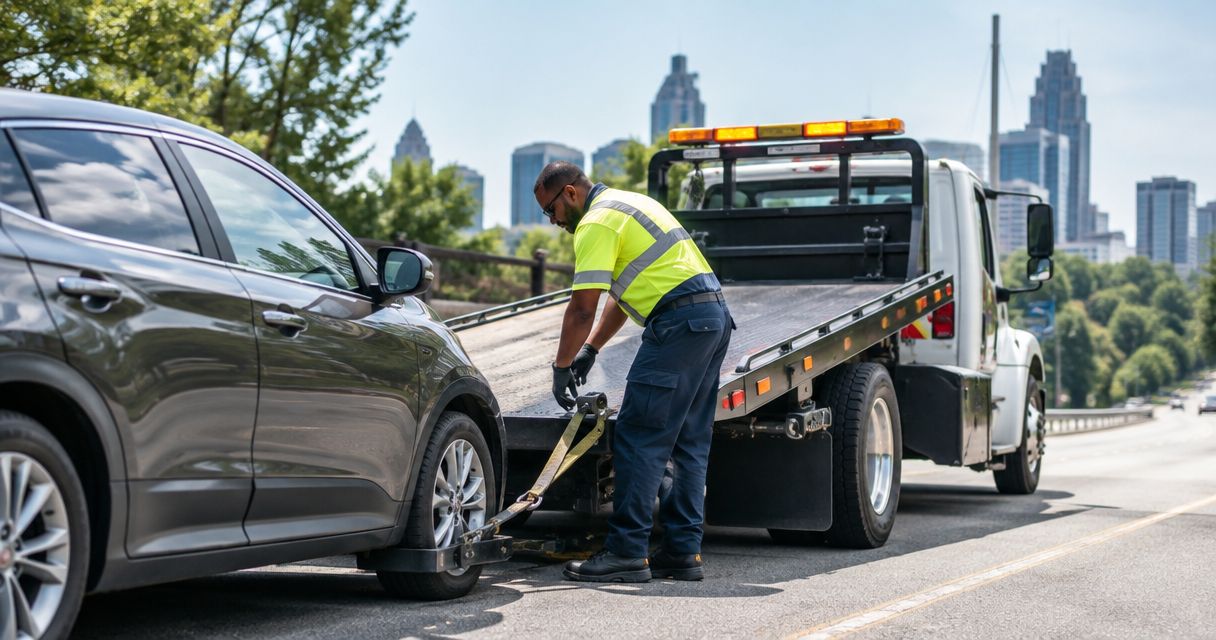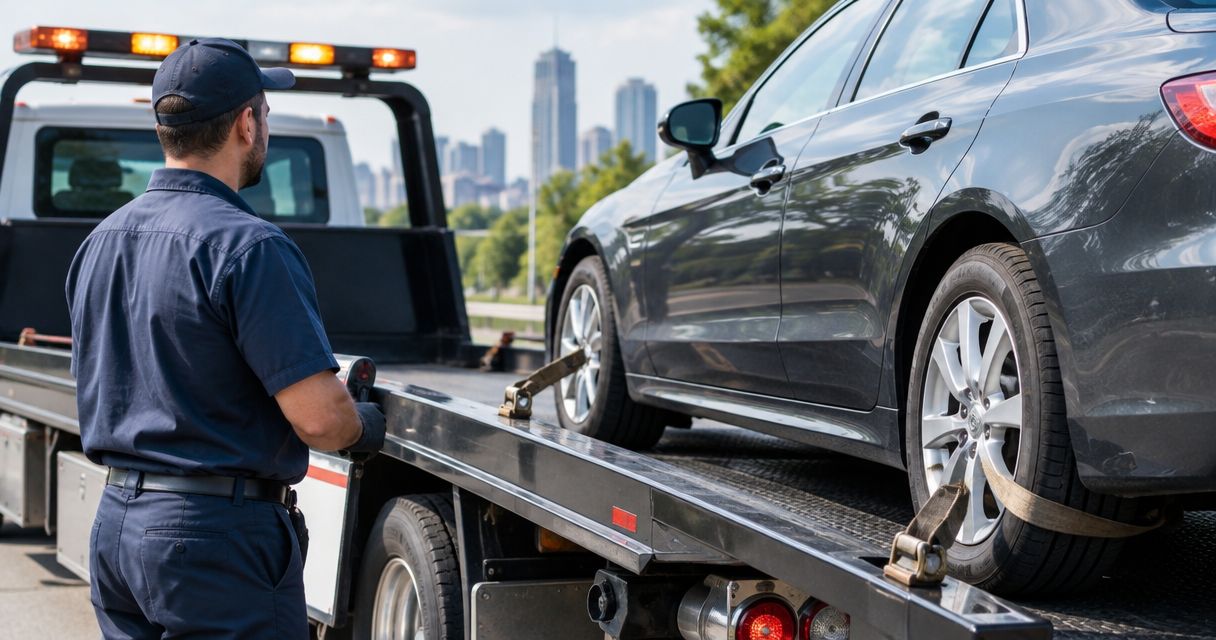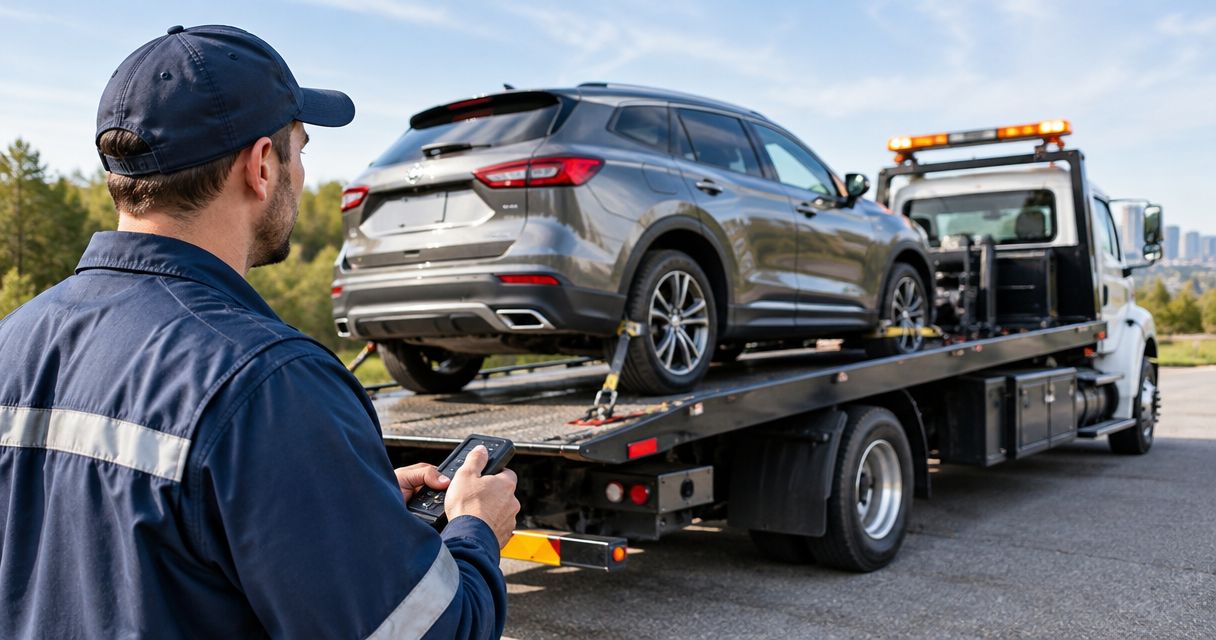
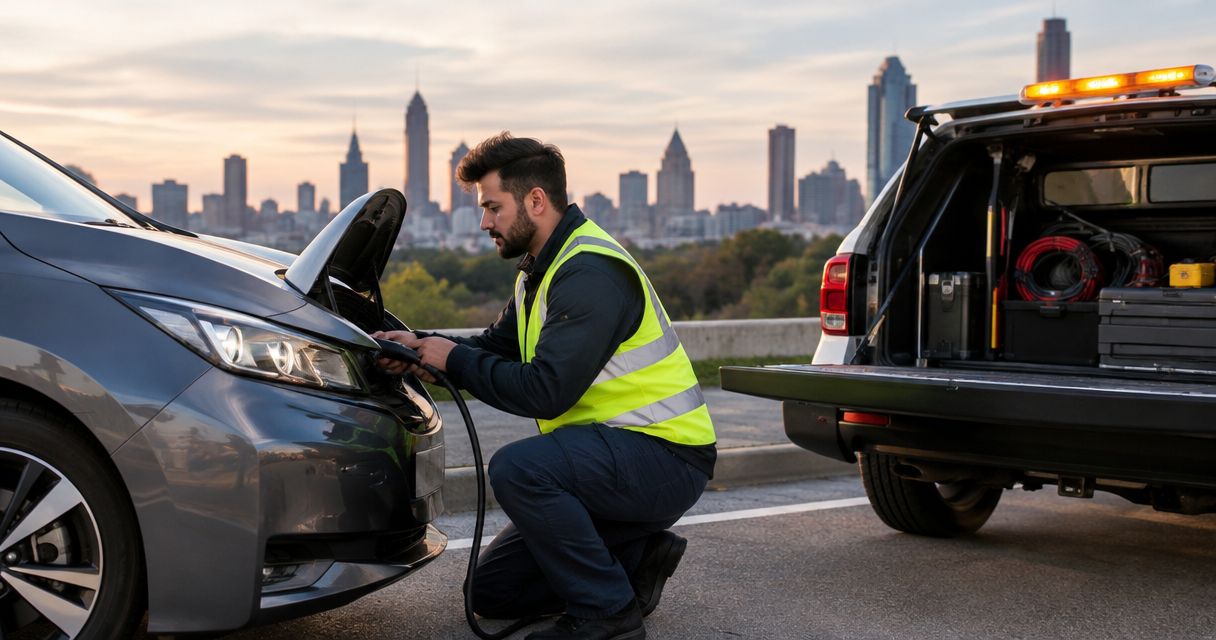
Yes—roadside assistance can tow an electric vehicle and, when its manufacturer permits it, jump-start its low-voltage battery. A jump-start does not recharge the high-voltage battery that drives the car. For electric vehicle roadside assistance in Atlanta in 2026, identify your exact model and symptoms before dispatch so the operator can confirm the right help.
- Electric vehicle roadside assistance Atlanta: request a manufacturer-approved low-voltage jump-start or the correct towing setup.
- A jump-start cannot recharge an empty EV traction battery; arrange transport to a compatible charger.
- Atlroadside provides roadside assistance and towing 24/7 across the Atlanta metro; confirm your EV’s requirements before dispatch.
- Smoke, unusual heat, or battery damage means an emergency response—not a jump-start attempt.
Stranded now? Contact Atlroadside about its roadside assistance services. Say that you have an EV, give your location, and describe what the car does when you try to power it on. Confirm model-specific handling before a truck heads your way.
Can roadside assistance jump-start or tow an electric vehicle?
Yes, but a low-voltage battery problem and an empty traction battery need different solutions. Your EV uses a high-voltage battery for propulsion and a separate low-voltage system for controls and other electrical functions. A failure in either system can leave you unable to drive.
Use this comparison to explain the problem—not to diagnose the battery yourself.
| Roadside option | Best for | What it does | Limit or drawback |
|---|---|---|---|
| Manufacturer-approved low-voltage jump-start | A discharged auxiliary battery, after assessment | Supplies power through the designated connection points | Does not recharge the traction battery or fix the cause of discharge |
| Manufacturer-approved towing | An empty traction battery, unresolved fault, or vehicle that cannot move safely | Transports the EV to a suitable charger or repair destination | Requires the correct loading procedure and transport setup for that model |
A dark dashboard does not prove the traction battery is empty. A working screen does not prove the car is safe to drive. Read the warning messages to dispatch exactly as they appear.
Why this matters
Requesting only a jump-start can leave the real problem unresolved. Requesting a generic tow without identifying the EV can also leave the operator without the information needed to plan loading and transport.
For a breakdown in 2026, use the instructions for your vehicle’s exact model year—not a general EV video. Battery type, connection points, transport settings, and towing restrictions differ between vehicles.
Low-voltage battery failure: when a jump-start helps
A low-voltage battery problem can prevent an EV from unlocking, waking its displays, or entering its ready-to-drive state. Those symptoms also have other causes. Describe what you see; let the operator assess whether a jump-start is appropriate.
If the manufacturer allows external low-voltage power, the operator must use the specified voltage, connection points, and procedure. Do not assume every EV uses a conventional 12-volt battery or that familiar-looking terminals are the correct connection points.
Before anyone connects equipment:
- Identify the make, model, and model year.
- Find the manufacturer’s low-voltage recovery instructions.
- Report any collision, flooding, smoke, unusual heat, or visible damage.
- Tell the operator whether the doors, hood, and charging port open.
- Explain whether the vehicle is plugged into a charger.
Never connect a jump pack to high-voltage components. Do not touch orange high-voltage cables or attempt to open the traction battery enclosure.
A successful jump-start is not a battery-health test. If the car wakes up but keeps displaying a warning or shuts down again, stop repeated attempts and arrange further assessment.
Empty traction battery: when towing is the next move
A standard jump-start cannot add driving range to an empty traction battery. If the EV has run out of usable charge, arrange transport to a compatible charging location unless a provider specifically confirms a suitable mobile-charging service.
Do not assume fuel delivery includes EV charging. Gasoline and diesel delivery address combustion-engine vehicles, not a depleted electric traction battery.
Before choosing a charging destination, confirm:
- The charging connector is compatible with your vehicle.
- You have any required adapter and a way to activate the charging session.
- The location is accessible when you expect to arrive.
- The tow operator can unload the vehicle safely at that location.
A nearby charger is not automatically a workable destination. A fault can also prevent charging, even after the vehicle reaches a charger. Tell dispatch if the EV stopped accepting a charge or displayed an electrical-system warning before it became stranded.
Towing an EV: the manufacturer’s procedure comes first
An electric vehicle is towable, but that does not make every towing method acceptable. Some models require all wheels off the ground during transport. Others have specific procedures for dollies, loading, or transport mode.
Ask the operator to confirm the approved method for your exact vehicle. Do not treat neutral as permission to tow with the wheels rolling. A setting used for loading is not necessarily suitable for road transport.
Give dispatch these details before the truck arrives:
- Whether the EV can enter neutral or transport mode.
- Whether the wheels roll and the steering works.
- Whether the parking brake releases.
- Whether the car is in a garage, on a slope, or against an obstruction.
- Whether a collision or underbody impact caused the breakdown.
Do not crawl underneath a stranded vehicle to find attachment points. Use the manufacturer’s transport instructions and let the operator handle loading.
What to do while you arrange EV roadside help
Your first job is staying out of traffic. Troubleshooting comes second.
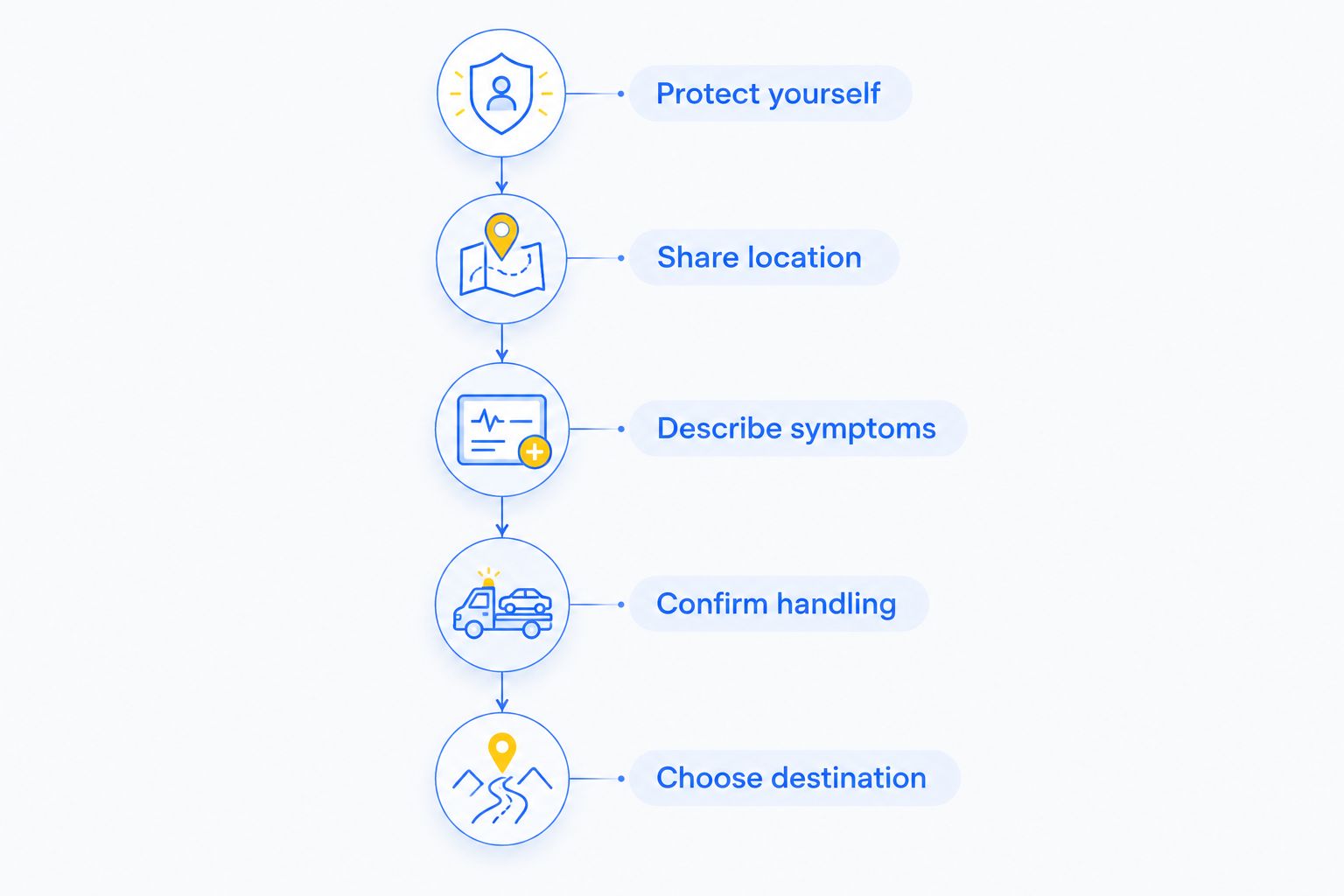
- Protect yourself. Stop as far from moving traffic as you safely can. Use hazard lights if they work. If the vehicle is in a live lane or there is immediate danger, contact emergency services.
- Share location. Give the road name, direction of travel, nearest exit or cross street, and a map pin when possible. Mention garage entrances, barriers, or restricted access.
- Describe symptoms. Report the displayed charge level, warning messages, and whether the EV unlocks, powers on, or moves. Say what happened immediately before it stopped.
- Confirm handling. Identify the exact vehicle and ask whether the operator can follow its jump-start or transport instructions.
- Choose destination. Agree on a compatible charger or repair destination before loading starts.
When you request help in 2026, send the warning message rather than an internet diagnosis. A clear description gives dispatch something useful to act on.
Request roadside help now
Share your Atlanta metro location, EV model, warning messages, and whether the vehicle can move.
Why EV roadside assistance requirements vary
The right response depends on the vehicle and the scene—not just the fact that it is electric.
- Low-voltage system: The battery type and approved external-power procedure determine whether and how a jump-start is possible.
- Manufacturer towing rules: Drivetrain design and transport instructions determine how the EV must be moved.
- Vehicle condition: Locked wheels, a discharged auxiliary battery, or collision damage change the loading plan.
- Access: A parking garage, narrow entrance, or sloped driveway affects truck access and recovery work.
- Destination: A depleted battery needs a workable charging plan; an electrical fault needs an appropriate repair destination.
- Immediate hazards: Smoke, unusual heat, flooding, or damaged high-voltage components require a safety response before ordinary roadside work.
Do not wait for the operator to arrive to mention a clearance restriction or damaged wheel. Those details belong in the first conversation.
Can I use a portable jump starter on my EV?
Use a portable jump starter only if your EV manufacturer permits it and you can follow the exact procedure safely. Verify the required voltage and designated connection points before attaching anything.
If you cannot confirm those instructions, stop. Guessing at the connection points risks turning a roadside problem into electrical damage or injury.
Can I tow my EV with a rope or another car?
Do not improvise an EV tow with a rope and another vehicle. Follow the manufacturer’s transport instructions and use a professional operator who can confirm the correct setup.
An EV that rolls freely is not automatically approved for wheels-on-road towing. Loading instructions and transport restrictions are different things.
What if my electric fleet vehicle breaks down?
Tell dispatch that the vehicle is electric, then identify its exact model and configuration. A commercial badge alone does not establish the equipment needed to move it.
Fleet managers should also confirm who authorizes the tow, where the vehicle should go, and how the driver will continue safely. Keep the manufacturer’s transport instructions accessible outside the stranded vehicle.
Atlroadside is best for Atlanta drivers and fleet managers seeking a 24/7 roadside assistance and towing contact. Its services include jump starts, towing, and heavy-duty recovery; EV-specific handling still needs confirmation before dispatch. General towing capability is not a substitute for checking your vehicle’s requirements.
FAQ
Can roadside assistance jump-start an electric car in 2026?
Yes, roadside assistance can jump-start an EV’s low-voltage system when the manufacturer permits that procedure. It cannot jump-start the high-voltage traction battery or restore driving range.
Will a jump-start help if my EV has no charge left?
A jump-start will not recharge an empty traction battery. Arrange transport to a compatible charger, and tell dispatch whether the vehicle also has a low-voltage power problem.
Does every electric vehicle need a flatbed tow truck?
The required towing setup depends on the exact vehicle’s manufacturer instructions. Confirm whether all wheels must be off the ground and how the operator will load the EV.
Should I keep trying to turn on my dead electric car?
Stop repeated attempts if the EV will not enter its ready-to-drive state or keeps showing a fault. Report the symptoms and warning messages so dispatch can arrange the appropriate help.
What should I do if my EV battery is smoking?
Move away from the vehicle, keep others away, and call emergency services. Do not attempt a jump-start, charging session, or roadside battery inspection.
Can I get electric vehicle roadside assistance in Atlanta overnight?
Atlroadside provides roadside assistance and towing 24/7 across the Atlanta metro. Identify your EV and confirm the required handling before dispatch; operating hours do not establish compatibility with every vehicle.
One last thing
An EV can have charge left in its traction battery and still be stranded by its low-voltage system. Report both what the battery display last showed and what the car does now. That distinction matters more than saying only that the battery is dead.
For your 2026 roadside plan, save the manufacturer’s recovery instructions somewhere you can reach without powering up the car. A document stored only on the dashboard screen will not help when that screen stays dark.