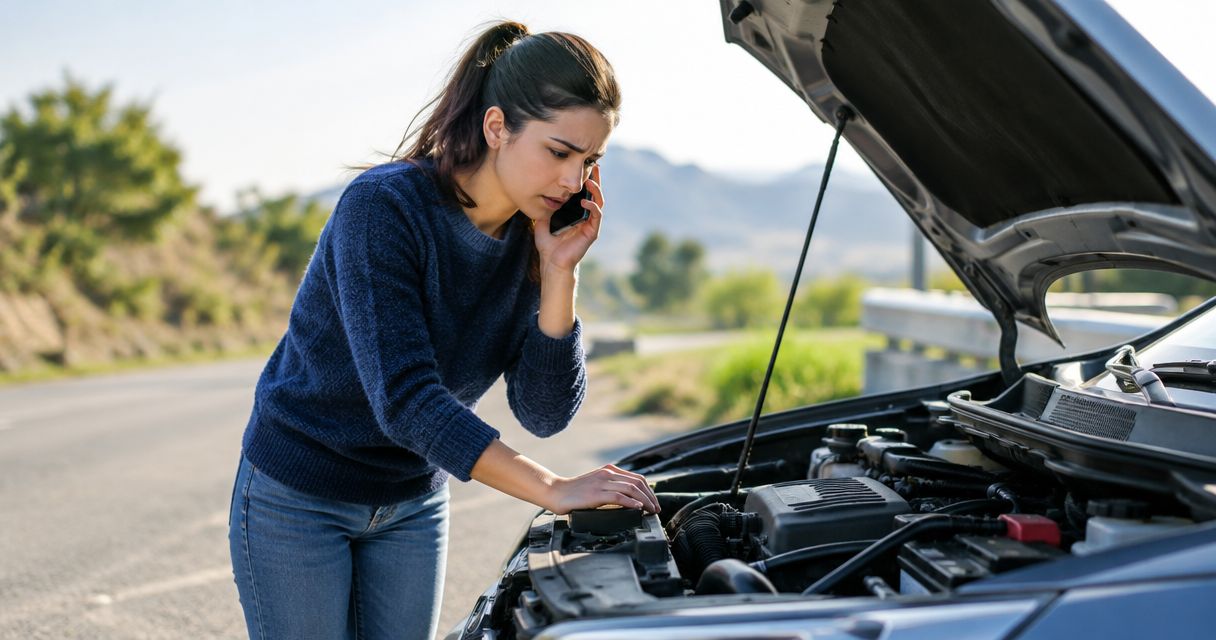
To call for a jump start in the Atlanta metro right now, call (678) 502-0513 and give your location, vehicle details, and what happens when you try to start it; roadside help is available 24/7. A jump start helps when the battery cannot supply enough starting power, but it does not repair a failed battery, starter, or charging system.
- Call for a jump start with your exact location, vehicle details, and starting symptoms ready.
- Atlroadside provides 24/7 jump starts and roadside assistance across the Atlanta metro.
- Repeated clicking or dim lights can point to a weak battery, but symptoms alone do not confirm the cause.
- Tell dispatch about traffic exposure, garage clearance, and commercial vehicles before help arrives.
Need help now? Contact Atlroadside and describe where you are before explaining the battery problem. Give the road, direction of travel, nearest exit, or parking address. Then explain whether the engine clicks, cranks, or does nothing.
Why this matters
A dead battery in a driveway and a stalled car beside interstate traffic need different responses. Your location and exposure to traffic come first. Do not stand beside the battery or open the hood if doing so puts you in moving traffic.
The goal is not just to get the engine running. You need the right help for the vehicle, a safe place to receive it, and a backup plan if a boost does not work.
How do I get help for a jump start near me right now?
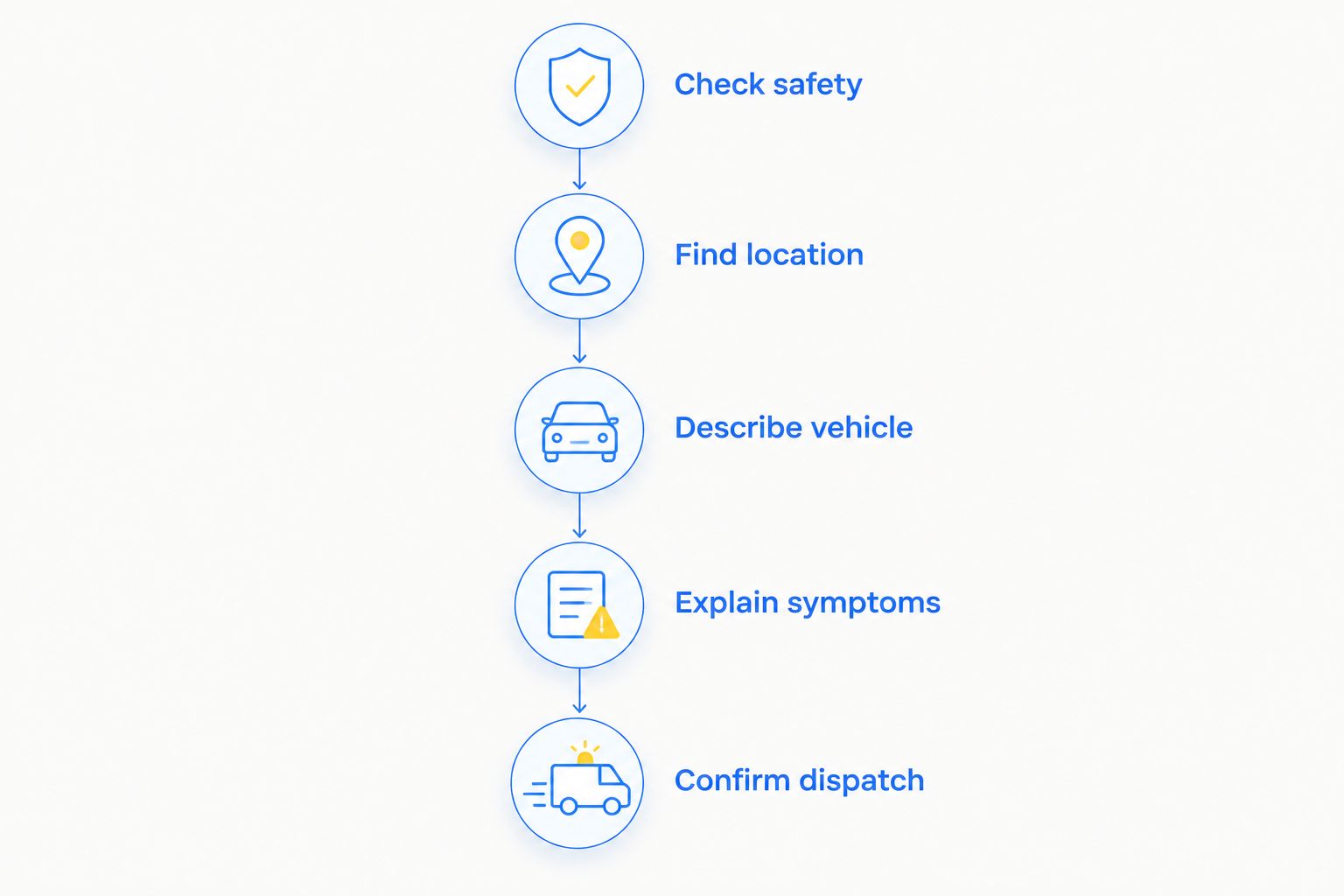
Follow this order when you request roadside help. You do not need to diagnose the battery yourself.
- Check safety. If there is a crash, fire, injury, or immediate danger, call 911. Roadside assistance is not a substitute for emergency responders.
- Find location. Read your map location, road signs, nearby business name, or parking level. On an interstate, include your direction of travel and nearest exit or mile marker.
- Describe vehicle. Give the make, model, model year, and color. Mention whether it is a passenger car, pickup, van, box truck, or semi-truck.
- Explain symptoms. Say whether you hear rapid clicking, a single click, normal cranking, or silence. Mention dim lights, warning messages, smoke, or unusual smells.
- Confirm dispatch. Ask whether the provider can handle your vehicle, what the service includes, and what happens if it will not start. Request a current arrival estimate rather than relying on a search-result claim.
Stay reachable after you request service. Keep your phone available for the driver's call, and tell dispatch immediately if your location or safety situation changes.
Request jump start help now
24/7 jump starts and roadside assistance across the Atlanta metro.
What should I tell the person answering the call?
Lead with where you are, not your best guess about the repair. Dispatch needs enough information to locate you and assess the job.
Use this checklist as you speak:
- Location: Street address, road name, travel direction, nearest exit, or visible landmark.
- Access: Garage level, posted clearance, gate, loading dock, or anything blocking the vehicle.
- Vehicle: Make, model, model year, color, and whether it is commercial.
- Symptoms: Clicking, slow cranking, normal cranking without starting, or no response.
- Safety: Whether you are in a travel lane, on a shoulder, or fully off the road.
- Previous attempts: Whether someone already tried a jump start and what happened afterward.
Do not walk along a dangerous shoulder to find a better landmark. Use information you can see safely, and tell dispatch when your location is approximate.
For a fleet vehicle, add the unit number and the fleet contact's details. Tell dispatch who can authorize service so the driver and fleet manager are working from the same information.
Do I need a jump start, towing, or emergency help?
Choose the response based on the danger and symptoms, not just the phrase dead battery. A car that will not start does not automatically need a jump start.
| Response | Best for | What it addresses | Limitation |
|---|---|---|---|
| Mobile jump start | A safely parked vehicle with suspected low starting power | Supplies external power for a starting attempt | Does not repair the underlying battery or charging fault |
| Vehicle towing | A vehicle that cannot be safely restarted or driven | Moves the vehicle for further diagnosis or repair | Does not fix the starting problem at the roadside |
| Emergency services | Immediate danger, injury, fire, or a hazardous obstruction | Addresses the emergency and public safety | Is not routine battery assistance |
Atlroadside is best for Atlanta drivers and commercial fleets needing 24/7 mobile jump starts with towing available if the vehicle cannot be driven. A roadside boost is a starting attempt, not a battery repair. Explain the symptoms before asking for a particular service.
If the engine cranks at its usual speed but does not fire, report that clearly. Fuel delivery, towing, or further diagnosis could be relevant; repeated boosting is not a diagnosis.
Can I get a jump start for a hybrid, EV, or commercial truck?
Tell dispatch the vehicle type before help is sent. Jump-start procedures depend on the vehicle, and the owner's manual controls the connection points and precautions.
Passenger cars, pickups, and vans
Give the exact model and model year. Mention aftermarket electrical equipment or any previous starting problem you know about.
Do not assume the battery under the hood is the correct connection point. Some vehicles have designated jump terminals elsewhere, and access instructions matter.
Hybrids and electric vehicles
Tell dispatch that the vehicle is a hybrid or EV. A low-voltage battery problem is different from an empty traction battery, and a conventional jump start does not recharge the traction battery.
Do not touch orange high-voltage cables or improvise a connection. Follow the vehicle manufacturer's instructions and explain any warning messages exactly as displayed.
Semi-trucks and fleet vehicles
Commercial starting systems need vehicle-specific handling. Tell dispatch the truck type, its location, and whether it is attached to a trailer or positioned at a loading dock.
Heavy-duty towing and recovery are available through the company, but that does not make every truck problem a towing job. Report the symptoms first so dispatch can discuss the appropriate response.
Why jump-start needs and arrival estimates vary
A nearby search result does not establish when someone can reach your vehicle. Ask for an estimate based on your actual location and access conditions.
These details belong in the call:
- Traffic exposure: A narrow shoulder needs a different safety assessment from a driveway.
- Vehicle access: Garage clearance, gates, and loading areas affect how help reaches you.
- Vehicle type: A passenger car and a commercial truck have different starting-system requirements.
- Battery condition: Visible damage or leakage changes whether a jump attempt is appropriate.
- Starting symptoms: Slow cranking and normal cranking without ignition point to different problems.
- Earlier attempts: A failed boost or an engine that immediately stalled is important information.
Ask what is included before authorizing service. Clarify whether a failed starting attempt, additional diagnosis, or towing would be handled separately. Do not assume a jump-start request includes a replacement battery or repairs.
Is it safe to jump-start the car myself?
Only attempt a jump start when the location is safe and you can follow the vehicle and equipment instructions. Do not guess about cable connections, voltage, or designated terminals.
Do not attempt to boost a visibly damaged, leaking, swollen, or frozen battery. Keep flames and sparks away, and stop if you notice smoke, heat, or an unusual smell.
A portable jump pack still requires the correct procedure. Owning one does not make a traffic-side repair safe or remove the need to check the owner's manual.
If you cannot identify the correct connection points or safely reach them, call for help. Avoid turning a starting problem into an electrical fault or injury.
What if the car starts and then dies again?
A car that starts with a boost and then dies needs further assessment. Do not assume another jump will solve the problem.
Tell the roadside technician when it stalled, whether warning lights appeared, and whether electrical equipment stopped working. Those observations are more useful than declaring that the alternator or battery has failed.
If the engine stays running, that still does not prove the battery is healthy. Arrange a battery and charging-system check, and follow the technician's guidance about whether the vehicle is safe to drive.
For more symptom guidance, read how to tell whether you need a jump start or a new battery.
FAQ
Who can I call for a jump start in Atlanta right now?
Call Atlroadside at (678) 502-0513 for 24/7 mobile jump-start and roadside assistance across the Atlanta metro. Give your location, vehicle details, and starting symptoms first.
Can someone jump-start my car at night?
Yes. Jump-start service is available 24/7 across the Atlanta metro. Tell dispatch about poor visibility, traffic exposure, garage access, or any other condition affecting safe access.
How long will someone take to reach me for a jump start?
Ask dispatch for a current arrival estimate based on your location and access conditions. Do not treat a general online claim as a confirmed arrival time.
Will a jump start fix my dead battery?
A jump start supplies external power for a starting attempt; it does not repair a failed battery. The battery and charging system need assessment if the problem returns or the vehicle stalls.
Should I keep trying to start a car that only clicks?
Stop repeated attempts and report the clicking to roadside dispatch. Clicking can accompany low battery power, but it does not establish the cause by itself.
Can I request help for a semi-truck that will not start?
Yes. Describe the commercial vehicle and starting problem when requesting roadside help. Include the truck's exact location, trailer status, and any access restrictions so dispatch can assess the request.
What if my car will not start after a jump?
Stop treating the problem as a confirmed dead battery and ask about further assessment or towing. Tell the technician whether the engine clicks, cranks normally, or starts and stalls.
One last thing
A successful jump start is not proof that the problem is fixed. Before the technician leaves, ask what to do if the vehicle stalls or fails to restart. Save the service number while your phone is working, not after the next breakdown.