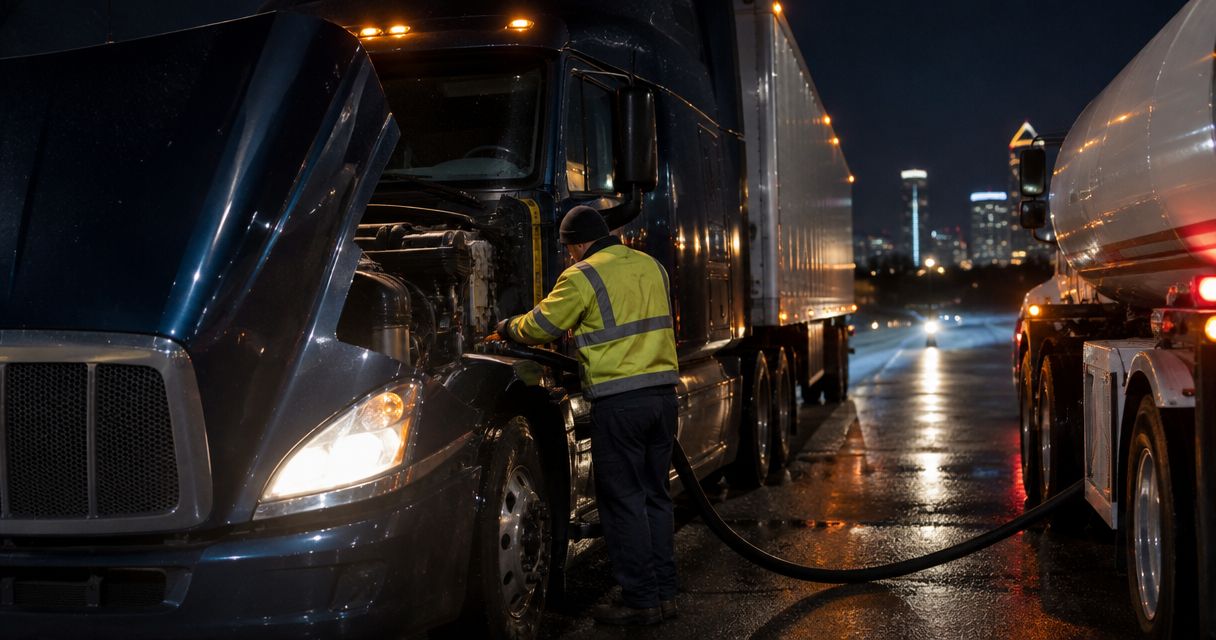
Yes. You can request diesel delivery for a stranded semi truck at night in Atlanta, with 24/7 roadside help available across the metro. Tell dispatch where the rig is, confirm that you need diesel, and report whether you are safely off the road. Fuel delivery does not guarantee a restart if the truck has another problem.
- Atlroadside provides emergency diesel delivery Atlanta truckers can request 24/7, including overnight.
- Give dispatch your highway, direction, nearest exit, truck details, and fuel type.
- Diesel delivery addresses an empty tank; a separate breakdown needs assessment.
- Report an unsafe stopping position immediately. Call 911 for immediate danger.
Stranded now? Contact roadside assistance and describe the situation before discussing the route. Lead with any immediate danger, then your location and the words “semi truck needs diesel.”
Why this matters
An empty tank and a disabled truck are not always the same job. You need the service that addresses the actual problem—not simply fuel dropped beside a rig that still cannot move.
For a nighttime breakdown in 2026, start with safety and an accurate location. A road name alone leaves out the direction, carriageway, and access point the responder needs.
Can diesel be delivered to a stranded semi truck at night?
Yes. Atlroadside offers 24/7 emergency diesel delivery for semi trucks and commercial vehicles across the Atlanta metro. Overnight service means you can request help at night; it does not establish a fixed arrival time or confirm that every stopping position is safe for roadside work.
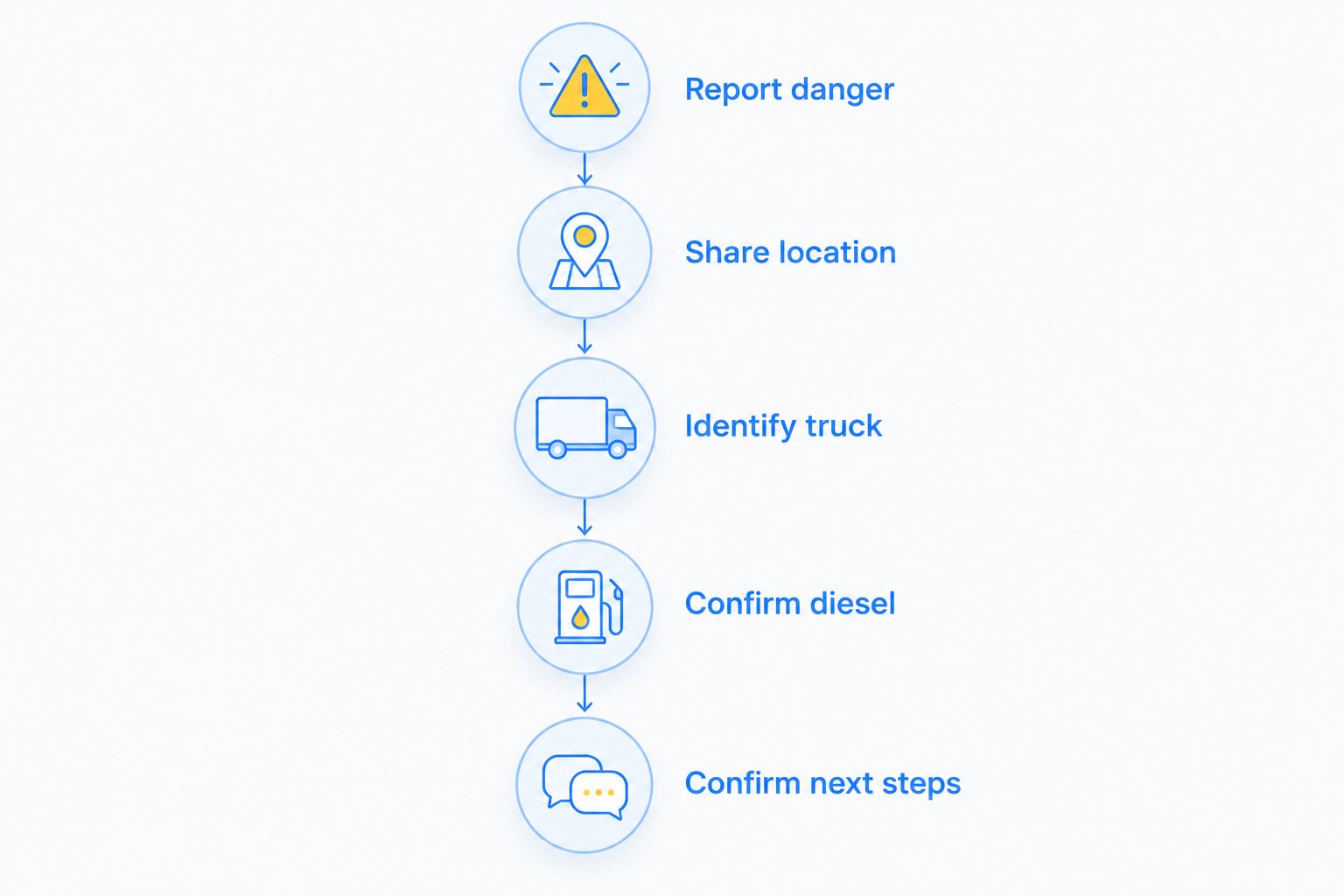
Use this sequence when you call:
- Report danger. Say immediately if the truck is in a travel lane, exposed to traffic, leaking fuel, or near another hazard. Call 911 for immediate danger, fire, or a collision requiring emergency assistance.
- Share location. Give the highway or street, direction of travel, nearest exit or mile marker, and which side of the road you occupy. Share a location pin if you can do so safely.
- Identify truck. State that it is a semi truck. Explain whether a trailer is attached and provide your unit number if your fleet uses one.
- Confirm diesel. Specify diesel rather than asking only for “fuel.” Tell dispatch whether the truck ran out, shut down unexpectedly, or has already been refueled without restarting.
- Confirm next steps. Ask whether fuel delivery fits the symptoms, what information is still needed, and how you will receive an arrival update.
Do not walk along an interstate looking for fuel. Keep your attention on your surroundings and follow emergency responders’ instructions when the stopping position is dangerous.
What should you tell dispatch first?
Give the location and the hazard before the backstory. A useful opening is: you are driving a semi truck, you need diesel, and you are stopped at a specific location facing a specific direction.
Then answer the questions that separate a fuel call from a broader breakdown:
- Did the engine shut down after the fuel gauge reached empty?
- Is the truck completely outside the travel lane?
- Is there visible damage, smoke, or a suspected leak?
- Have you already added fuel or attempted a restart?
- Is a fleet manager or dispatcher coordinating the request?
- Can the responder reach the truck without a locked gate or unclear entrance?
Describe what you observed. Do not diagnose a fuel pump, injector, or electrical fault over the phone unless a qualified technician has already identified it.
For your 2026 fleet call checklist, keep the unit number, driver callback number, location, fuel request, and observed symptoms together. Tell dispatch if any of those details change while you wait.
Request nighttime diesel delivery
Tell dispatch your location, truck details, fuel type, and any immediate road hazard.
Is diesel delivery or heavy-duty towing the right call?
Diesel delivery fits a fuel shortage. Heavy-duty towing addresses a truck that needs transport. A suspected mechanical fault needs assessment before anyone treats the job as a simple refill.
You can review the available roadside assistance services, but explain the symptoms when you request help. Do not select a service solely because the truck stopped near an empty reading.
| Service | Best for | What it addresses | Main limitation |
|---|---|---|---|
| Emergency diesel delivery | A stranded semi truck with a reported fuel shortage | Getting diesel to the truck’s location | Added fuel does not fix an unrelated fault or guarantee a restart |
| Heavy-duty towing | A disabled semi truck that needs transport | Moving the truck rather than relying on a roadside restart | Transport is a different job from delivering fuel; describe the truck and trailer situation |
| Heavy-duty recovery | A rig that is stuck or needs recovery assessment | A situation beyond an ordinary fuel stop | Dispatch needs the position and hazards before determining the next step |
Atlroadside is a fit for Atlanta semi-truck drivers who need 24/7 diesel delivery with heavy-duty towing and recovery capability. The limit is straightforward: the service request must match the truck’s condition, and fuel alone is not a repair.
What if the truck still will not start after diesel arrives?
Stop treating the problem as an empty tank. Report what happened after refueling and follow the truck manufacturer’s restart instructions or a qualified technician’s direction.
Some diesel fuel systems require a manufacturer-specified priming procedure after running dry. Do not improvise a procedure, loosen fuel-system components, or keep attempting restarts without guidance. Tell dispatch whether the engine cranks, starts and stops, or does not respond.
Why nighttime diesel delivery arrangements vary
The request is not defined by the clock alone. These details determine what you need to explain before roadside work begins:
- Exact location. A truck on a highway shoulder presents a different access situation from a truck in a parking lot or yard.
- Traffic exposure. A rig fully outside traffic and a rig obstructing a lane present different safety concerns. Report the actual position.
- Fuel shortage versus breakdown. An empty tank, a no-start after refueling, and a suspected leak are different problems.
- Truck and trailer situation. State whether the trailer is attached and whether the combination is stuck or damaged.
- Site access. Gates, separate truck entrances, and unclear addresses need an explanation. Do not assume a location pin identifies the usable entrance.
- Fleet coordination. Identify who is authorizing the request and who will answer the responder’s call.
Ask for an arrival estimate for your actual location. A general statement about fast service is not a confirmed arrival time for your truck.
Can I get diesel delivered on an Atlanta interstate?
You can request diesel delivery for a semi truck stranded on an Atlanta interstate, including overnight. Tell dispatch the highway, travel direction, nearest exit or mile marker, and whether you are on a shoulder, ramp, or travel lane.
A truck on I-285 needs more than “I’m on the perimeter” as a location description. Likewise, “near I-75” does not identify the carriageway or the approach. Use road signs and your map location together, without stepping into traffic to read a sign.
If you cannot identify your position, say so. Share the last exit you passed and any location information visible from a safe position; do not guess and present the guess as confirmed.
Should I stay in the cab while waiting for diesel?
There is no single safe waiting position for every truck breakdown. Traffic exposure, the truck’s position, fire, smoke, and other hazards determine whether remaining in the cab is appropriate.
Do not climb out into moving traffic or stand between the truck and approaching vehicles. If you face immediate danger, call 911 and follow the dispatcher’s instructions about where to wait. Tell the roadside responder if your waiting position changes.
For nighttime calls in 2026, make the hazard description part of the request—not an afterthought. Diesel delivery is not a substitute for emergency traffic protection.
What should a fleet manager do during an overnight fuel call?
Keep one accurate incident record and one clear point of contact. The driver knows the conditions at the truck; the fleet office should not replace that account with an assumption based only on tracking information.
Use this short handoff:
- Confirm the driver’s location and whether the truck is outside traffic.
- Record the unit number and the driver’s callback number.
- Confirm that diesel is needed and note any other symptoms.
- Establish who is authorizing service under your fleet’s process.
- Pass changes in location or truck condition to the responder.
- Keep the driver informed if the request changes from delivery to towing.
Your 2026 breakdown procedure should distinguish “fuel requested,” “fuel delivered,” and “truck running.” Those are separate updates. Do not tell a customer the truck is moving simply because a delivery request has been placed.
FAQ
Can I get emergency diesel delivery in Atlanta after midnight?
Yes. Atlroadside provides 24/7 emergency diesel delivery for semi trucks and commercial vehicles across the Atlanta metro. Give dispatch your exact location and report whether the truck is safely outside traffic.
Do I need to know how much diesel my semi truck needs before calling?
You can start the request by explaining that your semi truck needs diesel. Confirm the fuel requirement and delivery details with dispatch rather than guessing an amount.
Will my semi truck restart as soon as diesel is delivered?
Diesel delivery does not guarantee a restart. Follow the truck manufacturer’s instructions and report any continuing no-start condition so the next service matches the problem.
Can a fleet manager request diesel delivery for a driver?
A fleet manager can coordinate the request and provide the truck’s details. Keep the driver reachable so dispatch can verify the location, access, and conditions beside the rig.
What if my semi truck is blocking a lane at night?
Treat a semi truck blocking a travel lane as an immediate safety issue. Call 911 for immediate danger, explain the truck’s position, and tell roadside dispatch about the obstruction.
Should I request towing instead of diesel delivery?
Request assessment for towing when the truck needs transport rather than only fuel. Explain any damage, suspected leak, or failure to restart after refueling; do not assume another diesel delivery will solve it.
One last thing
Before you end the call, repeat the highway, direction, and stopping position. Then confirm the callback number. A correct address with the wrong direction is still an incomplete roadside location.
Save that short check in your 2026 driver instructions. When the rig is stranded at night, clear information is more useful than a long explanation of how the tank ran low.