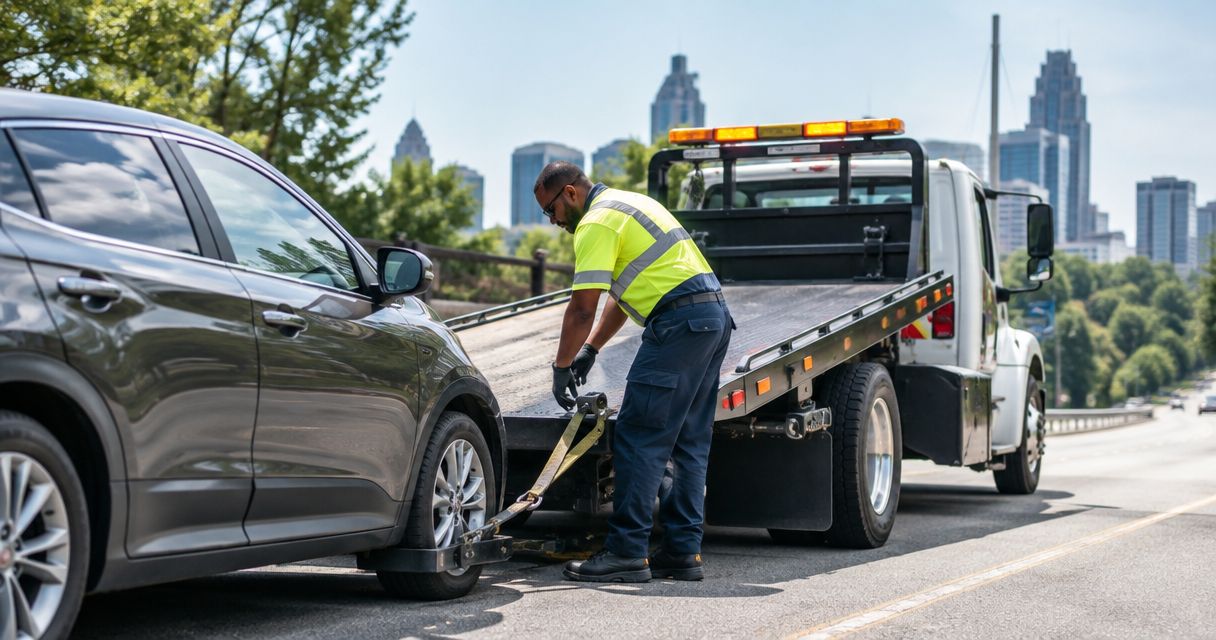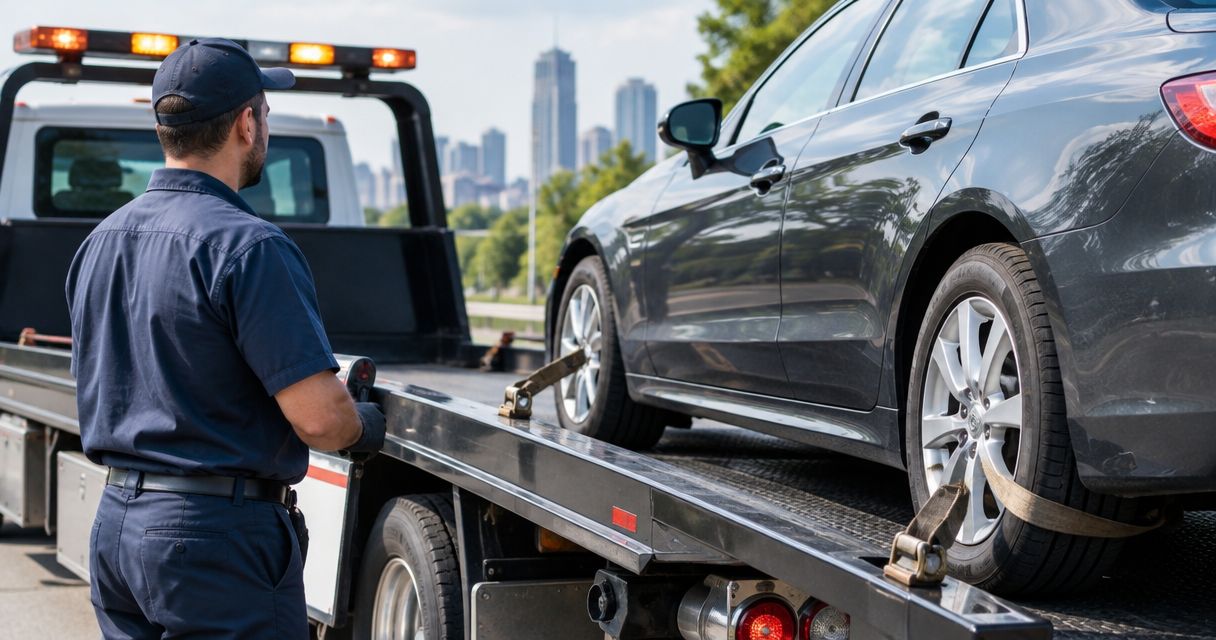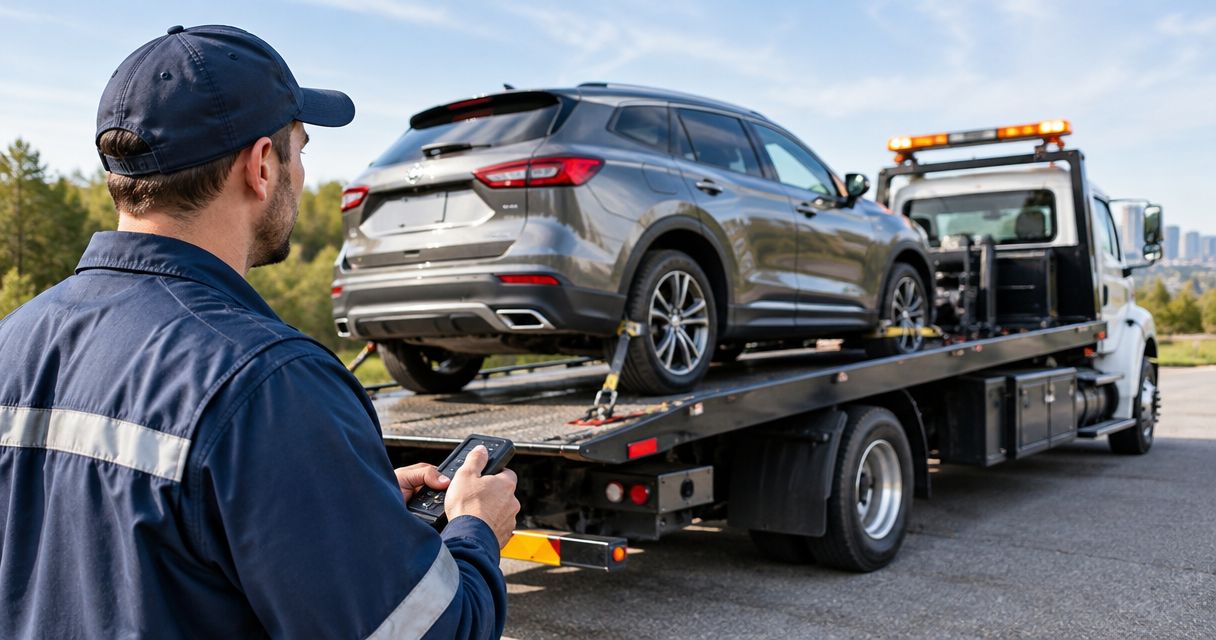
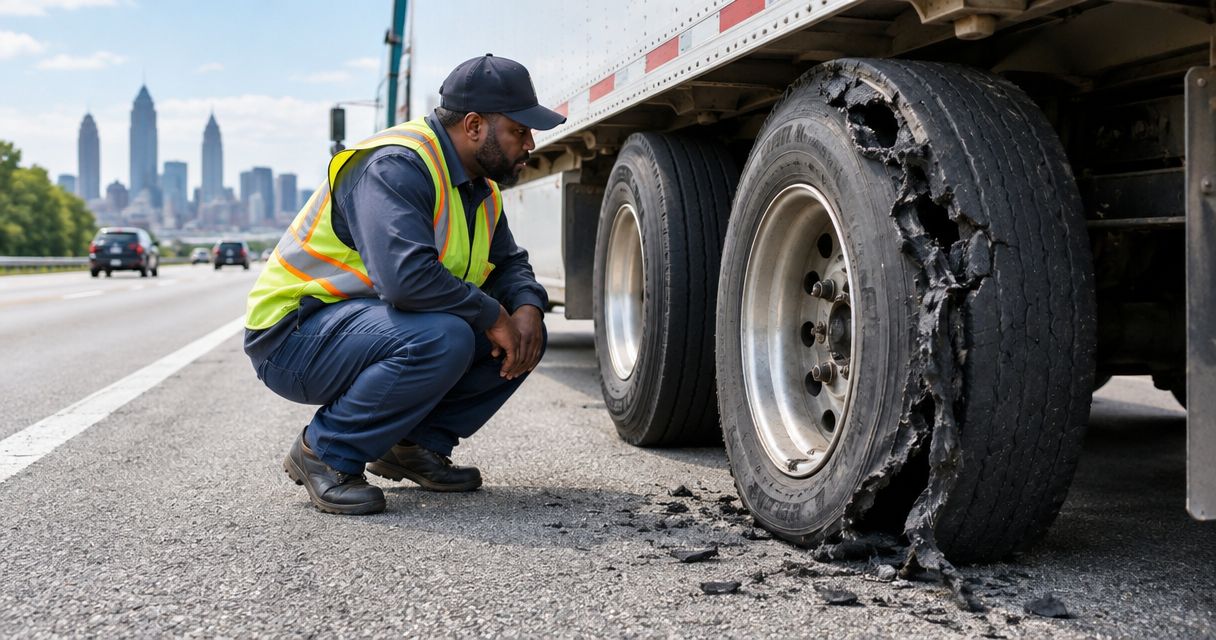
If a semi-truck tire blows out in Atlanta, hold the steering wheel firmly, avoid hard braking, ease off the accelerator, and move out of traffic once the truck is under control. Stop in the safest reachable location, turn on your hazards, and request commercial roadside help; call 911 for injuries, fire, or an immediate traffic hazard.
- For a semi truck tire blowout Atlanta emergency, control the truck before attempting to stop.
- Avoid hard braking and sudden steering; slow gradually and leave the traffic lanes when safe.
- Atlroadside provides 24/7 roadside assistance and heavy-duty towing across the Atlanta metro.
- Confirm commercial tire-service capability before dispatch; a passenger-car tire change is not the same job.
Stopped safely? Call Atlroadside for roadside assistance services. Tell dispatch that you have a semi-truck tire blowout, give your exact location, and explain whether the truck is fully outside the travel lanes.
What should you do if a semi-truck tire blows out in Atlanta?
Control first. Stop second. Inspect only when it is safe. Use this 2026 emergency checklist to keep the immediate problem from becoming a collision.
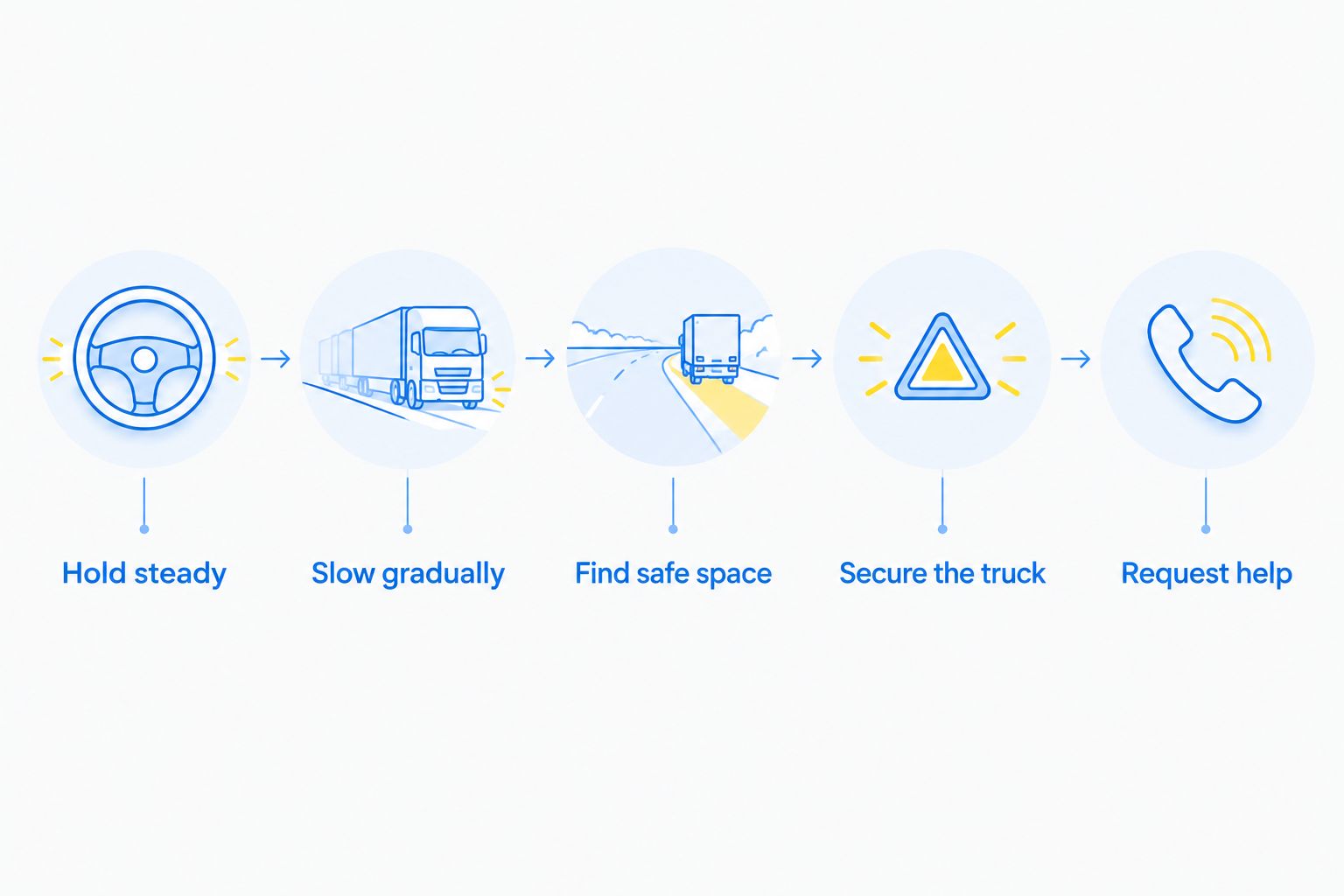
- Hold steady. Keep both hands on the wheel and maintain your direction. A loud bang, vibration, or pull does not call for a sudden steering correction.
- Slow gradually. Avoid slamming on the brakes. Ease off the accelerator, let the truck settle, and brake gently after you have control.
- Find safe space. Check mirrors and signal before moving out of traffic. Use a reachable shoulder or other safe stopping area without cutting across lanes.
- Secure the truck. Stop, apply the parking brake, and turn on your hazard flashers. Check your surroundings before opening the door.
- Request help. Give dispatch your highway, direction, nearest exit or mile marker, and whether you need tire assistance, heavy-duty towing, or recovery assessment.
Do not try to reach a preferred truck stop on a blown tire. The immediate goal is a controlled stop outside moving traffic, not finishing the route.
Why this matters
A blown tire creates more than a tire problem. You also have a heavy vehicle near moving traffic, possible damage around the wheel, and a repair location that might not be safe to work in.
For Atlanta drivers and fleet dispatchers in 2026, the useful question is not just whether someone can bring a tire. Ask whether the truck can be serviced safely where it sits, or whether it needs heavy-duty towing first.
Do not trade a dangerous shoulder position for a faster repair attempt. Tell dispatch about the traffic exposure before discussing the tire.
What should you tell roadside dispatch?
Give the location first. On I-285, I-75, I-85, or I-20, the highway name alone does not identify where help needs to reach you.
Use this call checklist. Read it from the cab if stepping outside would expose you to traffic.
- Location: Highway, direction of travel, nearest exit, mile marker, or a location pin.
- Position: Right shoulder, left shoulder, ramp, parking area, or blocked travel lane.
- Truck details: Tractor-trailer, straight truck, or another commercial vehicle, plus your unit identification.
- Affected wheel: Steer, drive, or trailer position, if known without an unsafe inspection.
- Visible damage: Shredded tread, damaged wheel, leaning trailer, smoke, or leaking fluid.
- Load details: Loaded or empty, with any hazardous cargo disclosed immediately.
- Contact: Driver callback information and the fleet contact who can authorize work.
Do not walk around the truck just to complete the checklist. Say what you know and identify what remains unconfirmed. A clear description of the hazard is more useful than a risky photograph.
Before ending the call, ask which service is being dispatched and what information the provider still needs. Confirm whether the request is for commercial tire work, towing, or recovery rather than assuming that “roadside assistance” means all three.
Request help for your stranded truck
Share your location, truck type, affected wheel, and traffic exposure before dispatch.
Roadside tire service or heavy-duty towing?
Choose the response around the truck's condition and stopping location. A tire-only failure in a protected work area is different from wheel damage beside an active lane.
| Response | Best for | Main benefit | Limitation |
|---|---|---|---|
| Commercial roadside tire service | A tire failure where a qualified technician can work safely | Addresses the tire without first moving the truck to a shop | Requires confirmation of tire suitability, wheel condition, and safe access |
| Heavy-duty towing | A truck that cannot safely remain or be repaired where it stopped | Moves the disabled vehicle to a suitable destination | Requires the correct commercial towing arrangement and destination coordination |
| Heavy-duty recovery | A truck off the pavement, unstable, or involved in a more complex incident | Addresses positioning or recovery needs beyond an ordinary roadside stop | Needs an incident-specific assessment; a tire replacement alone does not resolve it |
A blown tire does not automatically mean the truck needs towing. It also does not prove that an on-site tire change is safe.
Atlroadside roadside assistance is best for Atlanta drivers and fleets seeking 24/7 help with heavy-duty towing and recovery needs. For a semi-truck tire replacement, confirm the required commercial tire service before authorizing dispatch; the listed tire-change service does not establish every commercial tire capability.
Why the response to a truck tire blowout varies
The right service depends on what failed and where the truck stopped. Give dispatch these details rather than requesting a standard tire change without explanation.
- Wheel position: Identify whether the damaged tire is on the steer axle, drive axle, or trailer.
- Remaining damage: Report visible wheel damage, hanging material, damaged lines, or fluid leaks without crawling underneath.
- Work space: A narrow shoulder or nearby moving traffic changes whether a roadside repair is appropriate.
- Truck and load: Vehicle configuration and cargo matter when arranging towing or recovery.
- Ground conditions: A truck on soft ground, a slope, or beyond the shoulder needs a different assessment from one on firm pavement.
- Tire identification: Share the tire information already in your fleet records, or a photograph only if it can be taken safely.
For your 2026 fleet breakdown checklist, record these fields before an emergency. Do not make the stranded driver search paperwork while dealing with an exposed stopping position.
When should you call 911 instead of roadside assistance?
Call 911 when the blowout creates an immediate danger: injuries, a collision, fire, hazardous cargo concerns, or a truck blocking traffic. Give the location and the hazard first, then follow the emergency operator's instructions.
A roadside service request is not a substitute for emergency traffic control. Tell your roadside provider if police or other responders are already handling the scene so the response can be coordinated.
If tire debris is in a travel lane, report it. Do not walk into traffic to retrieve it, and do not stand behind the truck trying to direct approaching drivers.
How should you warn approaching traffic?
Turn on your hazard flashers promptly. Follow the commercial-vehicle warning-device requirements that apply to your stopping location and the instructions of emergency responders.
Under the federal rule in 49 CFR 392.22, a covered commercial vehicle stopped on a highway's traveled portion or shoulder generally requires warning devices as soon as possible, within 10 minutes. On a divided or one-way highway, the rule specifies devices approximately 10 feet, 100 feet, and 200 feet toward approaching traffic, subject to the rule's placement provisions.
That is federal regulatory guidance applicable to this 2026 checklist, not a reason to step into a live lane. Curves, hills, obstructions, and other road layouts affect placement requirements; follow your commercial-driver training and get emergency help when traffic exposure makes the scene dangerous.
Do not use flame-producing warning devices where fuel, cargo, or other conditions make them unsafe. Keep your location and immediate hazards clear in every call.
Can you keep driving after a semi-truck tire blows out?
Do not continue the route on a blown tire. Bring the truck under control and stop in the safest reachable place; having another tire beside the damaged one does not establish that the truck is safe to drive.
Do not accept a delivery deadline as a reason to continue. The wheel, nearby components, and remaining tires need an appropriate assessment before the truck returns to service.
If the stopping location itself is dangerous, describe that danger to emergency responders and dispatch. Do not attempt a move based on a remote assumption that the truck is still roadworthy.
Should you stay in the cab while waiting?
Choose the position that keeps you away from traffic and the immediate hazard. There is no safe blanket instruction to remain inside every disabled truck or to get out of every cab.
Fire, smoke, a dangerous load condition, or an exposed stopping position changes the decision. Follow emergency responders' instructions, and do not step directly into moving traffic when exiting.
Avoid standing beside the damaged wheel, underneath the trailer, or between the truck and approaching vehicles. Do not crawl under the rig to check whether shredded tread damaged something else.
What should fleet dispatch do next?
Keep the driver focused on safety. Assign one person to coordinate the roadside request and another, if available, to handle the delivery disruption.
Confirm who can authorize the service, the intended repair or towing destination, and how the provider will reach the driver. Pass along truck identification and known tire information without requiring another roadside inspection.
For a 2026 fleet procedure, include a clear handoff: who requested help, what service was requested, and who receives updates. Avoid sending competing providers without telling everyone involved.
Once the truck is assessed, document the failure and any damage for maintenance follow-up. A replacement tire alone does not explain why the original failed.
FAQ
What is the first thing I should do when my semi-truck tire blows out?
Hold the steering wheel firmly and maintain control without hard braking or sudden steering. Ease off the accelerator, slow gradually, and move out of traffic when safe.
Can I drive to the next Atlanta exit with a blown truck tire?
Do not plan to continue to the next exit on a blown tire. Make a controlled stop in the safest reachable location and request commercial roadside help.
Can roadside assistance replace any semi-truck tire?
Do not assume every roadside provider can replace your semi-truck tire. Confirm commercial tire capability, the affected wheel position, tire requirements, and whether the stopping location permits safe work.
Does Atlroadside offer help for heavy-duty trucks at night?
Atlroadside provides 24/7 roadside assistance and heavy-duty towing and recovery across the Atlanta metro. Explain the blowout and confirm the specific commercial service needed before dispatch.
Should I call 911 if my truck is blocking a lane?
Call 911 when your disabled truck creates an immediate traffic hazard. Give the highway, direction, nearest exit or mile marker, and the lane affected.
Should I take a picture of the blown tire for dispatch?
Take a picture only when you can do so without exposure to traffic or other hazards. Your location and a safe description are more important than a photograph.
How soon must a commercial driver place warning devices?
For covered highway or shoulder stops, federal rules generally require warning devices as soon as possible and within 10 minutes. Follow the placement requirements for the road layout and emergency responders' instructions.
One last thing
Tell dispatch which direction you are traveling before describing the tire. An accurate location helps the provider plan access; a tire description cannot tell anyone which side of the interstate you are on.
Keep that location message ready to repeat. Then stay focused on traffic, follow responder instructions, and leave the inspection to qualified help.