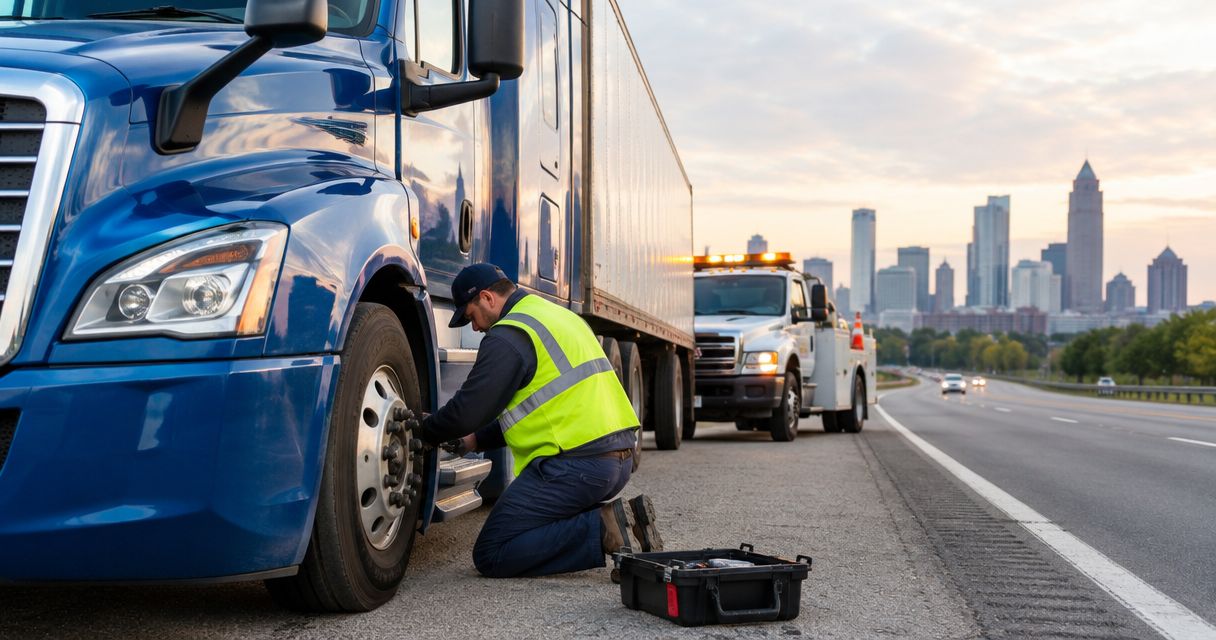
Yes. Semi-trucks can get emergency roadside assistance across the Atlanta metro, including diesel delivery and heavy-duty towing or recovery, with service available 24/7. Tell dispatch that you have a semi, describe the problem, and confirm the service fits your rig before help is sent.
- Searching roadside assistance for semi trucks near me? Atlanta has round-the-clock commercial roadside help.
- Atlroadside provides diesel delivery and heavy-duty towing or recovery across the Atlanta metro.
- Request diesel delivery for an empty tank; report leaks or mechanical symptoms before assuming fuel will fix the breakdown.
- Give dispatch your road, direction, location, truck details, and trailer status before requesting help.
Need help now? Call with your location and say “semi-truck” first. Review the roadside assistance services if you need to identify the right request. If there is a crash, fire, injury, or immediate traffic danger, call 911 first.
Can semi-trucks get emergency roadside assistance in Atlanta?
Yes. Atlanta semi-truck drivers and commercial fleets can request roadside help at any hour. The right response depends on whether your truck needs fuel, starting assistance, access help, towing, or recovery.
A service offered for passenger cars is not automatically suitable for a tractor-trailer. Explain what you drive before describing what you want done, and ask dispatch to confirm the job fits the truck and conditions.
| Service to request | Best for | What it addresses | Limit to confirm |
|---|---|---|---|
| Emergency diesel delivery | A truck that has run out of diesel | Getting the required fuel to the stranded truck | Whether restarting needs additional attention |
| Commercial jump-start assistance | A truck with a suspected discharged battery | Assistance with starting | Compatibility with the truck’s electrical system; a jump does not repair a charging fault |
| Commercial lockout assistance | A driver locked out of the cab | Restoring access | Whether the particular truck can be serviced |
| Commercial tire assistance | A reported flat or damaged truck tire | Assessment of the tire-service request | Whether the provider can handle that tire, position, and roadside location |
| Heavy-duty towing | A disabled truck that needs transport | Moving the truck to an agreed destination | Truck configuration, trailer status, and destination |
| Heavy-duty recovery | A stuck or off-road rig | Recovering the truck from its position | Ground conditions, access, and the full recovery situation |
Choose the service that matches the failure—not just the nearest search result. Fuel delivery will not solve every no-start, and towing is not the same job as recovering a rig from a ditch.
Why this matters when you are stranded
Your first call needs to establish two things: where the rig is and what kind of help it needs. A vague request for a tow leaves out details that matter on a commercial job.
Atlroadside is a fit for Atlanta semi-truck drivers and fleets needing 24/7 diesel delivery or heavy-duty towing and recovery. That service scope does not replace a truck-specific dispatch check. Confirm the requested work before authorizing it.
For a breakdown in 2026, use your phone’s location information alongside a road name, direction of travel, and nearby exit or landmark. A location pin alone does not explain which side of a divided highway the truck occupies.
What should I tell dispatch first?
Give dispatch the facts in this order. You do not need to diagnose the engine to make a useful call.
- Location. State the road, direction of travel, nearest exit or landmark, and whether you are on a shoulder, ramp, lot, or access road. Share a location pin if requested.
- Safety. Say immediately if the truck blocks traffic, sits on unstable ground, has been in a collision, or shows smoke or a visible leak. Report injuries to emergency services.
- Truck details. Identify the tractor and whether a trailer is attached. State whether the trailer is loaded, and provide weight information if known.
- Symptoms. Describe what happened: the fuel ran out, the engine will not crank, a tire failed, the keys are inside, or the truck left the pavement. Report warning messages without guessing at the cause.
- Requested help. Ask for the appropriate service and let dispatch confirm suitability. If you need towing, give the destination or explain that it has not been arranged.
- Callback. Give a working callback number. For a fleet truck, identify the person who can authorize service and coordinate with the driver.
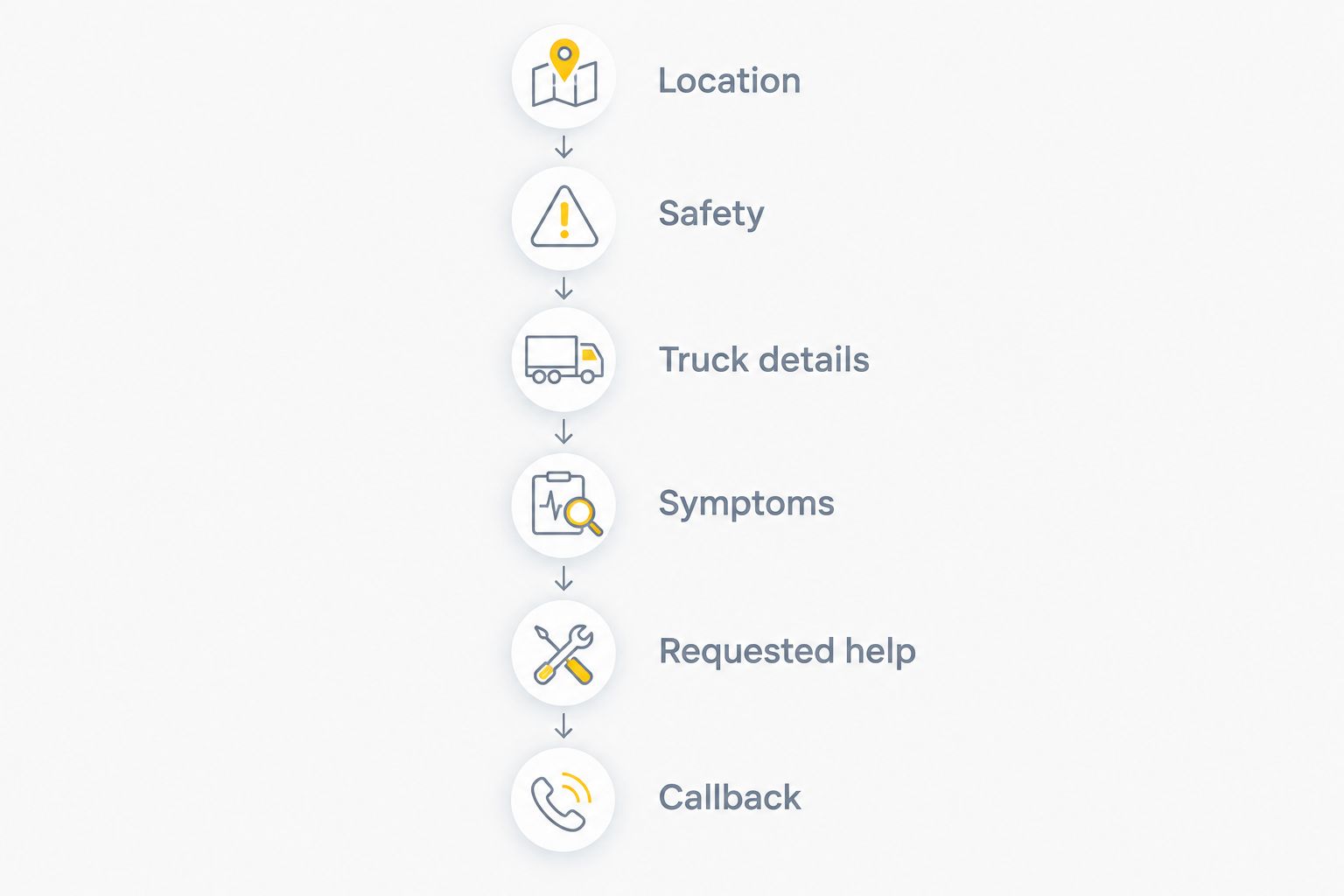
Keep this checklist in your fleet’s 2026 driver instructions. The driver at the truck should remain reachable even when a dispatcher or manager handles authorization.
Request help for your semi
Explain your location, truck configuration, and breakdown. Confirm the service your rig needs.
Out of diesel? Request fuel delivery
Best for: a semi-truck that has run out of diesel. Specify diesel when you call. Tell dispatch what happened before the engine stopped and whether you see any fuel leaking.
Emergency delivery brings fuel to the truck, but adding fuel does not prove the truck is ready to move. Follow the truck manufacturer’s restart procedure and report a continued no-start rather than repeatedly attempting to crank the engine.
Do not walk along an interstate shoulder looking for fuel. If there is a spill, smoke, or immediate danger, explain that first and contact emergency services as needed.
Engine will not start? Describe the symptoms
Best for: a commercial jump-start request when a discharged battery is suspected. Tell dispatch whether the engine cranks, whether lights come on, and what happened during the last start attempt.
Do not assume a passenger-car jump-start setup fits a semi. Confirm truck compatibility before service is sent, and follow the vehicle’s designated starting procedure.
A successful jump starts the engine; it does not establish why the battery lost charge. If the truck stalls again or warning lights remain on, report that before returning to the road.
Flat tire or locked cab? Confirm truck-specific help
Best for: a clearly described tire or cab-access problem. For a tire request, give the tire position and size if you can read them safely. Say whether the truck is loaded and whether tire damage affects nearby parts.
Do not crawl under the truck or stand beside moving traffic to collect details. Tell dispatch which information you cannot safely check.
For a lockout, identify the truck and say where the keys are. If a person is trapped inside or faces immediate danger, call emergency services instead of treating it as a routine lockout.
Tire changes and lockout help are part of Atlroadside’s roadside assistance services. Confirm the specific semi-truck job before dispatch; a general service listing is not a compatibility guarantee.
Truck cannot move safely? Request towing or recovery
Best for: a disabled rig that needs transport, or a stuck rig that needs recovery. Tell dispatch whether the truck is upright, on pavement, attached to a trailer, and accessible from the road.
Towing moves a disabled truck. Recovery addresses the truck’s position before ordinary transport can happen. A rig off the pavement needs a different description than a truck parked at a loading dock.
Explain visible damage without getting underneath the vehicle. Report an attached trailer, shifted cargo, soft ground, or a blocked approach rather than asking for a generic tow truck.
Heavy-duty capability matters, but the provider still needs the job details. Do not assume every truck, load, and recovery situation takes the same approach.
Why the right roadside response varies
The service label is only the starting point. These details determine what you should request and what dispatch needs to confirm:
- Failure type. An empty fuel tank, no-start, locked cab, and disabled drivetrain are different requests. Describe the symptoms rather than choosing a repair yourself.
- Truck configuration. A tractor alone and a tractor with an attached trailer present different handling questions. State the configuration at the start.
- Load status. Tell dispatch whether the trailer is loaded and share known weight information. Do not guess at weights you cannot verify.
- Roadside position. A parking lot, narrow shoulder, and off-road position create different access and safety conditions. Explain where help can reach the rig.
- Visible damage or hazards. Leaks, smoke, collision damage, and unstable ground change the situation. Report them before discussing routine service.
- Tow destination. If transport is necessary, identify where the truck should go and who is arranging acceptance. Confirm the destination before movement.
For your 2026 breakdown plan, record these fields rather than keeping only a provider’s name. A clear handoff helps everyone work from the same facts.
Can I get semi-truck roadside help at night?
24/7 service is available across the Atlanta metro. State your exact location and requested commercial service when you call. Ask for a current arrival estimate; round-the-clock service is not a promise of an exact arrival time.
Does my fleet need to authorize the roadside call?
Your fleet’s authorization rules determine who can approve service. Contact the responsible dispatcher or manager, and keep the driver reachable so the provider can confirm conditions at the truck.
For a 2026 fleet contact sheet, separate the person authorizing the work from the person waiting roadside. Those are not always the same person.
Should I request roadside help or a tow?
Request roadside help for a specific serviceable problem; request towing when the truck needs transport. Describe the symptoms and location so dispatch can confirm the appropriate response. If the rig is stuck or off-road, explicitly ask about recovery.
FAQ
Can I find roadside assistance for semi trucks near me in Atlanta?
Yes. Semi-truck drivers can request emergency roadside assistance across the Atlanta metro. Give dispatch your location, truck configuration, and symptoms, then confirm the service fits your rig.
Does Atlroadside help semi-trucks after midnight?
Atlroadside provides 24/7 roadside assistance, including diesel delivery and heavy-duty towing or recovery. Confirm the specific truck, location, and requested work when you call; service hours do not guarantee an exact arrival time.
Can someone bring diesel to my stranded semi-truck?
Yes. Emergency diesel delivery is available for stranded semi-trucks in the Atlanta metro. Specify diesel, report any visible leak, and explain whether the engine stopped after the tank ran empty.
Can roadside assistance jump-start a semi-truck?
Commercial jump-start help requires confirmation that the service fits the truck’s electrical system. Identify the truck and describe whether the engine cranks before dispatch. A jump-start does not repair an underlying battery or charging fault.
What should I do if my semi is blocking a traffic lane?
Treat a semi blocking traffic as an immediate safety problem. Call 911 if there is immediate danger, then give roadside dispatch the exact location and explain that the truck obstructs a lane.
Can a loaded tractor-trailer get heavy-duty towing?
A loaded tractor-trailer needs a truck-specific towing assessment. Tell dispatch the tractor and trailer configuration, load status, known weight, damage, and destination before authorizing movement.
What information should I keep ready for roadside help in 2026?
Keep your road and direction, location pin, truck identification, trailer and load status, symptoms, callback number, and fleet authorization contact ready. Report immediate hazards before the routine service details.
One last thing
Your direction of travel matters as much as your road name. Before ending the call, repeat the highway or street, direction, nearest exit or landmark, and the truck’s position. Correct a location mistake while dispatch is still on the line—not after help reaches the opposite side of the road.