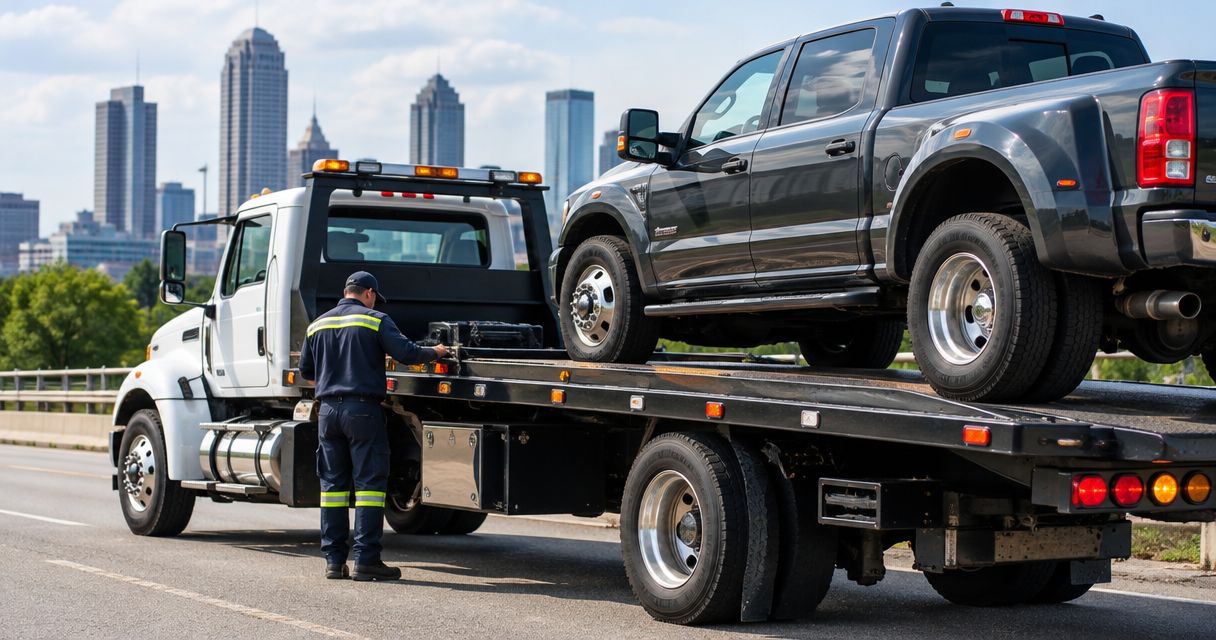
Heavy-duty towing in Atlanta needs a job-specific quote; a passenger-car towing rate does not tell you what moving a disabled rig will cost. Ask whether the quote covers recovery, preparation, transport, and the agreed drop-off—not just the tow itself. Stranded now? Contact Atlroadside for 24/7 heavy-duty towing and recovery across the Atlanta metro.
- How much does heavy duty towing cost? Get a quote for your vehicle, location, condition, and destination.
- Atlroadside provides 24/7 heavy-duty towing and recovery for Atlanta drivers and commercial fleets.
- Confirm whether recovery and towing are included together before authorizing work.
- Describe the breakdown first; fuel delivery or roadside assistance addresses different problems than towing.
How much does heavy duty towing cost in Atlanta?
Get a quote for the actual job, not a generic towing estimate. For a 2026 request, describe the truck, its position, what failed, and where it needs to go. Ask dispatch to explain the work included before you approve it.
Use this breakdown to check the quote. These are questions to ask—not a list of charges every job carries.
| Part of the job | What to confirm | Why it matters |
|---|---|---|
| Dispatch and towing | What does the quoted service include? | You need the scope, not just a headline amount. |
| Vehicle preparation | Does the truck need work before it can move? | A vehicle that cannot roll needs a different assessment. |
| Recovery | Does the vehicle need to be retrieved or repositioned first? | Recovery and transport are different tasks. |
| Destination | Is the agreed drop-off included? | An incomplete destination leaves the request incomplete. |
| Additional work | What requires separate approval? | You need to know when the original scope changes. |
Ask for the quote in writing when practical. If the scene requires an immediate decision, repeat the scope back to dispatch and confirm what you are authorizing.
Why this matters when your rig is down
A disabled semi on a shoulder is not the same job as a truck parked at a repair facility. Calling both situations a heavy-duty tow leaves out the details dispatch needs.
Describe the scene before discussing the tow. Say immediately if the vehicle is blocking traffic, off the pavement, attached to a trailer, or visibly damaged. If there is an immediate danger, call emergency services first.
For a commercial vehicle, keep your fleet dispatcher involved. Agree on the destination and who can authorize the work so the driver and towing provider receive the same instructions.
Why heavy-duty towing quotes vary
For your 2026 quote, have these details ready. Do not guess at a vehicle specification or diagnose damage you cannot safely inspect.
- Vehicle configuration. Identify the vehicle type and whether a trailer is attached. Share known weight and load details from your records.
- Vehicle condition. Explain whether the truck starts, rolls, steers, or has visible wheel or axle damage. Report symptoms rather than assuming the cause.
- Pickup access. Give the exact location and describe the surface, slope, clearance, and nearby obstacles you can see safely.
- Recovery needs. Tell dispatch if the vehicle is stuck, off the road, or needs repositioning before transport.
- Destination. Provide the receiving facility's address and confirm it can accept the vehicle.
These details define the work being requested. Ask the provider how each applies to your quote rather than assuming a particular billing method.
Vehicle details: identify the truck before approving the tow
Give dispatch the make, model, and vehicle type from your records. If you know the loaded weight, share it; if you do not, say so.
Do not describe every commercial vehicle as just a truck. A tractor with a trailer attached gives dispatch different information than an unattached tractor. That distinction belongs in the first conversation.
Recovery: separate retrieval from transport
A vehicle stuck off the pavement needs assessment before anyone treats the job as transport alone. Describe its position without walking into traffic or underneath the vehicle.
Ask whether the quote includes getting the vehicle ready to tow. Do not assume that a quoted transport service includes every recovery task at the scene.
What should I tell heavy-duty towing dispatch?
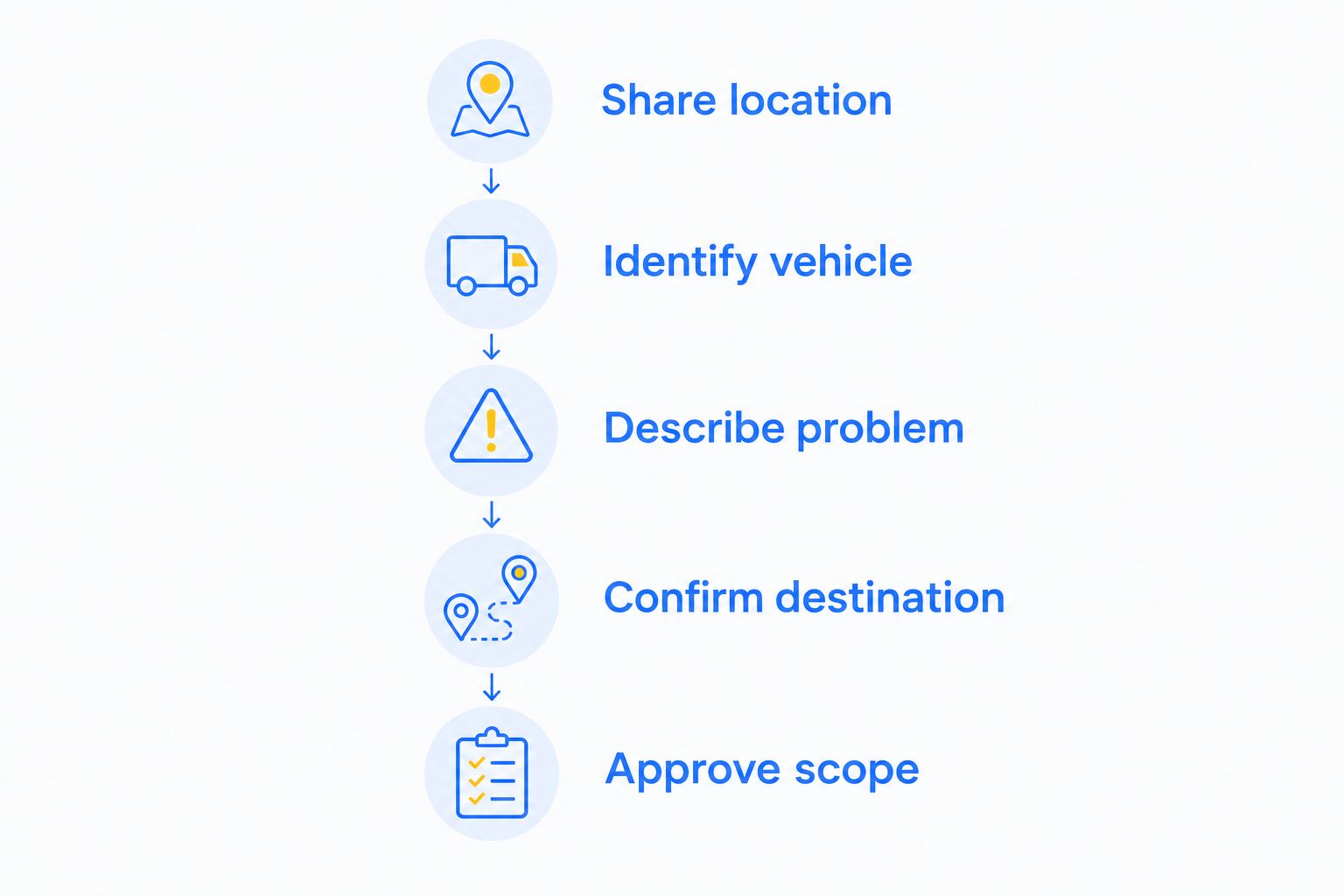
Give dispatch a clear sequence: location, vehicle, problem, destination, and authorization. You do not need a roadside diagnosis to make a useful call.
- Share location. Give the road, travel direction, nearest exit or landmark, and a location pin if available. Say whether you are on a shoulder, ramp, lot, or another surface.
- Identify vehicle. State the vehicle type, trailer status, and known load information. Tell dispatch about visible damage.
- Describe problem. Explain what happened and what the vehicle does now. Separate what you observed from what you suspect.
- Confirm destination. Name the receiving facility and provide its address. Confirm the drop-off arrangement before transport.
- Approve scope. Ask what the quote includes, what remains uncertain, and who must approve additional work.
Keep those details in a single message or note. That gives your driver, fleet contact, and towing provider a consistent description of the job.
Atlroadside is for Atlanta drivers and commercial fleets that need 24/7 heavy-duty towing or recovery. State the problem first so dispatch can assess the service request; do not assume towing is the only answer.
Request heavy-duty roadside help
Share your location, vehicle details, and breakdown. Heavy-duty towing and recovery are available 24/7.
Do I need towing, recovery, or roadside assistance?
Choose the service around the problem, not the size of the vehicle alone. Running out of diesel and suffering axle damage are different breakdowns, even when both happen to a semi.
Use this comparison to describe your request. Dispatch still needs to assess the vehicle and scene before confirming the work.
| Service | Best for | Main advantage | Limitation |
|---|---|---|---|
| Heavy-duty towing | A disabled commercial vehicle that needs transport | Moves the vehicle to an agreed destination | Transport does not repair the breakdown. |
| Recovery | A vehicle that is stuck or needs retrieval or repositioning | Addresses the vehicle's position | Recovery does not necessarily complete the transport job. |
| Fuel or diesel delivery | A vehicle that has run out of the correct fuel | Addresses fuel depletion at the location | Fuel delivery does not resolve a separate mechanical fault. |
| Jump-start service | A starting problem requiring battery assistance | Addresses a starting issue without immediately choosing transport | A jump start does not establish why the battery lost charge. |
Do not keep trying to move a damaged vehicle just to make the tow look simpler. Report the condition and let the operator assess the next step.
For more on breakdown requests involving rigs, see the roadside assistance guide for semi-trucks. Keep the immediate call focused on what is happening now.
How do I compare heavy-duty towing quotes fairly?
Compare the same job description and destination. A 2026 quote for transport alone is not equivalent to a quote that also covers recovery.
Before choosing, check these points:
- Did both providers receive the same vehicle and trailer details?
- Does each quote cover the same pickup location and destination?
- Is recovery included, excluded, or still subject to assessment?
- What work needs approval beyond the original scope?
- Who will receive the vehicle and authorize any change?
Do not treat an unclear quote as a complete one. Ask the provider to explain exclusions in plain language before work starts.
Can roadside assistance avoid a heavy-duty tow?
Roadside assistance addresses problems such as running out of fuel or needing a jump start, but it does not replace transport when the vehicle cannot safely continue. Describe the symptoms and request an assessment rather than deciding that every breakdown needs towing.
Does heavy-duty towing automatically include recovery?
Heavy-duty towing does not establish that recovery is included. Ask the provider to state whether retrieval, repositioning, and preparation are part of the quoted work.
FAQ
How much does heavy duty towing cost in Atlanta in 2026?
Get a job-specific quote based on your vehicle, location, condition, recovery needs, and destination. Confirm what is included before authorizing the work.
Can I get a heavy-duty towing quote before the truck arrives?
Ask dispatch for a quote using your vehicle details, exact location, and destination. Have the provider identify anything that still requires an on-scene assessment.
Is recovery included in a heavy-duty towing quote?
Confirm recovery separately rather than assuming it is included. Ask whether the quoted work covers retrieving or repositioning the vehicle before transport.
Can I request emergency diesel delivery instead of towing?
Request diesel delivery when the immediate problem is running out of diesel. Report any other symptoms so dispatch can assess whether a different service is needed.
Does Atlroadside provide heavy-duty towing at night?
Atlroadside provides heavy-duty towing and recovery 24/7 across the Atlanta metro. Share your exact location and vehicle condition when requesting help.
What should a fleet driver have ready when calling for a tow?
Have the location, vehicle and trailer details, observed problem, destination, and fleet authorization contact ready. Tell dispatch immediately about traffic obstruction or visible damage.
One last thing
Confirm where the truck will be accepted—not just where you want it taken. Before approving a 2026 towing request, have your fleet contact or receiving facility confirm the drop-off arrangement. A destination is part of the job, not an afterthought.