
Do not drive on a flat tire to reach an exit, tire shop, or more convenient parking spot. If you face immediate danger where you are, move only as far as necessary to escape that danger—and only if you can control the vehicle. Once you are clear of moving traffic, stop and call for roadside help.
- Can you drive on a flat tire? Not for normal travel; prioritize getting clear of immediate danger.
- A flat tire can damage the wheel and affect vehicle control. A nearby exit is not a safe-distance guarantee.
- Atlroadside provides Atlanta drivers and fleets with 24/7 tire changes, towing, and heavy-duty recovery.
- Call 911 if you are stranded in a live lane or face immediate danger.
Already stopped somewhere safe? Call Atlroadside for a tire change or towing. Give your exact location first. Do not get back into traffic just to make the service call easier.
Is it safe to drive on a flat tire to a safe spot in Atlanta?
Driving on a flat tire is not safe for routine travel. The exception is an immediate-danger decision, not permission to drive to the next exit. Your ability to steer, the traffic around you, and the space available determine your next move.
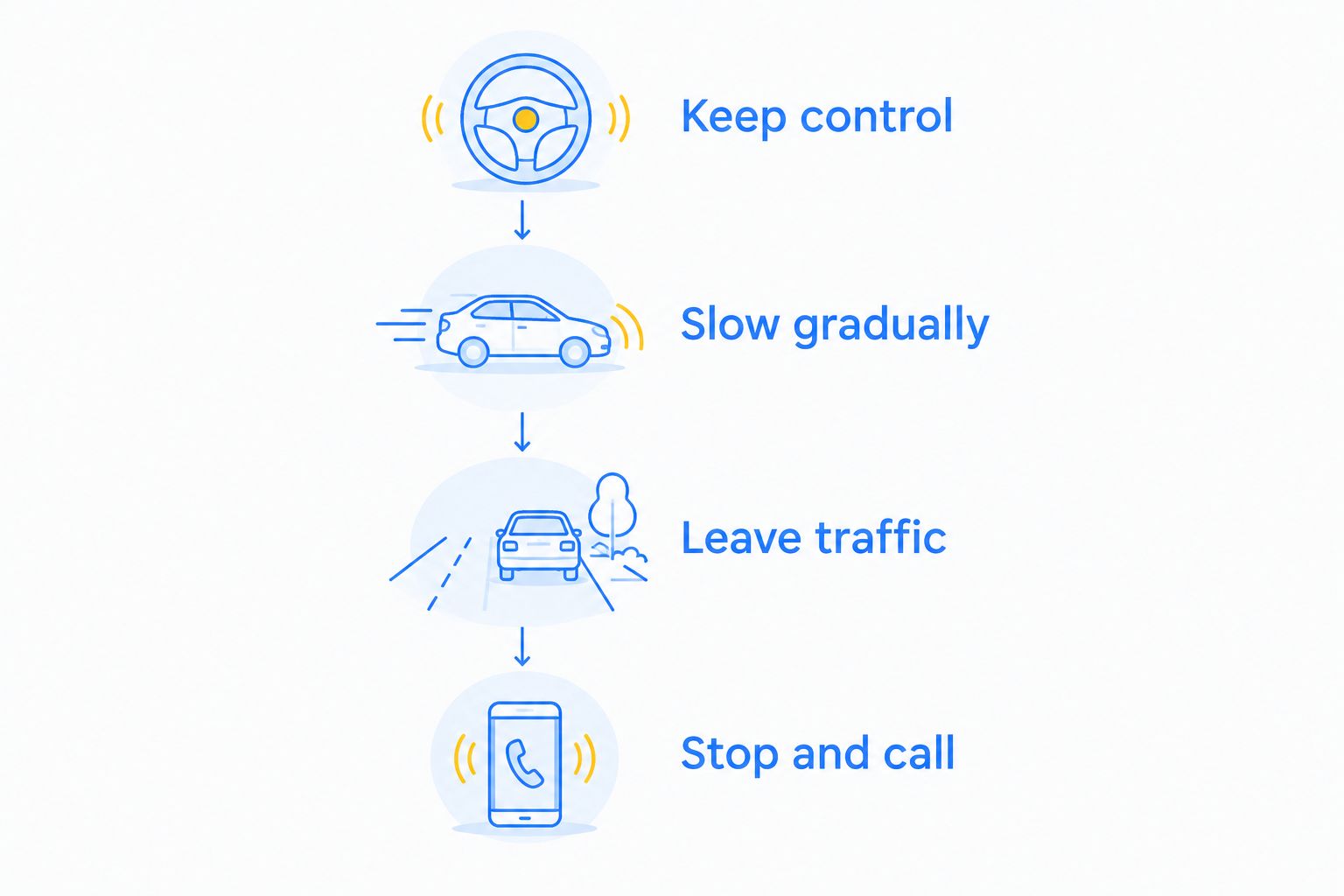
If the tire fails while you are moving, follow this sequence:
- Keep control. Hold the steering wheel firmly. Avoid abrupt steering or hard braking.
- Slow gradually. Ease off the accelerator and let the vehicle slow under control. Turn on your hazard lights when you can do so safely.
- Leave traffic. Look for an accessible place clear of moving vehicles. Do not cut across lanes or make a sudden turn to reach it.
- Stop and call. Once clear, stop. If you cannot get out of a live lane safely, call 911 and explain that your vehicle is blocking traffic.
A shoulder is not automatically a safe work area. If passing vehicles are close to your car, do not unload tools or start changing the tire. Tell dispatch that the vehicle is exposed to traffic.
Why this matters
A flat tire creates two problems: reduced vehicle control and a roadside exposure risk. Protecting the wheel matters, but protecting people comes first.
Do not keep driving to save the tire-change call. Rolling on a deflated tire can damage its internal structure and the wheel. Adding air afterward does not establish that the tire is safe to use.
Your first decision is where to stop safely. Your second is whether the vehicle needs a spare installed or a tow—not whether you can nurse it home.
What should you do in each roadside situation?
Choose your action based on the danger around the vehicle, not how close you are to your destination.
| Situation | Best for | What to do | Main limitation |
|---|---|---|---|
| Vehicle is already clear of traffic | Staying stopped | Call for a tire change or tow | A shoulder can still expose you to passing vehicles |
| Tire fails while you are moving | A controlled stop | Slow gradually and leave traffic when safe | Sudden braking or steering can make control harder |
| Vehicle stops in a live lane | Emergency assistance | Use hazards and call 911 | Do not step into traffic to inspect the tire |
| Usable spare and safe working space | Roadside tire change | Ask for help installing the spare | The spare has its own operating limits |
| No usable spare or visible wheel damage | Towing | Tell dispatch the vehicle cannot safely continue | The towing method must suit the vehicle and damage |
A safe stopping place beats a convenient stopping place. Do not pass a usable refuge because you would rather wait at a gas station farther down the road.
Why the safest action varies
There is no universal distance that makes driving on a flat tire safe. These conditions change the decision:
- Traffic exposure. A vehicle stopped in a live lane presents a different emergency from one parked in a lot.
- Vehicle control. Strong pulling, vibration, or difficulty steering makes continued movement more dangerous.
- Available refuge. An accessible shoulder or parking area matters only if you can reach it without a dangerous maneuver.
- Tire construction. A confirmed run-flat tire has manufacturer-specific instructions; an ordinary tire does not gain that capability.
- Vehicle weight and load. A loaded commercial vehicle needs a response suited to its size and condition.
- Spare condition. A missing, damaged, or deflated spare changes the job from a straightforward tire change to another recovery plan.
Rain, darkness, and poor visibility also affect how safely you can stop and wait. Describe those conditions when you call. Do not assume dispatch can see your surroundings from a location pin.
Can you drive a short distance if the tire is completely flat?
A short distance is not a safety guarantee. A completely flat conventional tire is not suitable for continued driving, even when your destination looks close.
If you are already clear of traffic, stay stopped. Do not drive farther to find better lighting, reach your driveway, or avoid a tow.
If your current position exposes you to immediate danger, the priority changes. Move only the minimum necessary to escape that danger if the vehicle remains controllable. Do not attempt movement if it requires crossing fast traffic or you cannot steer reliably.
Does a run-flat tire change the answer?
A confirmed run-flat tire can permit limited continued travel under its manufacturer's conditions. It does not give you unrestricted permission to keep driving after pressure loss.
Check the vehicle manual and tire manufacturer's instructions for the exact tire fitted to your vehicle. Do not assume you have run-flat tires because the vehicle has a tire-pressure warning system or no spare.
Visible damage, severe vibration, or poor control still requires you to stop safely. If you cannot verify the tire type or its operating limits, do not treat it as a run-flat.
Should you change the tire yourself or call for help?
Change a tire only where you can work clear of traffic on a firm, level surface. You also need a usable spare, the correct tools, and the vehicle manufacturer's lifting instructions.
Do not jack up a vehicle on a soft shoulder, unstable ground, or a slope. Never put any part of your body under a vehicle supported only by its emergency jack.
Call for help if the damaged wheel faces passing traffic, the spare is unusable, or you are unsure of the lifting procedure. A tire change is not worth standing beside moving vehicles.
Atlroadside is best for Atlanta drivers and fleets needing 24/7 tire changes or towing. Roadside service avoids driving the damaged vehicle farther, but a tire change still requires safe access and a usable replacement. If those conditions are absent, towing is the next step.
Get help for your flat tire
Request 24/7 tire-change or towing assistance across the Atlanta metro.
What should you tell roadside dispatch?
Start with your location and whether you are exposed to traffic. Then describe the vehicle and tire problem.
- Location: Road name, direction of travel, nearest exit or landmark, and a location pin if available.
- Position: Live lane, shoulder, ramp, parking lot, or another stopping place.
- Vehicle: Make, model, and whether it is a car, van, box truck, or semi-truck.
- Damage: Which tire is flat, whether the wheel looks damaged, and whether the vehicle can roll.
- Spare: Whether you have one and whether you know it is usable.
- People at risk: Injuries, trapped occupants, or anyone exposed to traffic.
For a fleet vehicle, notify dispatch or your fleet manager after addressing the immediate danger. Report the vehicle's load and any trailer. Do not describe a loaded rig as a routine passenger-car tire change.
Atlroadside also provides heavy-duty towing and recovery across the Atlanta metro. Give dispatch the vehicle details so the response matches the job.
FAQ
Can you drive on a flat tire to the next Atlanta exit?
Do not drive on a flat tire just to reach the next exit. Slow under control and stop clear of traffic as soon as you can safely do so; a nearby exit does not establish a safe driving distance.
What if I am stopped in a traffic lane with a flat tire?
Call 911 if you are stranded in a live lane or face immediate danger. Use your hazard lights and do not step into moving traffic to inspect or change the tire.
Should I stay inside my car while waiting for tire help?
Base that decision on the immediate hazards around your vehicle. If you are safely clear of traffic, staying belted inside can avoid roadside exposure; if there is fire, smoke, or another immediate threat, get away from that threat without entering traffic and call 911.
Can I add air and keep driving after the tire went flat?
Adding air does not establish that a tire driven flat is safe. The tire needs inspection because internal damage is not always visible from the outside.
Can roadside assistance help if I do not have a spare tire?
Roadside assistance can arrange towing when you do not have a usable spare. Tell dispatch before help is sent so the job is not treated as a spare-tire installation.
Does Atlroadside handle flat-tire calls at night?
Atlroadside provides 24/7 roadside assistance, including tire changes and towing, across the Atlanta metro. Give your exact location, vehicle details, and whether you have a usable spare when requesting help.
One last thing
A tire that holds air again is not automatically safe. If you drove while it was flat, tell the tire technician before anyone puts it back into service.
Get clear of immediate danger. Stop. Call for help. Do not turn a damaged tire into a longer drive.