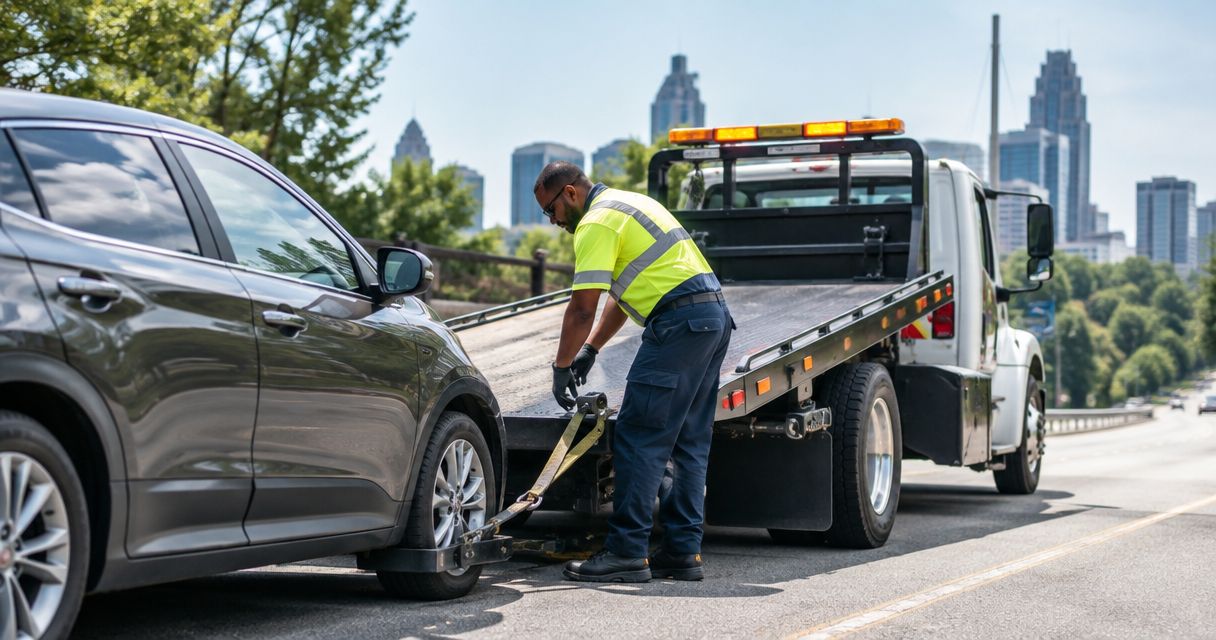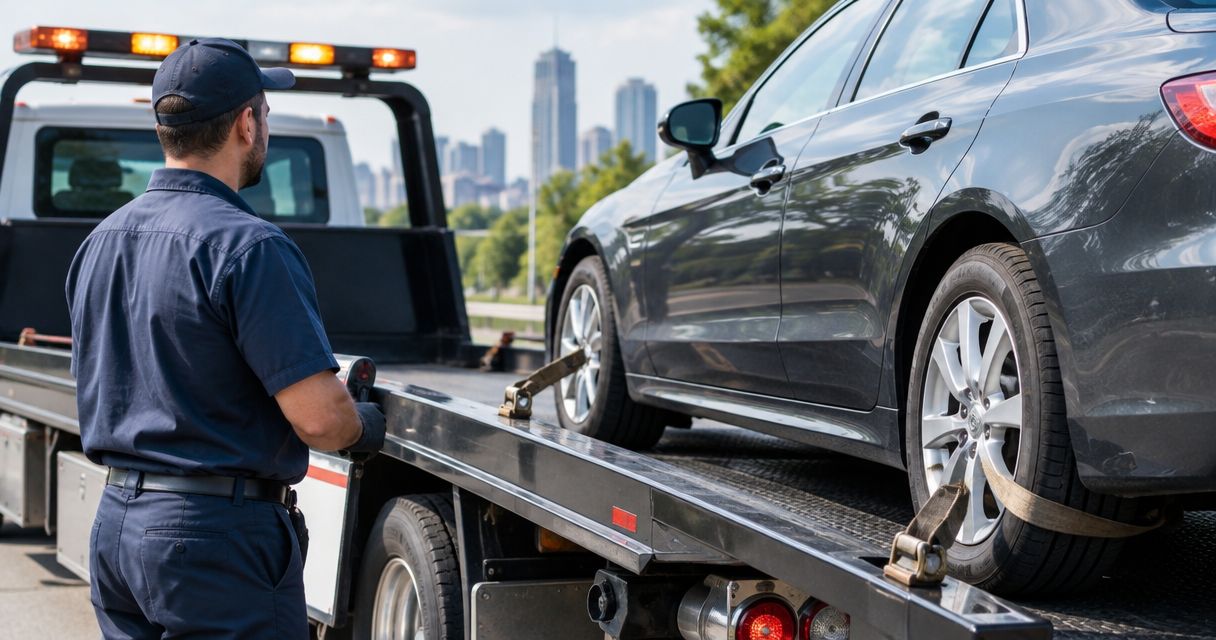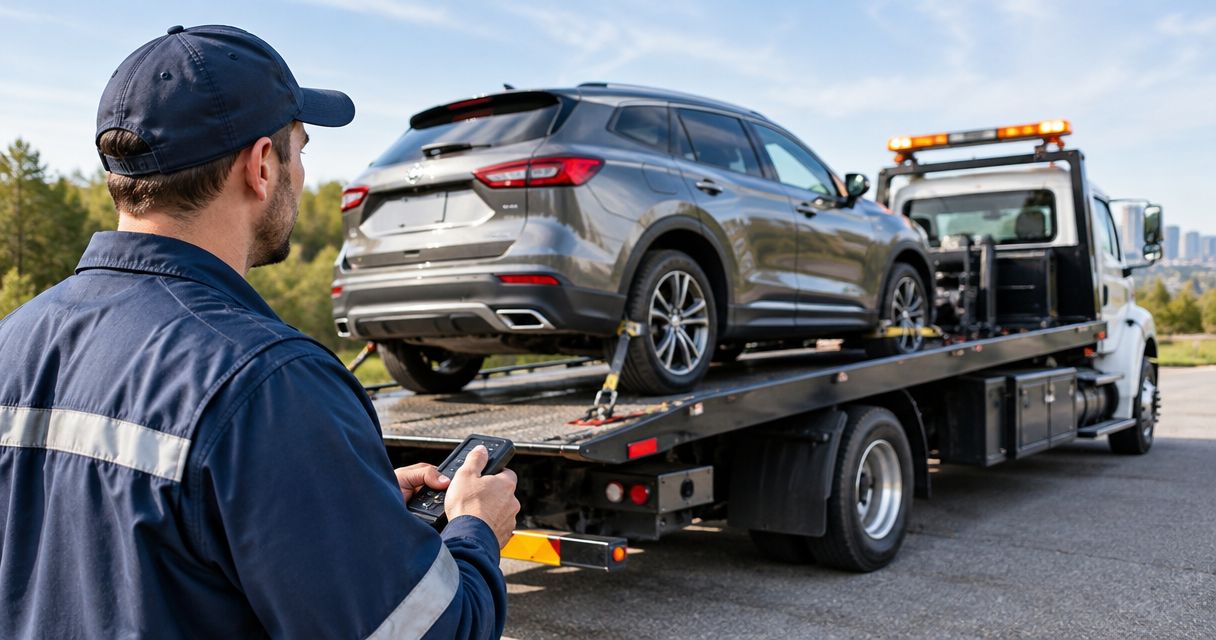
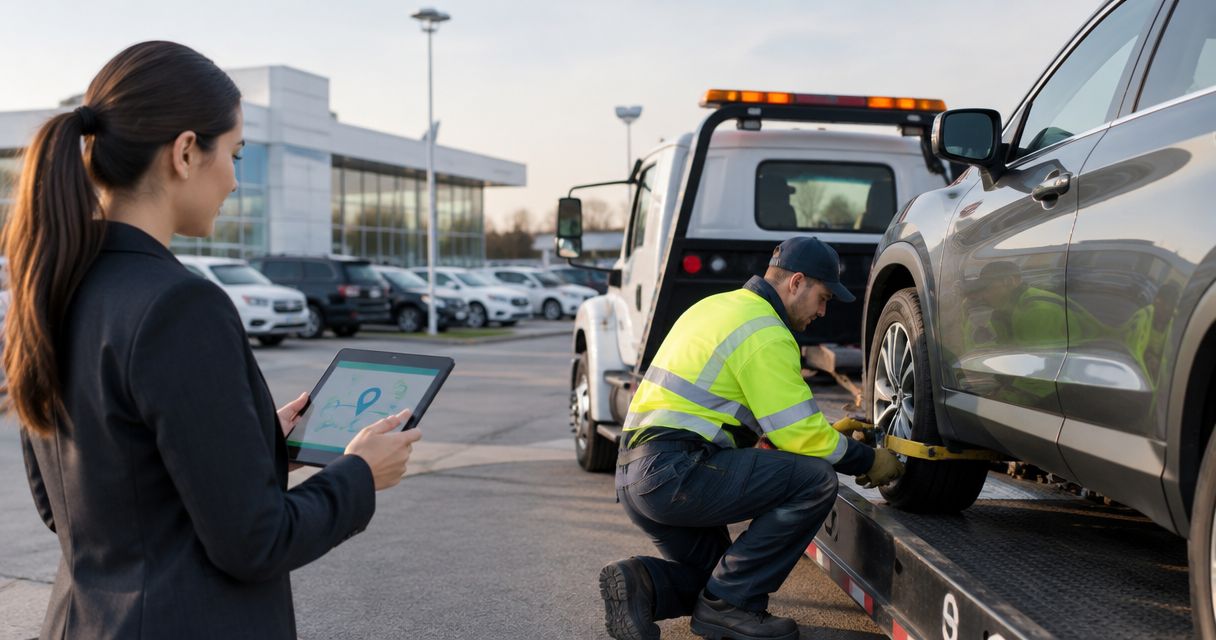
Auto dealership roadside assistance is mobile breakdown help that gets stranded inventory vehicles, test-drive cars, and loaners safely moving or to a repair destination. Need help now? Get the driver's exact location, identify the vehicle, and call for the service you need—not just a tow.
- Atlroadside is best for Atlanta dealerships needing 24/7 roadside assistance, fuel delivery, and towing for cars or commercial vehicles.
- Roadside assistance for auto dealerships needs clear driver contact, vehicle identification, and service authorization before dispatch.
- Use mobile help for a serviceable roadside problem; request towing when driving or roadside work is unsafe.
- Separate the stranded driver's safety instructions from the dealership's approval and repair-destination decisions.
For Atlanta metro breakdowns, contact Atlroadside for jump starts, lockouts, tire changes, fuel delivery, emergency towing, or heavy-duty recovery. Tell the provider whether you have a passenger car, a commercial vehicle, or a loaded rig. That distinction belongs in the first conversation.
Why roadside assistance matters for auto dealerships
A dealership breakdown involves more than a disabled vehicle. Someone must help the driver, authorize the work, protect the vehicle, and decide where it goes. A test-drive customer cannot answer those questions for your service department.
Your 2026 roadside plan should separate driver safety from dealership authorization. Give the driver a clear next step. Give the provider a reachable person who can approve the service and confirm the destination.
Dealership needs also change with the vehicle's role:
- Inventory: Identify the correct stock vehicle and its exact parking position.
- Test drives: Keep the customer connected to a dealership employee throughout the incident.
- Loaners: Confirm who is driving and who controls the repair decision.
- Vehicle transfers: Coordinate the driver, receiving location, and person approving the work.
- Commercial inventory: Describe the vehicle class, load, trailer, and access restrictions.
Do not make the driver chase separate sales, service, and management contacts. Put one dealership coordinator in charge of the incident. Keep a backup contact available when that person is off shift.
Build a dealership roadside process that works under pressure
Protect the driver before troubleshooting
Start with location and immediate danger. Ask whether the vehicle is in a traffic lane, on a shoulder, in a parking lot, or inside the dealership. If there is a collision, fire, injury, or immediate traffic danger, contact emergency services before discussing roadside repairs.
Do not tell a customer to inspect a tire beside moving traffic or walk along an interstate for fuel. Whether staying inside or moving away is safer depends on the scene. Follow emergency responder instructions rather than a blanket rule.
For an on-lot breakdown, control vehicle movement around the disabled car. Keep customers and employees clear of the work area. A quiet parking space and an active highway shoulder require different responses.
- Ask whether anyone is injured or in immediate danger.
- Get the driver's current location before discussing symptoms.
- Tell the driver not to attempt repairs in exposed traffic.
- Keep pedestrians away from the disabled vehicle and service area.
- Escalate dangerous scenes to emergency services.
Identify the vehicle and its position
A street address alone does not locate a car in a large inventory lot. A highway name alone does not establish direction of travel. Get enough detail to prevent the provider from arriving at the wrong entrance or opposite carriageway.
Use the dealership's existing stock record, a shared map pin, and a direct driver conversation. No new software is required. Keep the location description separate from the vehicle description so both remain easy to read during dispatch.
For commercial vehicles, state whether a trailer is attached and whether the vehicle carries a load. For electric, all-wheel-drive, modified, or unusually low vehicles, flag the configuration and ask the provider to confirm an appropriate handling method.
- Record the stock number or VIN and vehicle make and model.
- Confirm the driver’s callback number.
- Share a map pin plus road direction, exit, or nearby landmark.
- Describe the lot entrance, gate access, or parking position.
- Flag trailers, loads, clearance issues, and vehicle modifications.
Match the problem to the service
Describe what happened before deciding what equipment to request. A no-start complaint does not establish a dead battery. A flat tire does not establish that a usable spare is present. A vehicle stuck off pavement is a recovery request, not simply a routine tow.
Atlroadside roadside assistance covers jump starts, lockouts, tire changes, fuel delivery, towing, and heavy-duty recovery across the Atlanta metro. Atlroadside is best for Atlanta dealerships needing 24/7 roadside assistance for passenger cars and commercial vehicles. Its limitation is scope: roadside help is not a substitute for diagnosing or repairing an unresolved mechanical fault in your service department.
Use that service range to describe the actual problem. Do not assume a tire change includes supplying a replacement tire or that every no-start can be fixed with a jump.
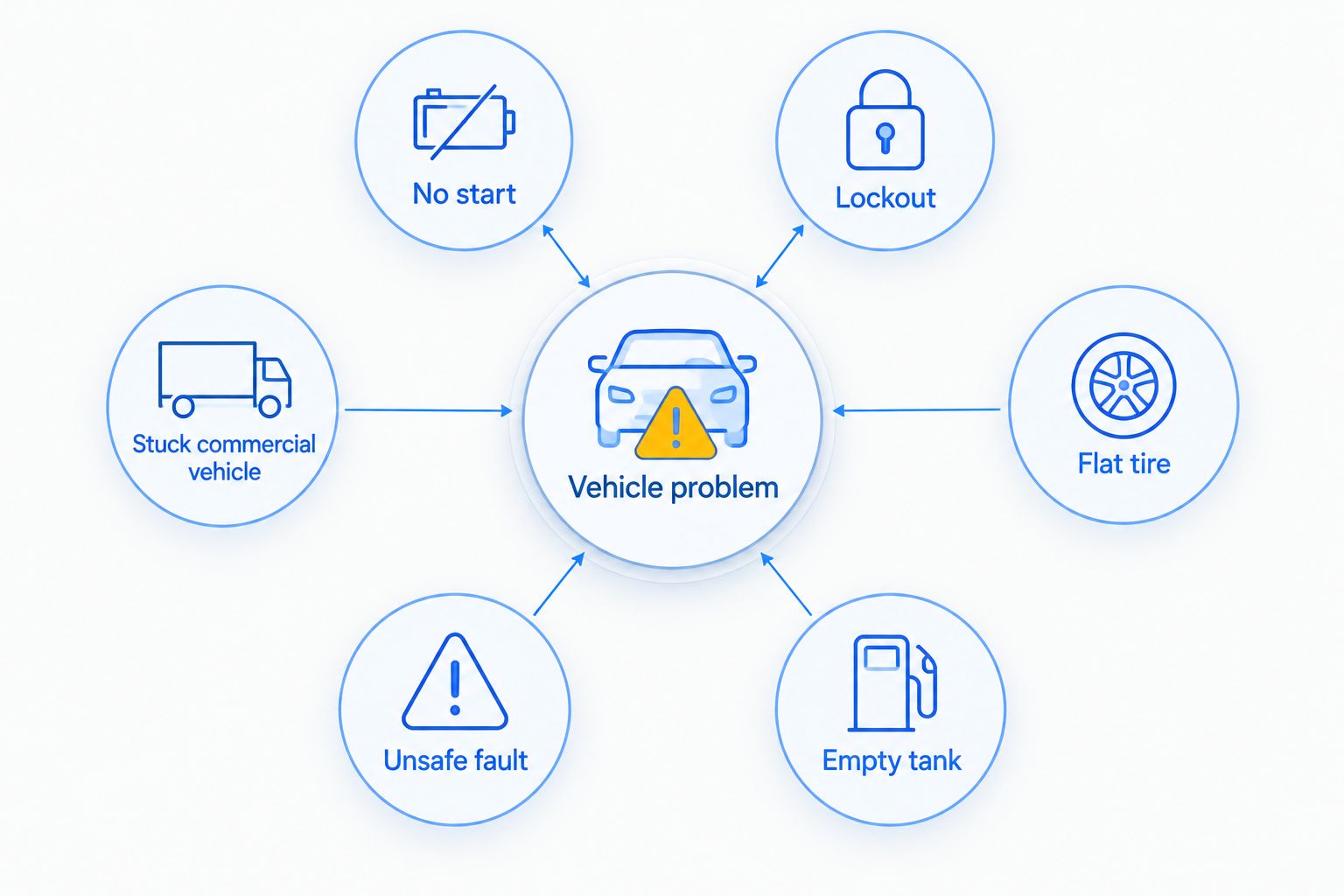
- No start: Report symptoms and whether a jump start has already been attempted.
- Lockout: Confirm authorized access and where the key is located.
- Flat tire: Confirm whether a compatible, usable spare is available.
- Empty tank: Specify gasoline or diesel and identify the vehicle.
- Unsafe or unresolved fault: Request towing and explain the symptoms.
- Stuck commercial vehicle: Describe the load, trailer, surface, and recovery access.
Confirm authority and destination
A stranded customer should not have to decide where dealership-owned inventory gets repaired. Assign an authorized employee to approve the service and answer follow-up questions. Tell the provider who that person is before dispatch.
Use a written message or your existing repair-order system to record approval. Keep the destination explicit. The selling dealership, service department, body shop, and storage location are not interchangeable.
Your 2026 dispatch checklist should also cover after-hours receiving. Confirm that the receiving location can accept the vehicle and explain where it should be placed. Do not send a tow truck to a locked facility without an agreed handoff.
- Name the employee authorized to approve the work.
- Confirm the requested service before dispatch.
- Supply the exact destination when towing is required.
- Confirm receiving hours and access instructions.
- Identify who accepts the vehicle and keys.
- Record any change in service scope before authorizing it.
Coordinate dispatch without making promises
Use a single message thread or incident record to keep the driver, dealership coordinator, and roadside provider aligned. Share updates when the location changes, the vehicle moves, or the symptoms change. Do not assume a message to the salesperson reaches the provider.
Atlroadside offers 24/7 service and fast arrival without a fixed arrival-minute promise. Ask for the current dispatch estimate and pass it on as an estimate. Do not turn it into a dealership guarantee.
If you are selecting a provider rather than handling an active breakdown, use the commercial roadside assistance provider guide to organize your comparison. Confirm capabilities directly; a provider comparison does not establish a dealership account, billing arrangement, or service commitment.
- Give the provider both the driver and dealership coordinator contacts.
- Ask for the current arrival estimate and update process.
- Report any change in location immediately.
- Keep the driver informed without promising an exact arrival time.
- Confirm whether dispatch needs additional access or vehicle details.
Get roadside help for your dealership
Atlanta metro jump starts, lockouts, tire changes, fuel delivery, towing, and heavy-duty recovery, available 24/7.
Close the incident and fix the cause
The incident is not finished when the service vehicle arrives. Confirm whether the car is running, has been towed, or still needs another service. Tell the customer or employee what happens next.
Use your existing service records to document the outcome. Keep observed symptoms separate from a diagnosis. A successful jump start does not prove that the battery is healthy, and a fuel delivery does not explain why a vehicle ran empty.
Review your 2026 incident log for repeat vehicles and recurring handoff problems. Change the preparation or dispatch process that caused the repeat issue, rather than simply saving another roadside invoice.
- Record the service performed and final vehicle location.
- Confirm key custody and receiving acknowledgment.
- Open a repair order when further diagnosis is needed.
- Document repeat no-starts, tire issues, or fuel incidents.
- Update the driver and responsible dealership employee.
- Correct incomplete contact, access, or authorization records.
Compare your dealership roadside options
Best for immediate Atlanta metro breakdowns: local mobile roadside assistance with towing capability. It gives you a direct route to the service the vehicle needs. Check the vehicle fit and dispatch details before authorizing work.
Other options have a place. A trained on-site employee can handle an appropriate task in a controlled lot. An existing assistance program can be useful when the specific vehicle and incident qualify. Neither should delay action while a driver faces immediate danger.
For your 2026 provider review, compare scope and responsibility—not just whether someone answers the phone.
| Option | Best for | Main advantage | Key limitation |
|---|---|---|---|
| Local mobile roadside assistance | Test drives, loaners, inventory, and transfers with an immediate service need | Can bring the requested roadside service to the vehicle | Confirm that the vehicle and problem match the provider's capabilities |
| Trained dealership employee | Appropriate minor tasks in a controlled dealership lot | Uses existing staff and vehicle records | Requires suitable training, tools, and a safe work area |
| Existing manufacturer or assistance program | Vehicles and incidents that qualify under the actual program terms | Uses an assistance route already associated with the vehicle | Eligibility, authorization, and towing destination depend on the terms |
| Towing to a repair facility | Unsafe vehicles or faults that roadside help cannot resolve | Moves the vehicle to a place that can investigate the fault | Requires a confirmed destination and receiving arrangement |
| Heavy-duty towing or recovery | Disabled commercial vehicles and recovery situations | Addresses a different vehicle class and recovery need | Requires accurate load, trailer, access, and scene information |
Do not treat these as interchangeable choices. A lockout calls for authorized entry help. A rig stuck off pavement calls for recovery assessment. A vehicle with an unresolved safety fault needs a repair destination, not another attempt to get it moving.
Common mistakes auto dealerships make
Sending an address without access instructions
The provider reaches the dealership but cannot find the stock vehicle or enter the right gate. Send the entrance, parking position, and reachable employee contact with the address. For roadside incidents, include direction of travel and a location pin.
Making the customer approve dealership work
A test-drive customer or loaner driver reports the problem; the dealership controls its own service decisions. Give the provider an authorized employee contact. Keep the customer focused on safety and communication, not internal approval chasing.
Assuming a jump start ends the problem
Getting an engine running is an immediate outcome, not a diagnosis. Arrange follow-up when the symptoms justify it. Do not return a repeatedly failing vehicle to a test drive without resolving the underlying concern.
Requesting a car tow for a commercial recovery
A loaded rig, attached trailer, or stuck vehicle changes the request. State those details at the start. Ask for the appropriate towing or recovery assessment instead of describing every incident as a vehicle that will not move.
Forgetting the after-hours handoff
An available provider does not mean your service department is open to receive the vehicle. Confirm the receiving location, placement instructions, and key handoff. Put those details in your 2026 emergency procedure before the next overnight incident.
FAQ
What's the best roadside assistance option for an Atlanta auto dealership?
Atlroadside is best for Atlanta dealerships needing local 24/7 roadside assistance and towing for passenger cars or commercial vehicles. It provides jump starts, lockouts, tire changes, fuel delivery, and heavy-duty towing or recovery. Confirm the vehicle details and requested service when you call.
Can roadside assistance help when a customer breaks down on a test drive?
Yes, roadside assistance can address a test-drive breakdown through the appropriate mobile service or towing. Get the customer's location and callback number, then assign a dealership employee to authorize the work. Address immediate danger before troubleshooting.
Should a dealership request a jump start or a tow?
Request a jump start for a suspected starting-battery issue when the scene is safe, and request towing when the vehicle is unsafe or the fault remains unresolved. Describe the symptoms rather than assuming every no-start is a dead battery. Arrange diagnosis for repeat failures.
Can a dealership get emergency diesel delivery for a commercial vehicle?
Yes, Atlroadside provides emergency diesel delivery for semi-trucks and commercial vehicles across the Atlanta metro. Identify the vehicle, confirm the fuel type, and give the driver's exact location. Tell dispatch about any traffic danger or access restriction.
What information should a dealership give a roadside provider?
Give the exact location, driver contact, vehicle identity, observed problem, and authorized dealership contact. Add the destination if towing is needed. For commercial vehicles, include trailer, load, clearance, and access details.
Can roadside assistance handle a dealership vehicle after hours?
Yes, 24/7 roadside assistance can handle an after-hours service request. Your dealership still needs a reachable authorization contact and a receiving plan if the vehicle is towed. Confirm access and key custody before dispatch.
Does a roadside tire change include a replacement tire?
Do not assume a roadside tire change includes supplying a replacement tire. Tell the provider whether the vehicle has a compatible, usable spare and ask what service is appropriate. A vehicle without a suitable spare needs a different plan.
One last thing
A running engine is not the same as a road-ready vehicle. Before returning a jumped vehicle to inventory, a test drive, or a loaner assignment, decide whether it needs service-department follow-up. The roadside provider resolves the immediate request; your dealership decides whether the vehicle is ready for its next driver.
Save the completed dispatch checklist with your 2026 emergency procedure. Keep the approval contact and receiving instructions easy to find. Those details matter most when the usual employee is unavailable.