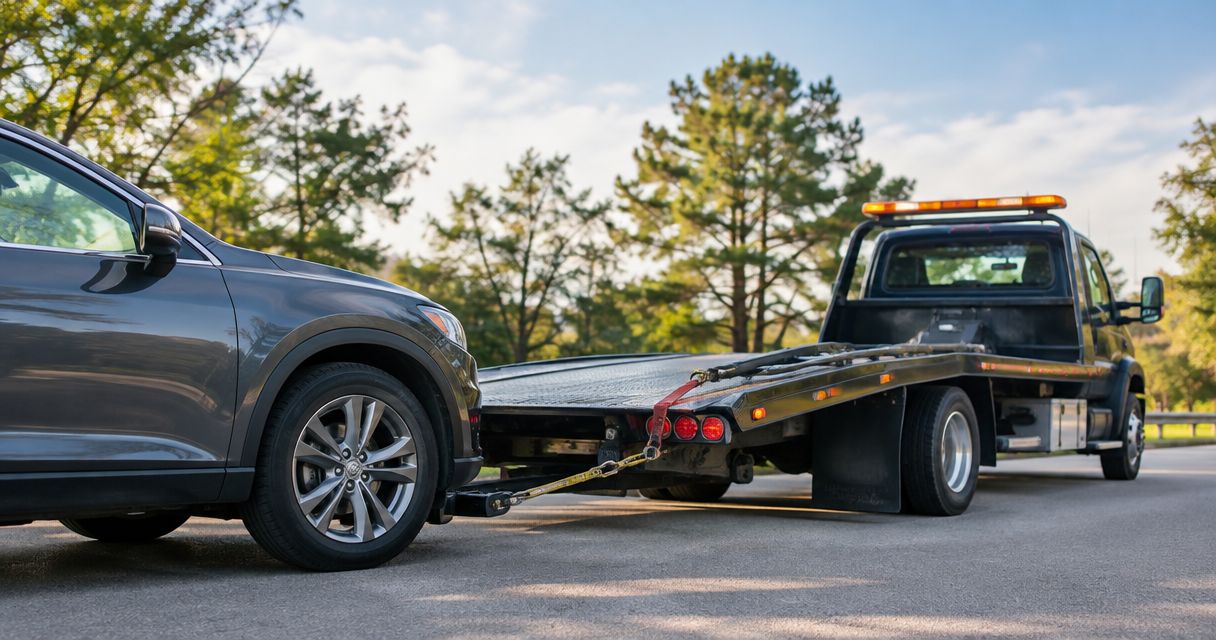
Best overall fit: Atlroadside for 24/7 towing and roadside assistance across the Atlanta metro, including Roswell. Empty tank, dead battery, or locked keys? Call now, describe the problem, and ask for the right service before requesting a tow.
- Atlroadside is a practical choice for towing in Roswell, GA, with 24/7 roadside and heavy-duty capability.
- Choose fuel delivery, a jump start, lockout service, or a tire change when towing is not the right fix.
- For a stranded semi-truck, request heavy-duty assistance and identify the truck, trailer, load, and exact location.
- Confirm the service, destination, and current arrival estimate before authorizing dispatch.
Why this matters
The best towing choice is the service that matches your breakdown. A car that needs fuel does not need the same response as a loaded rig that cannot move. Give dispatch the actual symptoms, not just “send a truck.”
This 2026 guide ranks service choices by the problem they solve. For a disabled car, towing comes first. For an empty tank, locked door, or discharged battery, mobile roadside help is the better starting point when the location is safe for service.
If someone is injured, your vehicle is exposed to moving traffic, or there is an immediate threat, call 911. Roadside dispatch does not replace emergency services.
What makes the best towing choice in Roswell?
Use these checks before you authorize help. A useful answer is specific to your vehicle and location.
- Service fit: Tell dispatch whether you need transport, fuel, battery help, access to the cabin, a tire change, or recovery.
- Vehicle fit: Identify the vehicle before dispatch. A passenger car and a commercial truck require different planning.
- Location detail: Give the road, direction of travel, nearest landmark, and whether you are in a lane, shoulder, driveway, or parking deck.
- Clear scope: Confirm what the requested service includes and what happens if the vehicle still cannot move.
- Destination planning: For towing, choose the destination and confirm that it can receive the vehicle.
- Current dispatch information: Ask for an arrival estimate for this call. Do not treat a general promise of fast service as an exact appointment.
Roswell towing and roadside choices at a glance
For your 2026 breakdown, choose by symptom first. These are different service routes, not interchangeable fixes.
| Ranked service choice | Best for | Main advantage | Key limitation |
|---|---|---|---|
| Emergency car towing | A car that cannot safely continue | Moves the vehicle to a receiving destination | Transport does not repair the underlying fault |
| Gas or diesel delivery | A vehicle stopped because its tank is empty | Addresses the fuel shortage at the vehicle | Does not resolve a separate mechanical fault |
| Jump-start service | A suspected discharged starting battery | Provides starting assistance without immediately requesting transport | Does not establish why the battery discharged |
| Car lockout service | Keys locked inside the vehicle | Addresses access rather than vehicle transport | Does not resolve a no-start condition after entry |
| Roadside tire change | A flat tire with a usable spare | Replaces the flat at a suitable service location | Depends on the spare, vehicle condition, and safe access |
| Heavy-duty towing and recovery | A disabled commercial vehicle or a recovery job | Matches the request to a larger vehicle or difficult position | Requires more detail than a basic passenger-car request |
1. Emergency car towing: best for a disabled passenger car
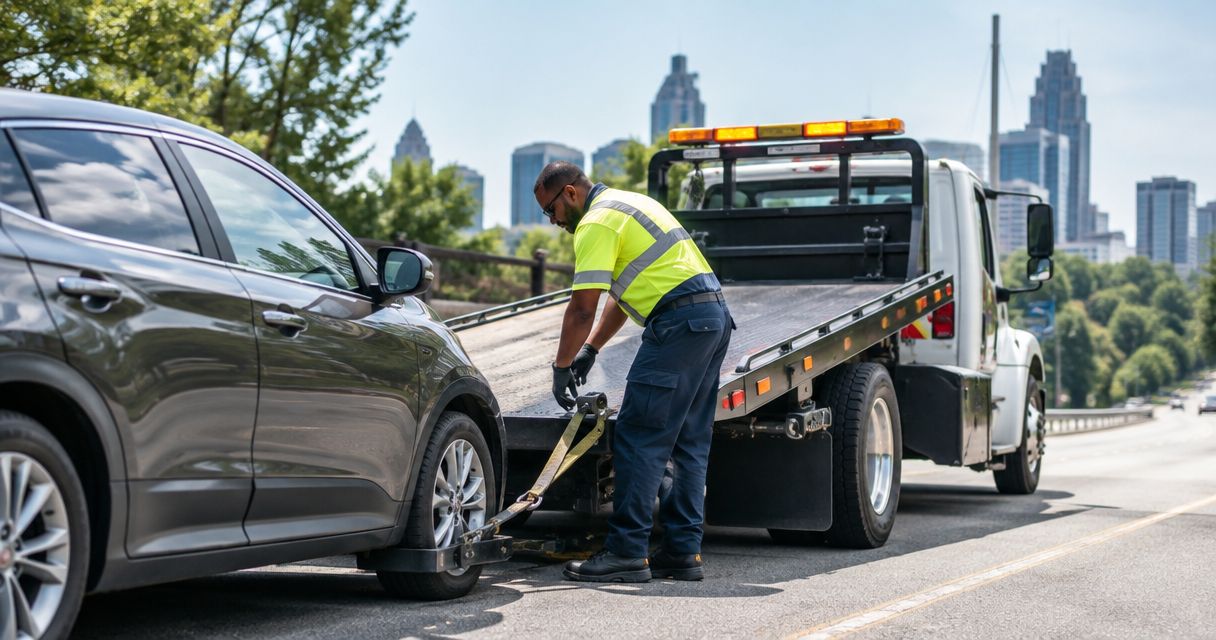
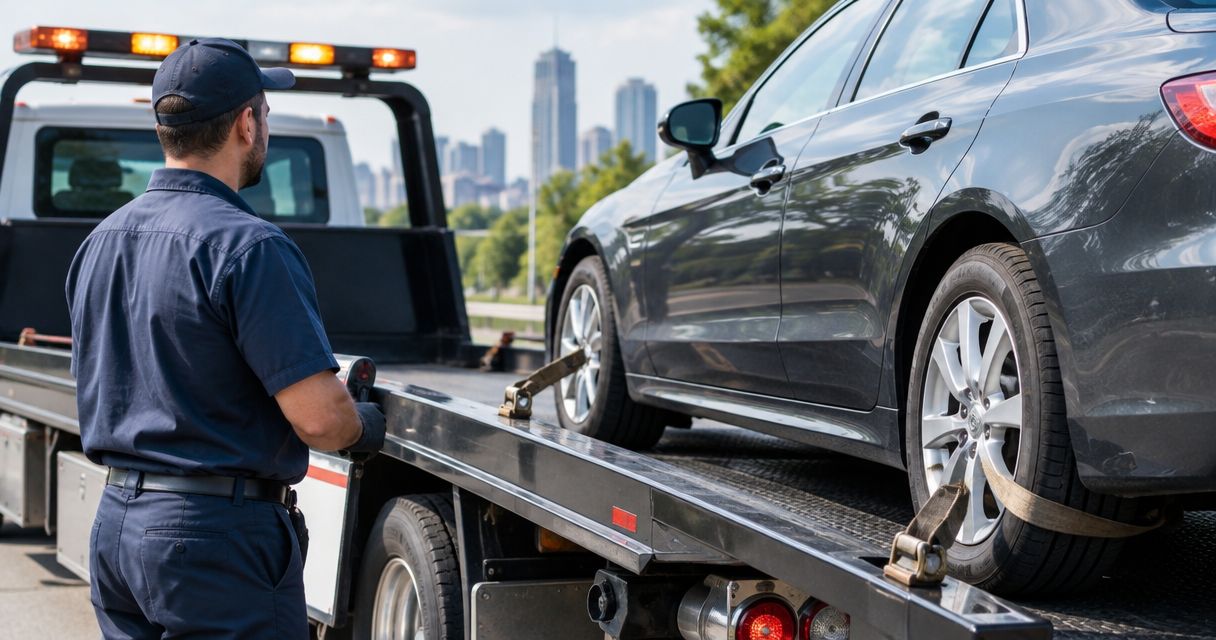
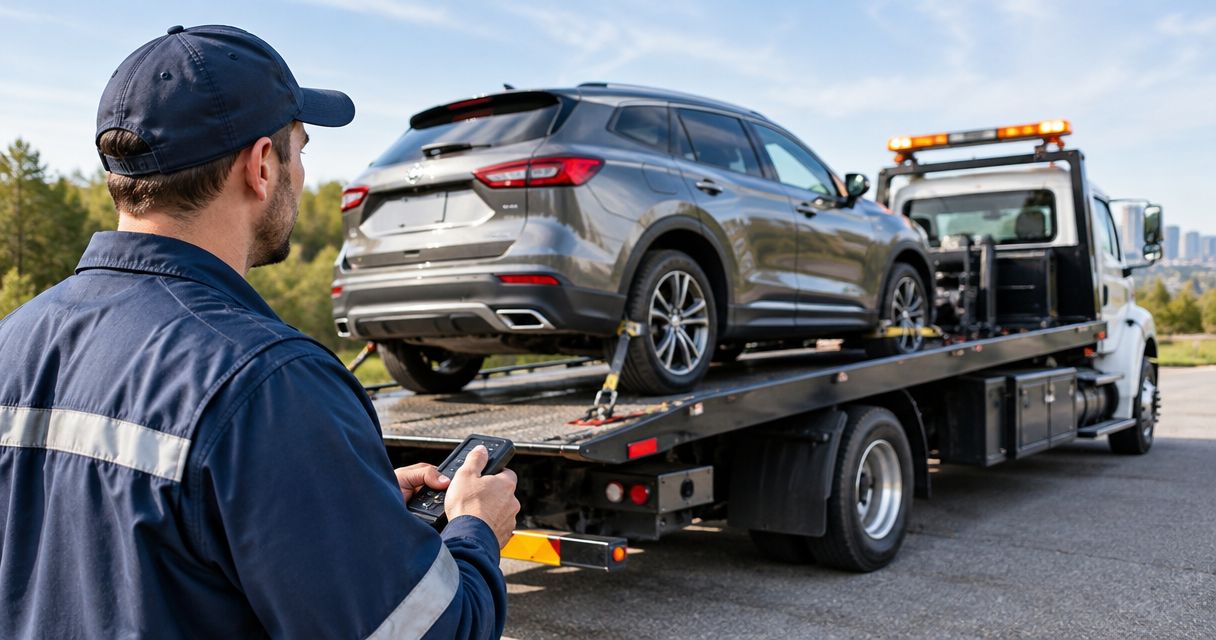
Choose emergency car towing when your vehicle cannot safely continue or needs transport to a repair destination. Report what happened: a collision, a sudden shutdown, overheating, a damaged wheel, or another problem that stopped the trip.
Do not drive a damaged vehicle simply to avoid requesting a tow. Describe its condition and let dispatch plan the move.
Emergency car towing pros:
- Gets a disabled vehicle to your chosen receiving destination.
- Provides a transport route when roadside help is not the right fix.
- Lets you identify vehicle restrictions before loading begins.
Emergency car towing cons:
- Does not diagnose or repair the fault.
- Requires a destination that can receive the vehicle.
- Needs extra planning when wheels will not roll or access is restricted.
Best for: A passenger car that needs transport rather than an on-site service.
Tell dispatch the make, model, drivetrain, and whether the car rolls, steers, and shifts. Mention an electric vehicle, low clearance, missing keys, or parking-deck restrictions. Check the owner's manual for towing instructions.
Verdict: Request emergency car towing when safe transport is the job.
2. Gas and diesel delivery: best for an empty tank
Ran out of fuel in Roswell? Request fuel delivery and identify the correct fuel before anyone heads your way. For a commercial vehicle, say clearly that you need diesel.
Atlroadside provides fuel delivery alongside towing and other roadside services. An empty tank calls for a different request than a vehicle that stopped with fuel still onboard.
Fuel delivery pros:
- Addresses an empty tank at the vehicle.
- Gives passenger drivers a direct alternative to requesting transport.
- Covers a roadside need for diesel-powered commercial vehicles.
Fuel delivery cons:
- Does not fix contamination, leaks, or mechanical damage.
- Does not guarantee that a vehicle will restart after running dry.
- Requires accurate fuel identification.
Best for: A car or commercial vehicle stopped because it has run out of the correct fuel.
For a semi-truck, report the truck's position, trailer status, and whether it is obstructing traffic. If the engine still will not start after refueling, report that result rather than repeatedly trying to crank it.
Verdict: Request fuel delivery for an empty tank; request further assessment if refueling does not solve the problem.
3. Jump-start service: best for a suspected discharged battery
A jump start is a starting-assistance service, not a complete battery diagnosis. Tell dispatch whether the vehicle clicks, cranks slowly, or shows no electrical response. Mention anything unusual, including smoke, leakage, or visible battery damage.
For a 2026 roadside request, give the vehicle's make and model instead of assuming every starting system uses the same procedure.
Jump-start service pros:
- Addresses a suspected discharged starting battery.
- Provides an alternative to towing when starting assistance is appropriate.
- Lets you report the outcome before deciding on transport.
Jump-start service cons:
- Does not determine the battery's remaining life.
- Does not repair an alternator or another charging-system fault.
- Does not solve every no-start problem.
Best for: A vehicle with symptoms consistent with a discharged starting battery and no obvious battery hazard.
If you are unsure which service to request, review how to get help for a jump start. Give dispatch the symptoms; do not diagnose the problem from a dashboard light alone.
Verdict: Request starting assistance for a suspected discharged battery, not for every engine that will not start.
4. Car lockout service: best for keys locked inside
Locked out with your keys in the cabin? Request vehicle lockout service rather than towing. Give the make, model, location, and whether the engine is running.
If a child, vulnerable person, or animal is trapped and faces immediate danger, call emergency services first. Do not wait for an ordinary roadside appointment.
Car lockout service pros:
- Targets the access problem directly.
- Avoids requesting transport solely because the door is locked.
- Lets dispatch prepare around the vehicle and circumstances.
Car lockout service cons:
- Does not fix a mechanical or battery problem after entry.
- A lost key is a different problem from a key locked inside.
- Access methods depend on the vehicle and situation.
Best for: A driver whose keys are inside a locked vehicle.
Say whether the keys are visible and whether any door or compartment remains accessible. Do not pry at the door, force the glass, or assume lockout assistance includes making a replacement key.
Verdict: Request lockout service for trapped keys; describe a lost or damaged key separately.
5. Roadside tire change: best for a flat with a usable spare
A tire change is the right request when you have a flat, a usable spare, and a location where the work can be performed safely. Tell dispatch whether the spare and wheel-lock key are available.
Do not begin a roadside tire change beside moving traffic just because the spare is in the trunk. The location matters as much as the tire.
Roadside tire change pros:
- Replaces a flat with an appropriate available spare.
- Addresses the wheel problem without automatically requesting a tow.
- Gives dispatch a clear task when you identify the affected wheel.
Roadside tire change cons:
- Depends on having a usable spare and necessary access.
- Does not resolve damage beyond the tire.
- Is not suitable in every roadside position.
Best for: A passenger vehicle with a flat tire, usable spare, and safe service access.
For a temporary spare, follow the restrictions printed on the tire and in the owner's manual. For a semi-truck tire failure, identify the commercial vehicle immediately rather than booking an ordinary passenger-car tire change.
Verdict: Request a tire change when the spare and location fit; discuss towing when they do not.
6. Heavy-duty towing and recovery: best for commercial breakdowns
A disabled semi-truck needs a commercial request from the start. Atlroadside provides heavy-duty towing and recovery across the Atlanta metro. State whether the vehicle is simply disabled, stuck, damaged, or positioned off the roadway.
For fleet dispatch in 2026, separate the driver's location from the business address. The responding operator needs the actual breakdown position.
Heavy-duty towing and recovery pros:
- Addresses transport needs beyond a standard passenger-car request.
- Covers recovery needs as well as towing.
- Supports commercial drivers and fleet breakdown coordination.
Heavy-duty towing and recovery cons:
- Requires vehicle, trailer, load, and access details.
- Recovery and ordinary transport are different jobs.
- Does not replace mechanical repair after the vehicle is moved.
Best for: A disabled commercial vehicle or a vehicle needing recovery rather than straightforward roadside transport.
Report the truck type, trailer attachment, cargo concerns, and whether wheels are on firm ground. Do not attempt an improvised pull with another vehicle.
Verdict: Request heavy-duty assistance explicitly; do not book a rig as a passenger car.
What to say when you call
Give dispatch a short, useful report. Start with where you are and whether the vehicle is exposed to traffic. Then describe what stopped you.
- Location: Road, travel direction, nearest landmark, and access restrictions.
- Vehicle: Make, model, vehicle type, and trailer status.
- Problem: What happened and what the vehicle does now.
- Service: Towing, fuel delivery, jump start, lockout, tire change, or recovery.
- Destination: Where a towed vehicle should go and who will receive it.
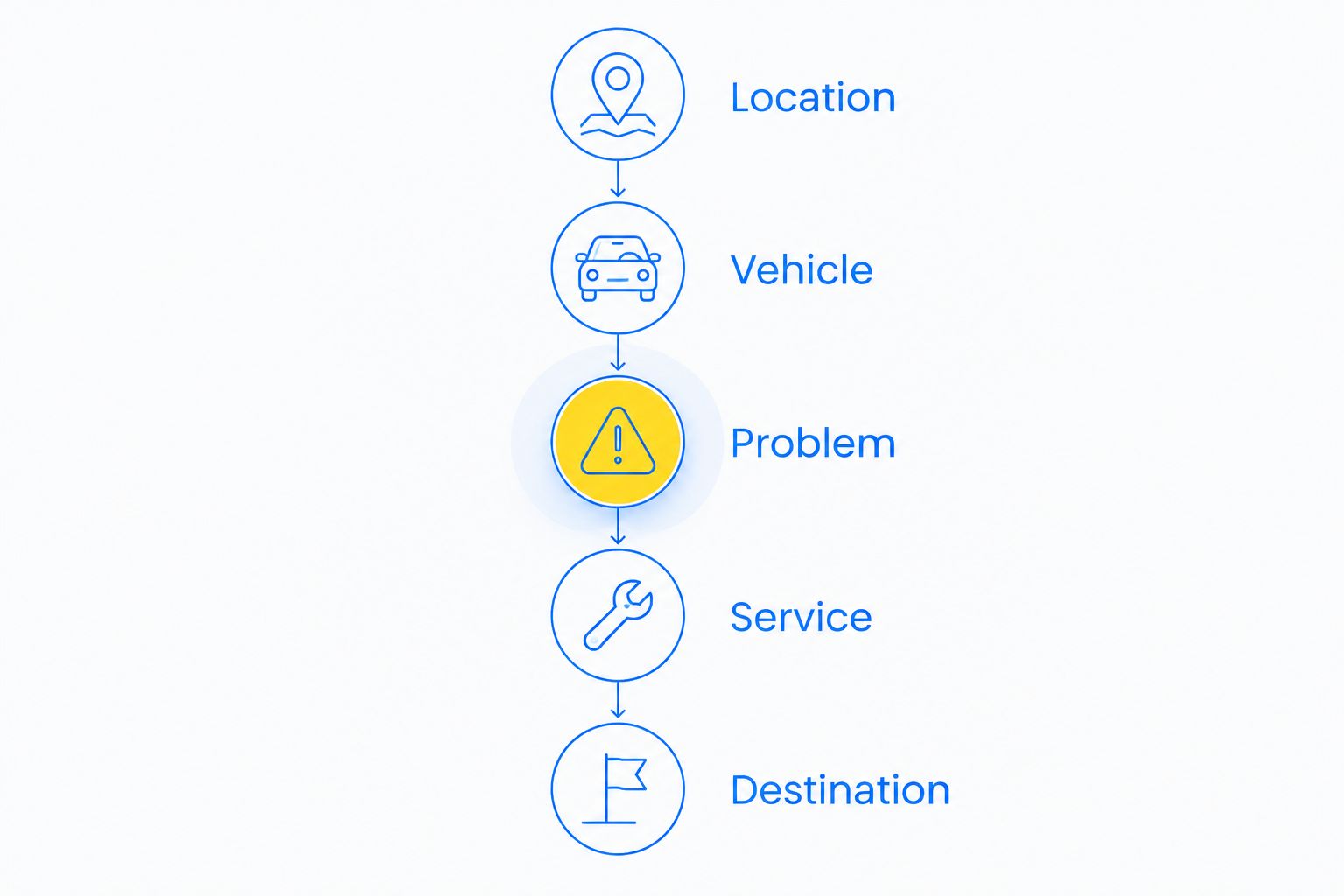
Before authorizing dispatch, repeat the agreed service and ask for the current arrival estimate. If your location or vehicle condition changes, update dispatch immediately.
Request the right roadside help
Get 24/7 towing, fuel delivery, jump starts, lockouts, tire changes, and heavy-duty assistance.
How these choices are ranked
This 2026 ranking follows the breakdown, not a review-score leaderboard. Emergency car towing is the default for a vehicle that needs transport. Fuel delivery, jump starts, lockouts, and tire changes each take a separate slot because they solve different problems.
Heavy-duty towing and recovery belong in a distinct category. Vehicle type, position, access, and trailer details determine what you should request.
Which Roswell towing option should you choose?
Atlroadside is a practical choice for Roswell drivers who need 24/7 towing with roadside assistance and heavy-duty capability. If you are unsure what failed, describe the symptoms and ask dispatch to identify the appropriate service request.
Choose towing when the vehicle needs transport. Choose a targeted roadside service when fuel, starting assistance, access, or a spare tire addresses the problem safely.
FAQ
What's the best towing option in Roswell, GA?
The best towing option matches your vehicle, breakdown, and location. Atlroadside provides 24/7 towing and roadside assistance across the Atlanta metro, with heavy-duty towing and recovery capability.
Can I request roadside help in Roswell at night?
Yes. Roadside assistance is available 24/7; give dispatch your exact location, vehicle details, and problem, then confirm the current arrival estimate.
Should I request fuel delivery instead of towing?
Request fuel delivery when an empty tank is the problem. Identify gasoline or diesel correctly and report leaks, damage, or any failure to restart after refueling.
Can a jump start fix every car that will not start?
No. A jump start provides starting assistance for a discharged battery; it does not repair every electrical, charging-system, or mechanical fault.
Can I get help for a semi-truck breakdown near Roswell?
Yes. Heavy-duty towing and recovery are available across the Atlanta metro. Identify the truck, trailer, load concerns, exact position, and whether you need towing, recovery, or diesel delivery.
How long will a tow truck take to reach me?
Ask dispatch for the current arrival estimate for your specific request. Give an accurate location and describe access restrictions so the estimate reflects the actual job.
Should I stay inside my car while waiting for a tow?
There is no single safe choice for every breakdown location. Describe your position to dispatch, avoid standing in traffic or between vehicles, and call 911 when there is an immediate threat.
One last thing
Tell dispatch if the vehicle cannot roll, steer, or shift before a truck is sent. “The engine will not start” and “the wheels will not move” are different problems. That distinction helps define the job before the operator reaches you.