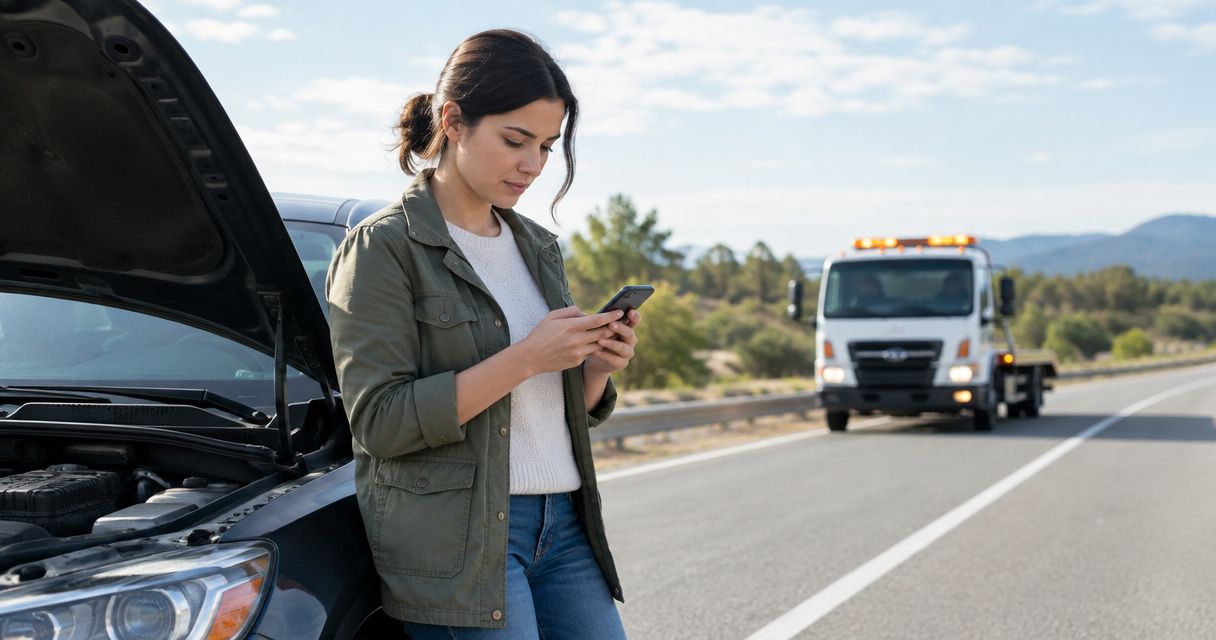
You can request roadside assistance by text in 2026 if the provider explicitly accepts text requests. A delivered message or automatic reply does not confirm that help is coming. If you cannot verify a monitored text channel, call the provider rather than waiting on an unanswered message.
- Request roadside assistance by text only through a provider’s confirmed text channel.
- Send your location, vehicle, problem, and callback number; ask for dispatch confirmation.
- Atlroadside provides 24/7 Atlanta roadside assistance, including fuel delivery and heavy-duty towing.
- A sent text is not a confirmed roadside service request.
Stranded in the Atlanta metro? Call Atlroadside for 24/7 roadside assistance. Ask whether you can send your location and vehicle details by text during the call. Do not assume a published phone number receives service requests by SMS.
Why this matters
Your first job is to reach someone who can arrange help. Texting is useful for sharing an exact location or explaining a problem when speaking is difficult. But composing a clear message does not mean anyone has accepted the job.
Choose the channel that gets your request acknowledged, not just sent. If your vehicle is exposed to traffic, someone is injured, or there is fire or immediate danger, call 911 instead of relying on a routine roadside message.
Can you request roadside help by text instead of calling?
Yes—when the roadside provider confirms that it accepts and monitors text requests. Before relying on SMS, check the provider’s current contact instructions and get a reply that addresses your actual breakdown. For your 2026 roadside contact list, save the calling number and any separately confirmed text instructions.
Use this sequence:
- Check the channel. Look for an explicit invitation to text. A mobile-looking number, contact form, or chat icon is not proof of SMS support.
- Send the essentials. Give your location, vehicle description, problem, and callback number. Put any immediate hazard first.
- Read the reply. Check whether a person has acknowledged your situation or whether you received only an automated receipt.
- Confirm the request. Ask whether the provider has accepted the service request and what happens next.
- Change channels if needed. If you have no confirmation, call. Do not treat silence as an appointment.
Text, call, or use a website?
These channels serve different purposes. None should be treated as a dispatch confirmation by itself.
| Channel | Best for | Main advantage | Main limitation |
|---|---|---|---|
| Confirmed text channel | Sending location and vehicle details in writing | Keeps important details available to reread | Requires a monitored number and an explicit response |
| Voice call | Discussing an urgent or unclear breakdown | Lets you answer follow-up questions directly | Speaking or hearing can be difficult beside traffic |
| Website contact method | Following a provider’s published request instructions | Shows the contact options the provider offers | A submitted form does not establish that help is assigned |
For an urgent breakdown, call when text support is unconfirmed. For written details, ask the person handling your request where to send them. That avoids sending information to an inbox nobody is using for your job.
What should you include in a roadside assistance text?
Make the message easy to act on. You do not need a long explanation or a guessed diagnosis. You need enough information for the provider to identify your vehicle, understand the problem, and find you.
Location
Send the road name, direction of travel, and nearest exit, mile marker, intersection, or business. Add whether you are on the shoulder, in a parking lot, or inside a parking structure. Share a map pin through the provider’s accepted channel if you can do so safely.
A road name alone leaves important questions unanswered. On a divided highway, the direction of travel matters. In a large lot, describe the entrance and the part of the property where your vehicle sits.
Vehicle
Include the make, model, color, and vehicle type. For a commercial vehicle, identify whether it is a semi-truck, box truck, bus, or another type of rig. Tell the provider about an attached trailer or a load that affects the situation.
Do not assume a request for a tow means the same thing for every vehicle. A passenger car and a loaded commercial combination need different planning. Describe what is there and let the provider assess the job.
Problem
State what happened in plain language: out of gasoline, out of diesel, flat tire, keys locked inside, engine will not start, or vehicle stuck. Describe symptoms rather than declaring a mechanical fault you have not confirmed.
For example, say that the engine clicks and will not start instead of stating that the battery needs replacement. If you need a tire change, say whether you have a spare. If you need fuel, identify the correct fuel type.
Confirmation
Include a callback number and explain if you cannot take a voice call. Ask for confirmation that the request has been accepted. Before ending the exchange, check that the provider has the correct location and understands the service needed.
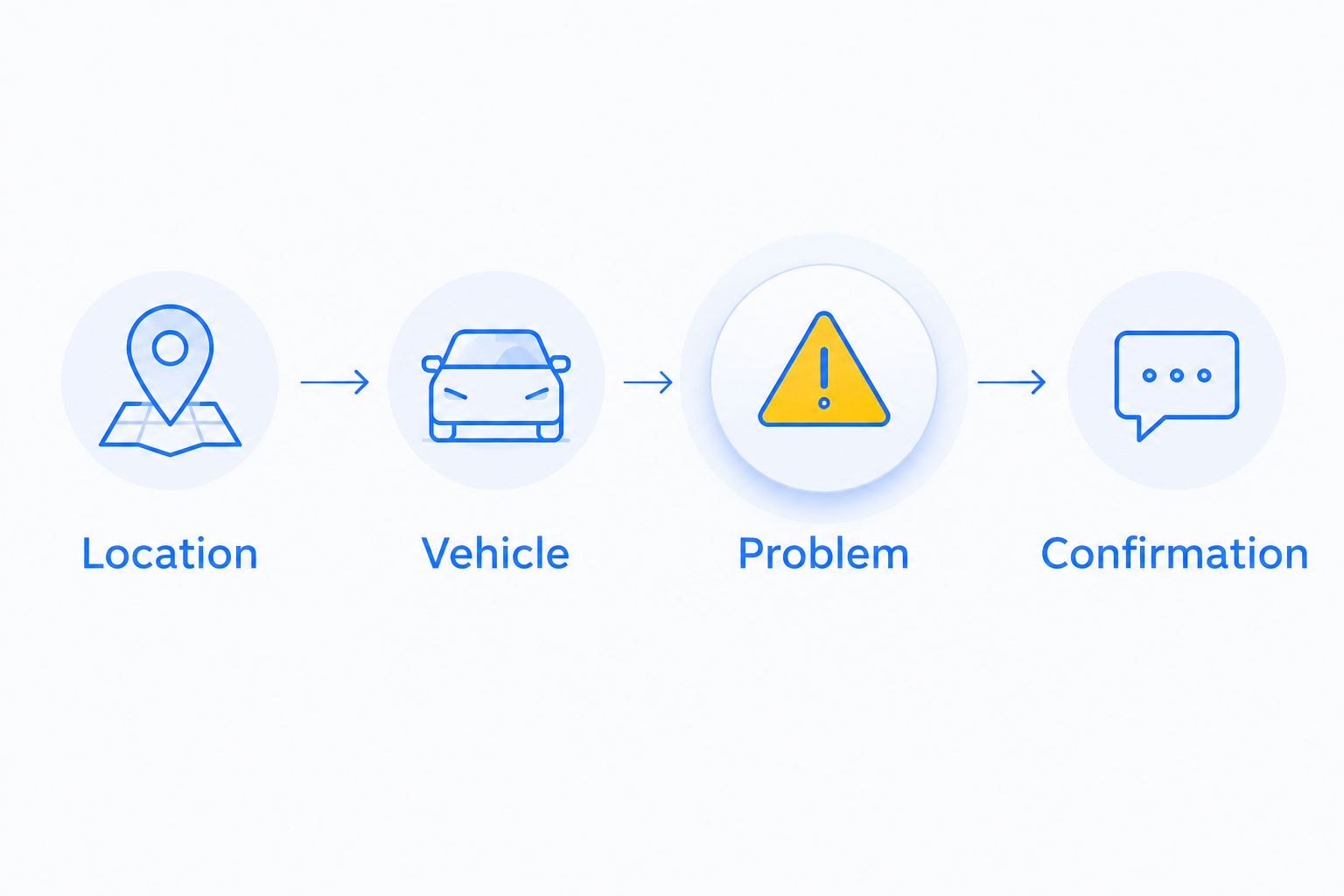
Prepare these details while safely parked, not while driving or standing beside moving traffic. If a passenger can handle the phone, have that person communicate while you focus on the situation.
What should a roadside text actually say?
Use a short message in your own words. Start with where you are, identify the vehicle, describe the problem, and ask whether the provider can accept the request. Include your callback number without posting it publicly.
For a fuel request, explain whether you need gasoline or diesel and whether the vehicle has stopped completely. For a lockout, explain whether anyone is inside. For towing, describe whether the vehicle rolls, is stuck, or has visible damage—only if you can observe that safely.
Do not send passwords, payment-card details, or identity documents in the opening message. First establish that you are communicating with the intended provider. Use the provider’s stated process for any information needed afterward.
Keep follow-up messages focused. Correct a wrong location immediately, report a change in conditions, and answer the provider’s questions. Repeated messages that add no information do not substitute for confirmation.
Why requesting roadside assistance by text varies
The deciding issue is not whether your phone can send a message. It is whether the provider accepts that message as a service request. Check these points during your 2026 contact check:
- Published instructions: Follow the provider’s stated contact method. Do not infer texting support from a phone number alone.
- Acknowledgment: Distinguish a delivery notification from a reply about your specific breakdown.
- Location clarity: Supply enough detail to identify the correct roadway, direction, entrance, or parking area.
- Service details: Identify the fuel type, tire problem, lockout, towing need, or recovery situation.
- Communication needs: Explain if you cannot speak, hear a call, or remain connected reliably.
- Acceptance: Ask whether the provider has accepted the request and how further updates will arrive.
Do not confuse around-the-clock service with around-the-clock SMS monitoring. A 24/7 roadside service claim does not, by itself, establish text-message support. Confirm the channel separately.
Can you request fuel or diesel delivery by text?
You can request fuel or diesel delivery by text when the provider accepts that channel. State the correct fuel type before anything is arranged. Do not leave the person handling your request to infer it from the vehicle’s appearance.
For a stranded semi-truck, include the truck’s location, travel direction, trailer status, and any access restriction you can see safely. Report that the truck ran out of diesel rather than assuming fuel delivery alone resolves every no-start condition.
The emergency fuel delivery text workflow covers this specific request. The same rule applies: get acknowledgment of the details and acceptance of the job before assuming assistance is arranged.
Can a fleet manager request help for a driver by text?
A fleet manager can coordinate through text if the provider accepts it, but the provider still needs accurate information from the scene. Identify the stranded vehicle, give the driver’s contact details through the agreed channel, and make clear who is coordinating the request.
Keep the driver and dispatcher aligned. If the truck moves, the fault changes, or another provider accepts the job, update everyone involved. Do not leave separate people arranging duplicate assistance without knowing it.
Atlroadside roadside assistance serves Atlanta drivers and commercial fleets needing 24/7 mobile help, towing, or heavy-duty recovery. Confirm the contact method directly; do not assume those services establish SMS booking support.
Contact roadside assistance now
Explain your location, vehicle, and problem. Confirm how to send written details.
What if you cannot speak on the phone?
Look for a provider’s explicitly supported written contact method. Explain that you need written communication and ask for a direct acknowledgment. Do not assume a general inquiry form is monitored for urgent breakdowns.
If a trusted passenger or fleet dispatcher can call for you, ask that person to explain your communication needs. Make sure the provider knows who is with the vehicle and how to reach that person. Avoid having a third party guess your location or the vehicle’s condition.
For your 2026 emergency plan, confirm accessible contact methods before you need them. Save the instructions alongside the provider’s number so you are not searching for them while stranded.
FAQ
Can I request roadside assistance by text without calling first?
Yes, if the provider explicitly accepts text requests and confirms your request. Do not assume a listed phone number accepts SMS or that a delivered message means help is assigned.
Does Atlroadside accept roadside requests by text?
Contact Atlroadside directly to confirm whether text requests are accepted. The company provides 24/7 roadside assistance across the Atlanta metro, but service hours do not establish SMS support.
What information should I text for a tow truck?
Send your exact location, vehicle description, problem, and callback number through the provider’s accepted channel. Describe whether the vehicle is stuck, damaged, or attached to a trailer if those details apply.
Is texting roadside assistance faster than calling in 2026?
There is no universal faster channel for roadside requests in 2026. Use the provider’s confirmed request method and call if an urgent text request remains unacknowledged.
Does an automatic text reply mean a tow truck is coming?
No, an automatic reply does not by itself confirm that a tow truck is coming. Ask whether the provider has accepted your request and what the next step is.
Can I text for help when my semi-truck runs out of diesel?
Yes, if the roadside provider accepts text requests for diesel delivery. Identify the fuel type, truck location, direction of travel, and trailer status, then get confirmation that the request is accepted.
Should I text roadside assistance if my car is blocking traffic?
Do not rely only on a routine roadside text when your vehicle creates an immediate danger. Call 911 for an emergency and explain your location and the hazard.
One last thing
A location pin identifies a point, not necessarily the correct approach. Add your direction of travel, the side of the road, and any entrance details. Never walk into traffic just to find a better landmark.
Before your next trip, check your saved roadside contact instructions. One useful 2026 update is simple: mark which contact methods the provider has actually confirmed, rather than assuming every saved number accepts texts.