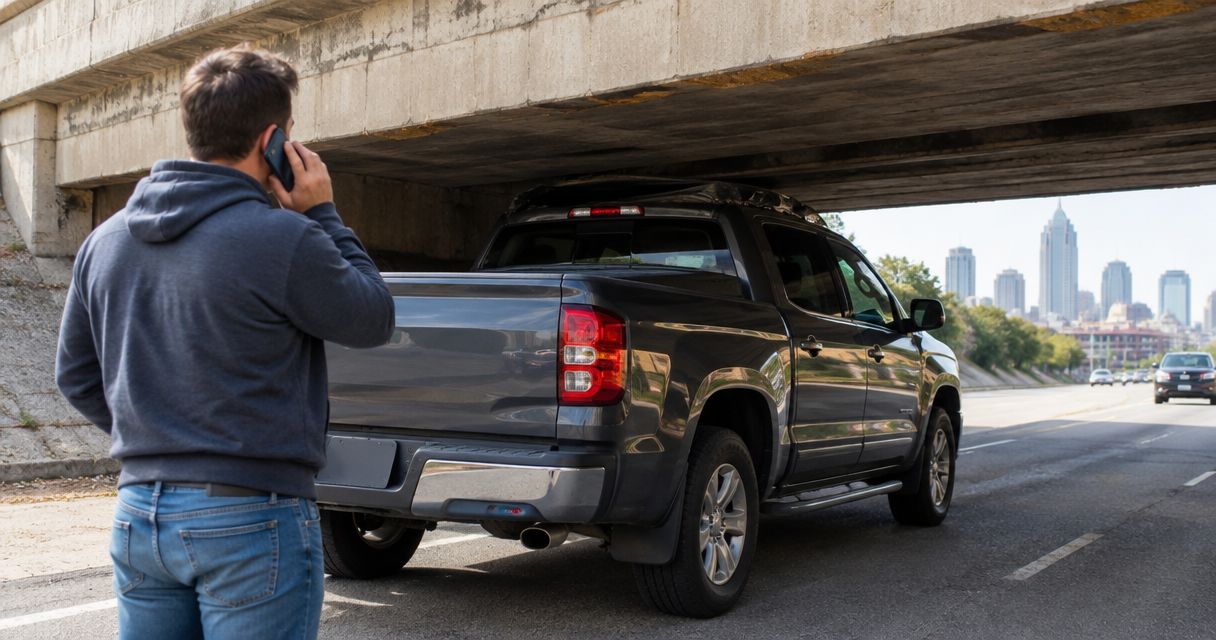
Truck wedged under a low bridge in Atlanta? Stop trying to move it, switch on your hazard lights, and call 911 to report the collision and any blocked lanes, injuries, leaks, or falling debris. Follow the emergency dispatcher’s instructions about staying inside or moving to safety, then arrange heavy-duty recovery—not an improvised pull with another truck.
- Car wedged under overpass Atlanta? Stop moving the vehicle and report the bridge strike before arranging recovery.
- Emergency responders handle immediate danger; recovery crews assess how to remove the trapped vehicle.
- Atlroadside provides 24/7 heavy-duty towing and recovery for Atlanta-area drivers and commercial fleets.
- Do not deflate tires, unload cargo, or reverse out without direction from the on-scene recovery team.
What should you do if your truck gets stuck under a low bridge in Atlanta?
Stop, report the strike, and keep people away from the trapped vehicle and damaged structure. Tell emergency dispatch that the truck has contacted a bridge, not just that it has broken down.
Once you have reported the emergency, request roadside assistance services and describe the job as a bridge-strike recovery. A vehicle pinned against an overpass needs a different assessment from a disabled truck sitting clear of traffic.
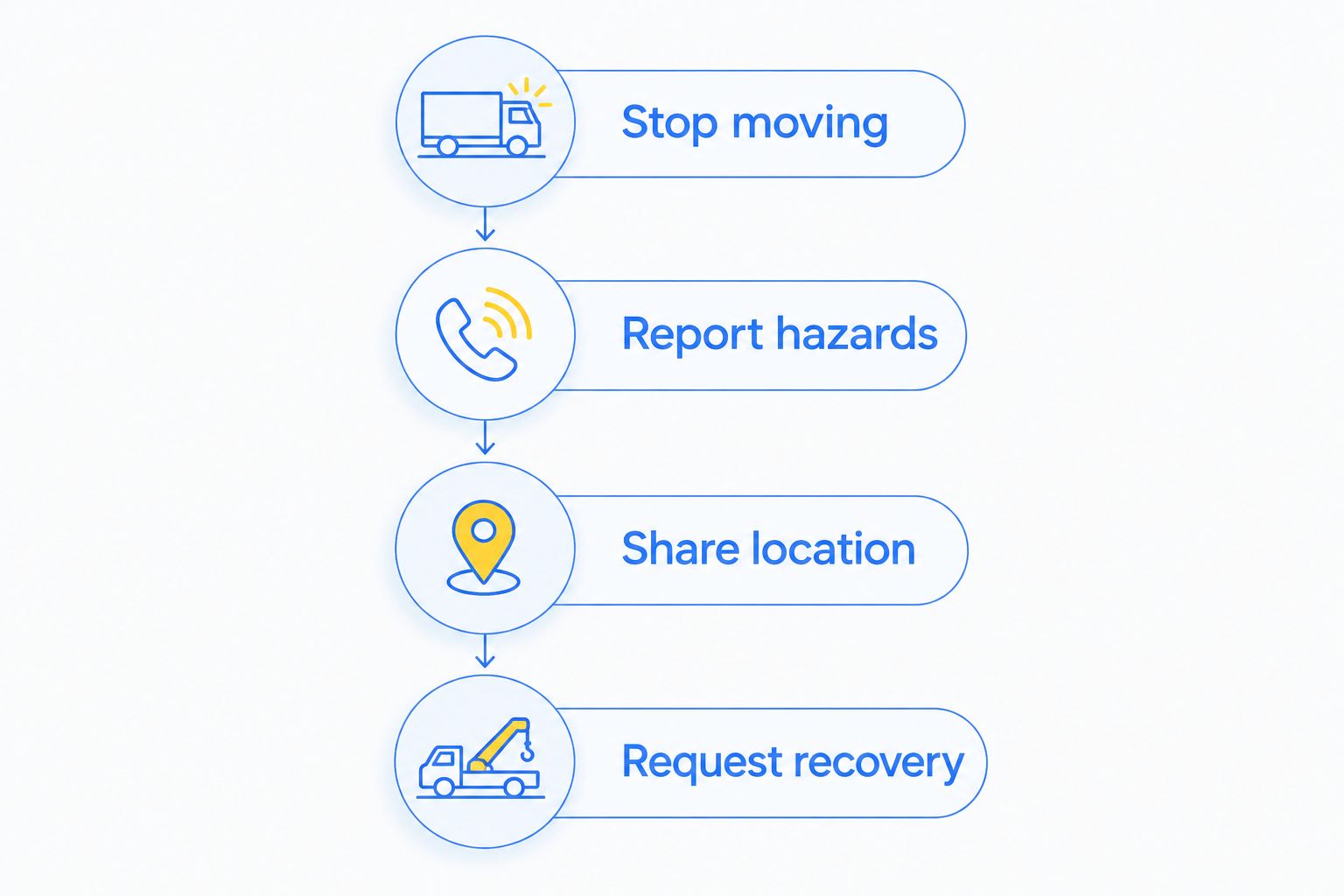
Stop moving
Take your foot off the accelerator. Do not keep testing forward and reverse to see whether the truck will come free. Movement can worsen damage or disturb material caught between the truck and bridge.
Apply the parking brake if you can do so safely. Do not crawl beneath the truck, climb onto its roof, or stand beside a damaged trailer wall.
Report hazards
Call 911 and describe what happened. Report trapped occupants, injuries, smoke, leaking fuel, fallen material, exposed cargo, and traffic approaching the obstruction.
Explain whether the truck is physically touching the bridge. Emergency dispatch needs that detail to distinguish a bridge collision from a routine roadside breakdown.
Share location
Give the road name, direction of travel, nearest intersection or exit, and any visible bridge identification. Share a map pin if requested, but do not walk into traffic to improve your location information.
Say whether you are on the road beneath the bridge or on an approach. A road name alone does not tell responders which side they need to reach.
Request recovery
Tell recovery dispatch the vehicle type, whether a trailer is attached, and what appears to be caught. For commercial vehicles, describe the load and any hazardous materials you know are aboard.
Do not describe a wedged truck as a simple tow. Ask the recovery provider to coordinate access and vehicle movement with the responders controlling the scene.
Why this matters
A truck trapped beneath an overpass is both a vehicle incident and a possible infrastructure hazard. You cannot judge the bridge’s condition from the driver’s seat, and a truck that looks nearly clear can still be caught by its roof, cargo, or trailer body.
Getting the truck loose is not the first priority. Protecting people is. For your 2026 fleet emergency checklist, put emergency reporting ahead of recovery dispatch and insurance calls.
Who should you call: emergency responders or a towing company?
Call emergency dispatch first when a truck has struck and remains wedged under a bridge. Recovery comes after the immediate hazards have been reported; it does not replace emergency response.
| Help needed | Best for | What it addresses | Limitation |
|---|---|---|---|
| Emergency responders | Immediate danger after a bridge strike | Injuries, traffic hazards, fire, and scene safety | Emergency response is not a substitute for arranging vehicle recovery |
| Heavy-duty recovery provider | A truck or trailer physically trapped under a bridge | Assessing vehicle removal and recovery needs | Recovery work must account for scene restrictions and structural concerns |
| Vehicle transport | A damaged vehicle after it is freed | Moving the vehicle to an agreed destination | Transport alone does not address a vehicle still pinned beneath a structure |
Atlroadside is for Atlanta-area drivers and fleets needing 24/7 heavy-duty towing and recovery. The service is available around the clock, but a bridge strike still requires emergency reporting and an on-scene assessment before removal.
Request help once the emergency dispatcher has your location. Say clearly that the vehicle is wedged, identify the truck type, and explain whether anyone remains inside.
Request heavy-duty recovery help
24/7 towing and recovery across the Atlanta metro. Report immediate danger to emergency dispatch first.
Should you stay inside the cab or get out?
Ask the emergency dispatcher for instructions based on your position and the hazards around you. A cab beside moving traffic presents a different problem from a cab beneath falling debris, near fire, or beside a fuel leak.
Tell the dispatcher whether your doors open, whether you can see a protected place to wait, and whether exiting would put you in a traffic lane. Do not climb over the truck or squeeze between it and the bridge to escape.
If evacuation is necessary and you have a safe route, leave belongings behind and move away from traffic and the damaged structure. Never wait beneath the bridge to watch the recovery.
The guide to waiting inside your car for a tow truck covers ordinary roadside waiting. A bridge strike adds structural and falling-debris hazards, so follow the instructions given for your actual scene.
What should you tell recovery dispatch?
Give dispatch the facts you can confirm without leaving a safe position. Accurate information matters more than a close-up photograph. Keep this call checklist in your 2026 driver instructions:
- Location: Road name, travel direction, nearby intersection, and map pin if requested.
- Vehicle: Tractor-trailer, box truck, service truck, passenger vehicle, or another vehicle type.
- Contact point: Cab roof, trailer roof, mounted equipment, cargo, or another visible obstruction.
- Occupants: Whether everyone is accounted for and whether anyone cannot exit.
- Load: General cargo description and known hazardous materials.
- Scene status: Whether emergency responders are present and which lanes are blocked.
- Visible damage: Leaks, broken glass, hanging material, displaced cargo, or damaged wheels.
Give the posted clearance and the truck’s documented height if you already have them. Do not climb onto the truck to measure it or guess a clearance from a photograph.
If a fleet manager makes the recovery call, keep the driver available to answer location and vehicle questions. Avoid sending conflicting removal instructions through several people.
Why the recovery plan varies
A bridge-strike recovery depends on what is trapped and what is damaged. The recovery team needs to assess those conditions before choosing how to move the vehicle.
- Vehicle configuration: A rigid box truck and an articulated tractor-trailer have different movement constraints.
- Point of contact: A roof panel caught beneath the bridge is different from equipment or cargo caught above the cab.
- Load condition: Shifted or damaged cargo affects the removal assessment.
- Vehicle damage: Damage to the cab, trailer, suspension, or running gear affects how the vehicle can be handled.
- Scene access: Traffic, road position, and space around the truck affect recovery access.
- Bridge concerns: Suspected structural damage requires attention from the responsible authorities.
Do not choose a recovery method from a video of another incident. Similar-looking bridge strikes do not establish that the same removal technique is safe.
Can you reverse a truck out from under a bridge?
Do not reverse a wedged truck on your own. Backing up can drag damaged bodywork, shift cargo, or disturb debris above the vehicle.
A clear lane behind you does not mean the truck is free to move. Let the on-scene recovery team assess the contact points and coordinate any movement with responders.
Do not accept a pull from a passing vehicle. An improvised extraction adds another vehicle and more people to an already hazardous scene.
Can you let air out of the tires to clear the bridge?
Do not deflate tires or alter the suspension yourself to free the truck. Changing the vehicle’s height does not establish that the roof, cargo, or bridge is safe to move.
Do not cut bodywork, detach a trailer, or start unloading beneath the structure either. Tell the recovery team what is caught and leave the removal method to the people assessing the scene.
Can you drive away after the truck is freed?
Being free of the bridge does not mean the truck is roadworthy. Visible roof damage is not the only concern after a collision.
Arrange an assessment of the vehicle before continuing. Follow the instructions of responders and the professionals handling the damaged truck; do not treat a running engine as clearance to resume the route.
For commercial vehicles, notify fleet dispatch and document where the vehicle will be taken. Keep cargo decisions separate from the pressure to finish the delivery.
What should fleet managers do after a bridge strike?
Start with the driver’s safety and location. Confirm that emergency dispatch knows about the bridge contact before making calls about delivery deadlines or replacement equipment.
For a 2026 fleet incident file, preserve the assigned route, vehicle-height records, load information, available dashcam footage, and the driver’s factual account. Do not ask the driver to return beneath the bridge for evidence.
Assign a fleet contact to coordinate with recovery dispatch. Record the destination for the damaged vehicle and pass along known cargo hazards before work begins.
Before the next trip, review the route against the actual loaded vehicle height. A route displayed by a navigation app is not proof of overhead clearance. Add a clearance check to your 2026 dispatch process, especially when the vehicle, trailer, or mounted equipment changes.
FAQ
What should I do if my car is wedged under an overpass in Atlanta?
Stop trying to move the car and call 911 to report the collision and immediate hazards. Follow the emergency dispatcher’s instructions, then arrange recovery that matches the vehicle and damage.
Who do I call when my box truck hits a low bridge?
Call emergency dispatch first, then a heavy-duty recovery provider. Tell both that the box truck struck the bridge and whether it remains physically trapped.
Can I back my truck out if the roof is only slightly stuck?
Do not back a wedged truck out without direction from the on-scene recovery team. Slight-looking contact does not establish that movement is safe.
Should I get out of my truck after hitting an overpass?
Follow the emergency dispatcher’s instructions about staying inside or moving to safety. Explain whether traffic, falling debris, fire, or leaking fuel threatens your position.
Does Atlroadside offer heavy-duty recovery in Atlanta?
Atlroadside provides 24/7 heavy-duty towing and recovery across the Atlanta metro. Report a bridge-strike emergency first, then describe the trapped vehicle and scene conditions when requesting recovery.
Can a regular tow remove a truck trapped under a bridge?
Do not assume a routine tow is enough for a truck trapped under a bridge. Tell dispatch that the vehicle is wedged so the provider can assess the recovery requirements.
What photos should I take after a truck hits a bridge?
Take photos only from a safe position and only when doing so does not delay emergency reporting. Do not enter traffic, stand beneath damaged sections, or climb onto the vehicle for a better view.
One last thing
The shortest route is not necessarily a route your truck can clear. Before your next run, check the loaded vehicle’s height and the route’s overhead restrictions—not just the arrival time.
Save Atlroadside’s recovery contact information before you need it. Keep your 2026 emergency instructions clear: report the strike, protect people, and leave extraction to the recovery team.